Our Odoo implementation brings financial discipline, operational visibility, and process control across departments. From accounting automation to manufacturing workflows, we design ERP systems that reduce operational leakage and provide real-time decision clarity.
We use Sitecore to drive measurable revenue growth through intelligent personalization and behavior-driven content delivery. By aligning marketing automation, data orchestration, and omnichannel engagement, we help brands turn digital touchpoints into retention engines.
We architect AWS environments that stay stable under scale, traffic spikes, and compliance pressure. From secure cloud migrations to CI/CD automation and cost governance, we engineer cloud foundations that protect performance while enabling rapid product evolution.
We implement Dynamics 365 to align systems with actual business operations, bringing clarity, control, and accountability across CRM, ERP, and service functions. From sales to finance, configurations eliminate inefficiencies and enable confident, real-time decisions.
Think of a workplace where mental wellness isn’t just a checkbox, but a priority. In the latest episode of AppTalk by AppVerticals, Dr. Farah Ahmed, Founder of Noor Corporate Health, shared how she’s bringing that vision to life. Her organization isn’t just another wellness provider, it’s a movement centered around employee well-being.
From Insight to Action
Dr. Farah’s journey began with a simple observation: while managers recognized employee struggles, they lacked the tools or structure to address them. After years in Dubai’s hotel industry, she identified a clear gap, the need for a multi-dimensional approach to corporate wellness.
“There was no framework to truly help employees. I knew I could do something different,” she shares in the podcast.
This realization led to the birth of Noor Corporate Health. By integrating psychology, architecture, and policy-making, the organization helps companies build environments where employees can genuinely thrive.
Wellness from the Inside Out
Noor Corporate Health isn’t about quick fixes or surface-level solutions. Their approach dives deep into the root causes of workplace stress, helping organizations uncover blind spots and make data-driven decisions to enhance employee well-being.
“We’re not here to diagnose,” says Dr. Farah. “We provide insights to help businesses support their people better.”
The organization is also selective in choosing its partners, collaborating only with companies committed to meaningful change.
“Not everyone is a potential client,” she emphasizes.
Wellness Meets Technology
As wellness increasingly moves digital, Noor Corporate Health is developing a new app currently under construction, designed to bring mental and emotional well-being support closer to employees. The platform will feature a screening tool to assess well-being across multiple dimensions, including stress, financial health, and workplace environment.
The goal isn’t to replace human connection, but to strengthen it through responsible use of technology.
“AI is a tool, not a magic wand,” says Zain Muhammad, Director of Sales at AppVerticals. Dr. Farah agrees, “AI should enhance human performance, not replace it.”
By recognizing Noor Corporate Health’s vision, AppVerticals continues to highlight innovators who are reshaping industries through empathy, technology, and purpose.
The Grit Behind Entrepreneurship
Building Noor Corporate Health wasn’t easy. Dr. Farah and her team quickly learned that entrepreneurship is glamorous only from afar.
“It’s long hours, failures, and constant reinvention,” she admits.
She also describes self-doubt as healthy, urging founders to “walk through the damn fire.”
“Mistakes teach you what not to do,” adds Paul Okonweze, Business Advisor at Noor Corporate Health.
Both agree that trust and shared vision are the foundation of success.
“Building a business is like marriage; you need patience and trust,” Paul emphasizes.
Success, Impact, and Legacy
For Noor Corporate Health, success isn’t measured by numbers, but by meaningful transformation. Their vision extends beyond corporate programs, aiming to influence policy-making and wellness frameworks on a global scale. Operating out of Dubai, a hub that celebrates innovation and well-being, the organization is redefining what modern workplaces can look like.
The Takeaway: A Shared Responsibility
Corporate wellness isn’t just HR’s job; it’s a shared responsibility between leadership, technology, and culture.
“Wellness is a journey, not a destination,” Dr. Farah reminds us.
At its core, Noor Corporate Health stands at the intersection of healthcare, business, and human empathy, making that journey meaningful for every organization.
In transportation, every detour, delay and downtime translates into cost. With global logistics networks expanding, AI in transportation has become the core of safety, efficiency, and sustainability. From autonomous fleet operations to predictive routing, artificial intelligence is now integrated in how people, goods, and data move – and how quickly they reach their destinations.
AI in transportation market is expected to cross $10.3 billion by the end of 2030, growing at an annual rate of over 12%. This momentum is backed by edge computing, IoT, and generative AI, enabling smarter decision-making across ports, fleets and public transit systems.
For logistics teams and startups, this is not just a trend, it’s an entirely new model for operations. Companies that are integrating AI into predictive maintenance, dispatch, and demand forecasting strategically are already witnessing 15-30% gains in the utilization of assets as well as measurable reduction in carbon emissions. Find out how logistics dashboards are unlocking real-time supply chain visibility and profitability in this detailed guide.
This article breaks down how AI is transforming transportation, where the highest ROI opportunities lie and how you can design an AI-ready infrastructure, even if you’re barely starting with a minimal tech stack.
Ready to future-proof your fleet operations?
Partner with AI experts to design, test, and scale your transportation software with measurable ROI.
Key Takeaways
AI in transportation is no longer optional, it’s driving measurable efficiency across fleet operations, route optimization, and predictive maintenance, with startups reporting up to 30% asset utilization gains and 40% downtime reduction.
Edge and generative AI are leading the next wave of innovation, empowering real-time decision-making, simulation-based planning, and carbon-aware routing.
Startups can start small with an AI MVP focused on one KPI (like predictive maintenance or route optimization), then scale incrementally using modular, data-driven architecture.
High-value opportunities lie in underexplored areas like AI-native insurance, privacy-preserving ML, and generative demand forecasting; where competition is still low but ROI potential is high.
ROI compounds over time, early adopters see a 20–25% operational cost reduction within 12–18 months as models learn from more data and automation expands.
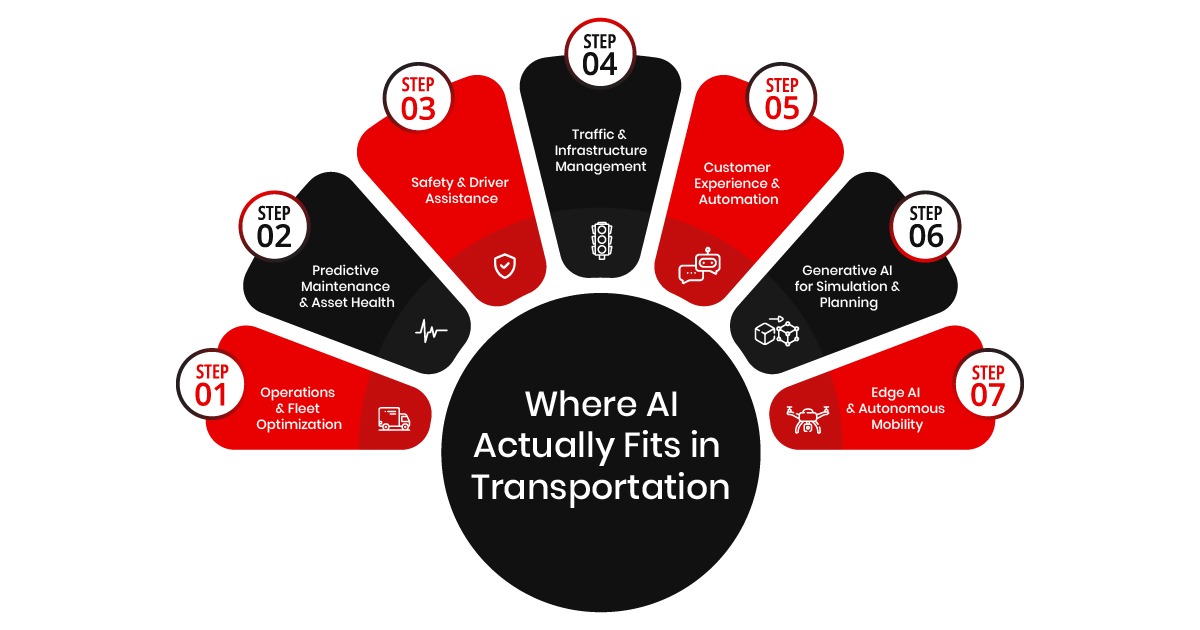
Where AI Actually Fits In Transportation
Artificial Intelligence is redefining how transportation works, not with a single innovation but through optimization of every part of the network. From city-level traffic control to fleet operations, AI is enabling real-time decision-making that enhances cost-efficiency, safety, and sustainability.
Here’s a thorough description of the core application areas of AI in transportation and logistics so you can understand how they’re contributing to the modern business models and operational transformations.
Operations and Fleet Optimization: AI-backed route optimization algorithms are designed to analyze live data from weather APIs, GPS, and traffic cameras to assist with reducing delivery times and fuel consumption.
Real-time dispatch that instantly reroutes vehicles on the basis of reported accidents or congestion can reduce fuel costs by 20% and increase delivery times by 30%. Commonly used tools for this purpose include. Dynamic ETA prediction, machine learning-based route planning and AI fleet management dashboards.
Predictive Maintenance and Asset Health Monitoring: machine learning models help with the detection of anomalies in temperature, engine vibration or break wear before the failure actually occurs. This can help reduce unplanned downtime by almost 40% and maximize the vehicle’s lifespan.
Methods like anomaly detection, sensor fusion and time-series analysis are used to perform this function.
Safety and Driver Assistance: computer vision systems also use AI to keep track of road conditions, identify fatigue and prevent any collisions. Advanced driver assistance systems (ADAS) such as pedestrian recognition, lane departure detection, AI dashcams and emergency braking algorithms are often used to alert drivers about any potential risks or threats. It helps reduce both accident rates and insurance claims.
Traffic and Infrastructure Management: city-level traffic signals, public transport schedules, and toll booths are all being increasingly controlled by AI. Adaptive traffic signal systems such as AI-backed traffic cameras, Edge AI for local signal control and predictive congestion models are often used for the purpose and help with ensuring a seamless flow of traffic, lower carbon emissions in urban centers and reduced congestion.
Customer Experience and Automation: AI enables chatbots for transport services, predictive ETAs and personalization in routing and ticketing. Using natural language processing (NLP) and generative AI for query handling in chatbots that are meant for logistics updates and ticketing queries can help maximize service satisfaction and customer retention.
Generative AI for Simulation and Planning: The latest innovation of AI in transportation is the use of generative models for stimulating logistics routes, infrastructure and maintenance schedules before deployment. Digital twin simulations help business planners and decision-makers evaluate the ‘what-if’ scenarios without any real-time disruption in the networks, allowing data-driven investment decisions and quicker pilot testing.
Edge AI and Autonomy: with most vehicles becoming sensor-rich, edge AI enables split-second decisions for safety and autonomous navigation. Self-driving delivery vans and AI-powered drones for last-mile logistics are helping reduce the human-error and maximizing delivery coverage in constrained areas.
AI isn’t just a single solution, it’s a full-feature stack of intelligent layers integrated across the multiple operations of transportation. From system-wide optimization to vehicle-level decision-making, AI in transportation is making an impact in every corner, be it big or small. Companies that are investing early in AI are setting themselves up for sustainability, scalable efficiency, and competitive edge.
High-Value, Under-Covered Opportunities in AI Transportation
While routing automation and predictive maintenance are an integral part of how AI is transforming transformation, they’ve become pretty mainstream in 2025. What’s really helping startups standout are the next-wave applications that combine sustainability with data-blends and intelligent automation in modern ways.
Here’s the list of emerging AI opportunities that smart logistics founders and leaders can adapt in order to succeed:
Digital Twins for Smarter Network Planning
Think of it: you’re capable of testing every delivery route, scheduling tweak, or infrastructure change virtually before it happens in the real world. That’s exactly what digital twins backed with AI can help you do.
What It Is: a digital replica of your transport or logistics network that can stimulate routes, traffic, and weather impact using live data and AI.
Why It Matters: startups can easily experiment with emission-reduction strategies and cost-saving without having to disrupt anything in real-time.
ROI Potential: companies that have adapted to the digital twins report almost 20% faster planning cycles with very few and less-costly errors in the real-world.
Carbon-Aware Routing and Sustainability Optimization
Sustainability isn’t just about PR anymore, it’s become a competitive advantage. One of the finest benefits of AI in transportation is that these systems can now calculate both speed and distance not just by the speed but also through carbon footprints.
How It Works: AI combines vehicle type, fuel data and emission factors to determine and plan the most efficient route.
Why It Matters: it can help logistics and transportation companies align with global ESG standards and qualify for green incentives.
Startup Takeaway: entrepreneurs can now practically utilize AI application in the transportation sector by building AI models that are capable of tracking and optimizing carbon dioxide per delivery or ton-mile, it’s becoming a key client metric.
AI-Native Insurance and Risk Modeling
Insurance premiums are often volatile in logistics, but AI use in transportation is changing how they can be calculated.
New Model: AI analyzes route risk, driver behavior and vehicle data in real time to determine and create dynamic insurance pricing.
Why It Matters: low-risk operators get to pay less and high-risk fleets can be prompted for early interventions.
Startup Angle: entrepreneurs can now leverage the role of AI in transportation by investing in AI-driven risk dashboards and insurtech integrations within fleet platforms.
Privacy-Preserving Machine Learning (PPML)
A major roadblock of AI in logistics and transportation is data sharing. Companies do not want to compromise on their sensitive data related to drivers and routes but still take benefit of collaboration.
The Solution: federated learning allows multiple logistics companies to train a shared AI model without having to transfer any raw data.
Why It Matters: It helps with ensuring industry-wide model accuracy while keeping all the data and insights secure.
Startup Takeaway: if you’re an AI startup aiming to offer compliance-ready platforms, PPML can serve as a significant differentiator and help you stand out.
Generative AI for Scenario Planning and Demand Forecasting
Generative AI in transportation and logistics isn’t limited to the chatbots only, it’s now proving power in simulating disruptions, predicting freight demand and planning resource allocation. For example, using ‘what-if’ simulations can help manage driver shortages, peak season loads, and port delays very effectively.
Why It Matters: It can help logistics leaders make critical decisions backed up with data-driven insights.
Startup Opportunity: entrepreneurs can leverage AI in transportation optimization by building genAI copilots for planners, a niche almost unidentified in transport SaaS.
Edge AI for Real-Time Decision Making
Speed matters the most in logistics. Edge AI, running models on IoT devices or vehicles directly, can help reduce the latency and maintain instant decision-making.
For example: detecting brake overheating or driver fatigue in milliseconds without any cloud dependency.
Startup Insights: Edge AI development is becoming high-in-demand for fleet tech partnerships.
AI-Driven Freight Marketplaces
Traditional freight booking still faces empty miles and inefficiency. AI in transportation is helping with smart load-matching algorithms, optimizing those empty miles.
How It Works: Machine learning helps connect shippers with carriers by predicting optimal pricing and capacity availability.
Impact: it can help improve profit margins and reduce empty miles by almost 30%.
Startup Takeaway: building logistics marketplaces backed with AI can help with strong traction among investors in 2025.
The opportunities for innovation are endless; they go beyond automation and are redefining how transportation ecosystems think and operate. Startups that are investing to explore generative AI, digital twins and sustainability-driven algorithms now are positioning themselves on top of competitors who are still only focusing towards basic analytics and optimization.
Want to explore where AI fits into your logistics model?
Let’s identify quick-win AI pilots tailored to your business goals.
Concrete Use Cases with Metrics and Implementation Ideas
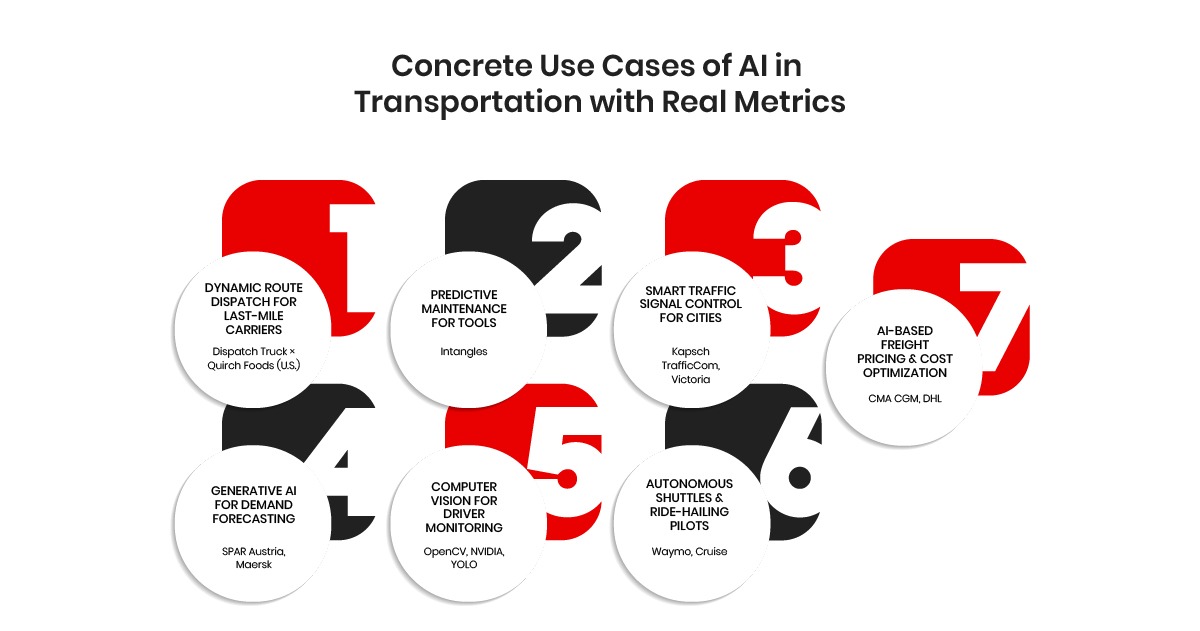
The impact of AI on transportation isn’t just theoretical anymore, it can be seen in real dashboards, KPIs and cost reports. Some of the most promising AI applications in transportation and logistics include:
Dynamic Route Dispatch for Last-Mile Carriers
KPI: fuel consumption per trip, average delivery time
Case Study: Dispatch Truck integrated a hybrid routing solution for Quirch Foods (U.S.). They use static route skeletons and dynamically adjust stops as deliveries happen. The integration led to faster delivery fulfillments and better route efficiency.
Impact: The Company claims an average 3 times better efficiency in fulfillment compared to traditional methods.
Tech Stack: mobile driver apps + cloud-based routing engine + real-time traffic and delivery windows integration.
Predictive Maintenance for Tools
KPI: downtime percentage, maintenance cost saved
Real-World Example: Intangles was facing a major issue around their waste-truck fleet. Integrating a predictive maintenance system helps them identify radiator clogging issues even before the failure so that they can be repaired timely. The system has graphic sensors that send alerts on the basis of temperature changes.
Impact: they report preventing an average 2 overheating breakdowns every month; saving thousands in towing and downtime and majorly reducing the reactive repairs.
Real-World Examples: Kapsch TrafficCom ran a pilot testing in Victoria, Spain. They deployed transit signal priority (TSP) systems so the buses could automatically receive green lights along busy routes.
Impact: It helped enhance the bus schedule adherence and cut-down wait times at the intersections on Line 5. While there’s no report published about the total quantitative gains yet, the initial outcomes show a seamless flow of traffic and reduced delays.
Tech Stack: vehicle detection + connected traffic signal controllers + priority logic + integration with existing traffic management systems.
Generative AI for Demand Forecasting and Load Consolidation
KPI: load utilization rate and forecast accuracy
Real-World Example: SPAR Austria managed to enhance their demand forecasting by using a combination of Microsoft Azure with partner Paiqo. They leveraged market trends, historical sales and external factors to get an above 90% forecast accuracy.
Maersk also uses generative AI and simulation tools to forecast schedule loads, route congestion, and plan container handling.
KPI: driver alertness score and safety incidents prevented
Use Case: many fleets in the U.S. are piloting video-based fatigue detection and lane-departure monitoring using computer vision such as: OpenCV, NVIDIA, YOLO.
Impact: While the use of computers for onboard driver monitoring is showing incredible results, companies are often reluctant to share that publicly because of privacy. It sure is a technology worth experimenting with whether you’re a startup or an existing enterprise that aims to innovate.
Autonomous Shuttles & Ride-Hailing Pilots
KPI: regulatory compliance milestones and safety incidents per million miles
Real-World Example: Waymo and Cruise are top names in the ride-hail/autonomous shuttle industry. The Guardian reports a very low rate of incidents for Waymo’s AVs in operation regions, meaning the autonomous systems are working just fine.
There are multiple other small pilots happening in different areas for campus shuttles, etc. While this is worth investing in, regulatory frameworks often vary from place to place and there’s strong requirements for extensive insurance, remote human oversight and safety validation.
Tech Stack: deep learning perception models + LIDAR/radar/camera stacks + redundant safety systems + edge computing
AI-Based Freight Pricing and Cost Optimization
KPI: profit margin per load, quote response time, pricing accuracy
Real-World Example: CMA CGM, a giant in shipping and logistics, recently signed a deal with Google to integrate AI tools to optimize their routes, handle container operations, and manage inventory, including better pricing and forecasting.
DHL is also using generative AI to plan routes and track shipments, etc. These tools often come along with cost and pricing optimization.
Impact: better cost forecasting, enhanced route selection (less idle time), and more accurate pricing under varying conditions.
Tech Stack: ML regression/forecasting + dynamic pricing engines + APIs for shippers/carriers + external data (fuel prices and traffic)
These real-world applications prove AI’s tangible business impact. But turning such use cases into scalable software solutions requires strategic planning; starting small, iterating fast, and measuring continuously.
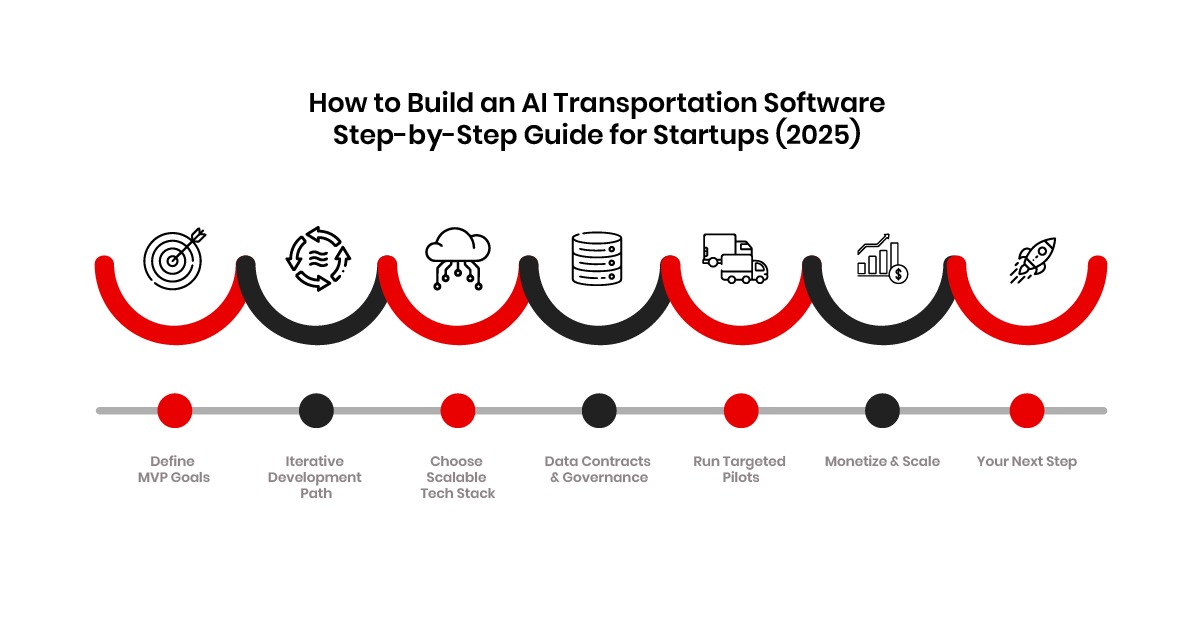
How to Build an AI Transportation Software: Step-by-Step Guide for Startups (2025)
AI in transportation doesn’t begin with a massive neural network or a self-driving fleet, it starts with a data-driven, focused MVP. The goal is to validate value early, automate one process at a time, and build scalable layers over months, not years.
Below is a complete, practical roadmap designed for startups and logistics teams aiming to bring AI-driven efficiency into transportation operations:
1. Define Your Minimum Viable AI Product (MVP)
The most successful AI transportation products start small, by tackling one high-ROI pain point like:
Predictive maintenance to minimize downtime
Dynamic routing to reduce idle miles
Dispatch optimization to improve delivery speed
Your MVP should integrate three essential layers:
Model layer: Use lightweight ML models for forecasting and anomaly detection.
Data layer: Gather inputs from telematics, GPS, CAN bus (vehicle diagnostics), and camera sensors.
Add ML gradually: Predict breakdowns or delays using historical data.
Move to hybrid logic: Combine heuristics and ML for smarter automation.
Scale with Generative AI: Integrate LLMs for route Q&A, dynamic load planning, and driver support.
This staged approach balances cost, data maturity, and time-to-value, critical for startups seeking investment or pilot traction. If your AI use case revolves around fleet automation or a freight management system, check out how logistics apps use iterative scaling.
3. Choose a Scalable Tech Stack
Your tech stack should allow for fast prototyping, low latency, and modular scaling.
Suggested stack:
Inference & compute: NVIDIA Jetson (edge AI) or AWS Inferentia for cost-efficient deployment.
Data ingestion: Apache Kafka or AWS Kinesis for real-time GPS and telematics streaming.
Storage & context: Vector databases (Pinecone, Milvus) to store embeddings for routes or driver behavior.
AI planning: LLMs (OpenAI GPT, Claude, or Gemini) for dispatch planning and predictive Q&A.
MLOps: MLflow or Vertex AI for model tracking, retraining, and rollout.
Each tool aligns with the goal of fast iteration and traceable performance improvement. For startups comparing frameworks or platforms, here’s a deep dive into some of the best mobile app frameworks for cross-platform development.
4. Establish Data Contracts & Governance Early
Your data is your product. Define data contracts upfront, what each sensor sends, in what format, and how often. A typical setup includes:
GPS data: position, timestamp, velocity
CAN bus: temperature, fuel, error codes
Camera data: frames per second, event triggers
Pair this with a governance layer:
Bias testing and safety checks before production
Human override on all high-risk actions
Continuous logging and drift monitoring
Regular third-party audits for transparency
Frameworks like ITS America and ISO 26262 can help structure compliance for city or fleet pilots.
5. Run Targeted Pilots and Capture ROI Metrics
Instead of a big launch, deploy to a limited test environment — a fleet of 3–5 vehicles or one delivery corridor. Track business KPIs from day one:
Delivery time
Downtime %
CO₂ per mile
Cost per delivery
Use monitoring dashboards (Grafana, MLflow) to visualize improvement trends and validate the ROI story.
6. Monetize and Scale
Once pilots deliver measurable gains, move toward productization:
Adopt pricing models like per-vehicle, per-mile, or transaction-based SaaS.
Strengthen partnerships with telematics vendors, OEMs, and insurers.
Create a modular API layer for third-party integrations.
Example growth timeline:
3–6 months: MVP + initial pilot
6–12 months: Model refinement, automation expansion
12–18 months: Visible ROI and cost savings through reduced idle time and optimized fuel use
Building AI in transportation isn’t about scaling fast — it’s about getting something useful running fast and letting data prove its worth.
7. Your Next Step
If you’re a startup or logistics business exploring AI in transportation, begin with a pilot use case that solves one clear operational bottleneck. Define your KPIs, deploy a lean MVP, and gather real metrics, the rest will follow. You can also learn about logistics software development cost by reading our detailed guide and make decisions accordingly.
Need Expert Guidance for Your AI Implementation?
Our AI engineers and logistics experts can help you identify the right use case, build a lean MVP, and scale with measurable ROI.
Data silos between telematics, routing, and ERP tools reduce insight accuracy.
Adopt API-first architecture; standardize data exchange formats (JSON/CSV/Parquet).
Scaling from Pilot to Production
Models perform well in pilots but fail at scale due to infrastructure limits.
Use containerized MLOps pipelines and cloud-native scaling via Kubernetes or Vertex AI.
Lack of Clear KPIs and ROI Tracking
Difficult to prove business value to investors or fleet partners.
Define quantifiable KPIs (delivery time, cost per mile, downtime %) before pilot launch.
Pro Tip: the fastest growing logistics startups focus on modular AI layers and data discipline, not the giant, all-in-one systems. Each pilot should be capable of validating one KPI, automate one process, and generate one measurable business outcome at a time.
Calculating the ROI of AI in Transportation
A critical question that you’ll often come across as a founder or logistics team is ‘how do we measure whether AI in transportation is actually worth it?’
The answer is simple – AI isn’t a technology expense, it’s a strategic investment that multiplies over time through reduced downtime, operational efficiency, and enhanced decision-making. Calculating the ROI (return on investment) requires connecting technical metrics with financial outcomes.
Identify Measurable KPIs
You can start by defining baseline performance metrics that can realistically improve with the help of AI. The most common KPIs linked with ROI include:
Metric
Pre-AI Baseline
Post-AI Target
Typical Improvement
Average delivery time
60 mins
50 mins
15–20% faster
Fleet downtime
10%
7%
30% reduction
Maintenance cost per vehicle
$800/month
$640/month
20% savings
Fuel efficiency
6.0 MPG
6.6 MPG
10% improvement
On-time deliveries
85%
95%
10% gain
Here’s a generic formula you can use to determine the ROI:
ROI (%) =Implementation Cost (Savings + New Revenue) – Implementation Cost×100
Quantify the Financial Impact
Once you’ve defined the KPIs, it becomes easy to translate improvements into dollar value. You can do that as follows:
Fuel cost savings: measure MPG improvement * average miles driven * fuel price
Downtime reduction: calculate average revenue loss per truck-hour and multiple by hours saved.
Labor Efficiency: Estimate time saved from AI automation (routing, dispatching, and reporting).
Customer Satisfaction: enhanced on-time rates lead to reduced penalties and repeat business.
Startups can often attain 20-25% reduction in the operational cost within 12-18 months of deploying an AI-powered logistics system.
Factor in Development and Maintenance Costs
To get an accurate ROI, include all major investment components:
Data collection & cleaning
Model development & deployment
Cloud and edge compute infrastructure
Integration and staff training
On average, an AI transportation MVP costs $80K–$150K, but the payback period can be under 18 months for mid-sized logistics operators.
Visualize ROI over Time
ROI grows non-linearly, the more data you collect, the smarter your models get. A simple projection looks like this:
0–3 months: Pilot phase — minimal ROI
3–6 months: Efficiency gains visible
6–12 months: Cost savings become measurable
12–18 months: ROI compounding via automation & optimization
You don’t need massive datasets to see results, just a focused pilot, clean data, and measurable KPIs. When executed right, AI in transportation transitions from a cost center to a profit multiplier within the first operational year.
Build Your AI Transportation Software with AppVerticals
AI is no longer an experimental edge in transportation, it’s the new operating system for how fleets move, optimize, and grow. From dynamic routing and predictive maintenance to carbon-aware logistics, AI transforms every mile into measurable intelligence.
But realizing that potential requires more than models, it demands a strategy, a scalable tech stack, and a reliable development partner who understands both logistics and machine learning. That’s where AppVerticals comes in.
As an experienced logistics software development company, AppVerticals helps startups and enterprises move from concept to deployment with confidence. Our team specializes in:
Designing custom AI-powered logistics platforms tailored to your data and infrastructure
Building scalable MVPs with the right blend of rule-based logic and ML/GenAI models
Delivering measurable ROI through optimized fleet operations, cost savings, and automation
Whether you’re planning your first pilot or scaling to a national rollout, AppVerticals can help you build, integrate, and deploy AI solutions that drive real business impact.
Ready to move from concept to a working AI transportation system?
Let’s turn your fleet data into decisions that move business forward.
If your logistics team is still juggling spreadsheets, emails, and disconnected tools, you’re already at a disadvantage. Today’s customers expect real-time tracking, faster delivery, and error-free operations — and without a unified system, businesses lose valuable time, money, and even customer trust.
That’s where logistics management systems (LMS) come in. More than just software, an LMS is the digital backbone of modern supply chains, connecting order management, fleet, inventory, transport, warehouse operations, and analytics into one platform. Businesses that digitize their logistics processes cut costs by up to 30% and improve service levels by more than 10%, making an LMS a strategic investment for startups, SMEs, and enterprises alike.
Unlike rigid, off-the-shelf tools, custom-built LMS solutions adapt to your workflows, compliance needs, and industry-specific challenges. Whether you’re an eCommerce brand, a manufacturer, or a 3PL provider, the right system ensures your logistics work for you — not the other way around. At AppVerticals, we bring this to life as a logistics app development company, helping businesses design scalable solutions that streamline operations and drive ROI.
Ditch Spreadsheets, Go Digital
Upgrade to a smart logistics management system that reduces costs and boosts efficiency.
Key Takeaways
Logistics management systems (LMS) are essential for connecting planning, execution, and data across supply chains.
Core LMS modules include order, inventory, warehouse, transport, fleet, reverse logistics, and analytics.
Seamless integration with ERP, WMS, TMS, 3PL, and cloud platforms is critical for real ROI.
Technologies like AI, IoT, blockchain, and LLMs are shaping the future of logistics systems.
Custom LMS solutions outperform off-the-shelf tools by aligning with workflows, scaling faster, and offering higher ROI.
Businesses in eCommerce, retail, manufacturing, healthcare, and 3PL already leverage custom logistics systems for competitive advantage.
Sustainability, automation, and AI copilots will dominate the next decade of logistics innovation.
Core Modules of a Logistics Management System
A well-designed logistics management system (LMS) is built on modular components that work together to streamline every part of the supply chain. Instead of relying on disconnected tools, businesses can manage their entire logistics workflow under one roof. Here are the key modules every LMS should include:
1. Order Management
The order management module ensures every customer order is tracked from placement to final delivery. It provides complete visibility into order status, automates invoicing, and reduces manual errors. Modern LMS platforms also integrate directly with ERP and eCommerce systems, allowing businesses to process large volumes of orders while keeping customers updated in real time.
2. Inventory Management
This module centralizes stock information across warehouses, retail outlets, and distribution centers. With real-time tracking powered by IoT sensors, businesses can avoid stockouts and overstocking. Advanced LMS solutions also use AI-driven demand forecasting to maintain the right inventory levels, improving order fulfillment rates and reducing carrying costs.
3. Warehouse Management
An LMS warehouse management system streamlines day-to-day warehouse operations. It optimizes storage layouts, automates picking and packing, and manages stock allocation. By reducing manual errors and increasing efficiency, businesses can speed up fulfillment while keeping operational costs under control.
4. Strategic Transport Planning
Unlike daily transport management, this module focuses on long-term logistics planning. It helps businesses forecast demand, analyze costs, and design optimal transport networks. With strategic planning, companies can ensure timely deliveries while minimizing expenses, making it especially valuable for scaling businesses with complex supply chains.
5. Transportation Management (TMS)
The TMS module helps plan, execute, and monitor shipments effectively. Features include route optimization, load balancing, carrier selection, and freight cost calculations. By reducing empty miles and improving resource utilization, it not only cuts costs but also boosts delivery reliability and customer satisfaction.
6. Fleet Management
Fleet management gives businesses real-time insights into vehicle location, driver behavior, and fuel usage. Preventive maintenance scheduling reduces unexpected breakdowns, while AI-enabled tools can even predict issues before they happen. This keeps fleets running efficiently, ensures driver safety, and extends vehicle lifespan.
7. Reverse Logistics
Managing returns, recycling, and disposal is crucial for customer trust and sustainability. This module makes the return process smooth and transparent, helping businesses recover value from returned goods while reducing waste. A strong reverse logistics setup also supports eco-friendly practices, which are becoming increasingly important for brand reputation.
8. Logistics Analytics & Reporting
Analytics turns raw logistics data into actionable insights. Businesses can track KPIs such as delivery accuracy, fulfillment speed, transportation costs, and warehouse efficiency. Customizable dashboards provide real-time visibility, enabling decision-makers to identify bottlenecks and continuously improve supply chain performance.
Tailored Logistics Software for Your Business
Integrate order, warehouse, fleet, and analytics into one seamless platform built for your needs.
Key Benefits of a Logistics Management System
Adopting a logistics management system (LMS) isn’t just about going digital — it’s about transforming your supply chain into a profit center. Here’s how businesses benefit:
1. Improved Supply Chain Visibility
An LMS provides real-time tracking of shipments, fleets, and inventory. Businesses gain transparency across the supply chain, reducing delays and preventing costly disruptions.
2. Cost Optimization
By automating order processing, warehouse operations, and route planning, companies can reduce fuel costs, labor expenses, and error-related losses. According to Deloitte, logistics automation can cut operational costs by up to 25%.
3. Faster & More Reliable Deliveries
AI-driven route optimization and predictive analytics ensure shipments arrive on time. Faster deliveries improve customer satisfaction and retention rates.
4. Better Inventory Control
With centralized inventory management, businesses avoid overstocking and stockouts. Integrated forecasting tools allow smarter procurement planning.
5. Data-Driven Decision Making
Advanced analytics dashboards track KPIs such as delivery times, warehouse utilization, and order accuracy. Decision-makers can identify bottlenecks and improve overall efficiency.
6. Scalability for Growing Businesses
A robust LMS adapts to your growth — whether you’re adding new delivery hubs, expanding into eCommerce, or scaling to international markets.
Want to learn more about how technology can redefine visibility? Read our blog on logistics dashboards.
Not Sure Where to Start?
Book a free consultation with our experts to map your logistics challenges and explore custom solutions.
Types of Logistics Management Systems
Not all businesses need the same type of logistics management system (LMS). The right choice depends on your company size, budget, compliance requirements, and scalability goals. Below are the main types of LMS solutions:
1. On-Premise Logistics Management Systems
Installed locally on a company’s servers and managed by its in-house IT team.
Advantages:
Full control over security and data management
Customizable to complex workflows
Better suited for companies in highly regulated industries (e.g., pharmaceuticals, defense)
Limitations:
High upfront investment in hardware and licenses
Requires ongoing IT support and maintenance
Limited scalability compared to cloud-based solutions
Best for: Enterprises with strict compliance needs and budget to manage in-house IT infrastructure.
2. Cloud-Based Logistics Management Systems
Hosted on cloud servers, accessible from anywhere via the internet.
Advantages:
Lower upfront cost (subscription or SaaS model)
Easy scalability to support business growth
Accessible across devices and locations
Continuous updates and support from the provider
Integration with AI, IoT, and analytics tools is easier
Limitations:
Dependency on internet connectivity
Some industries may face compliance concerns with sensitive data
Best for: SMEs, startups, and growing businesses that prioritize flexibility, cost-efficiency, and quick deployment.
3. Hybrid Logistics Management Systems
Combines on-premise and cloud-based models, giving businesses a balance of control and flexibility.
Advantages:
Allows sensitive data to stay on-premise while using cloud features for scalability
Flexibility in adapting to unique operational needs
Ensures business continuity even if one system faces downtime
Limitations:
Higher complexity in setup and management
Requires careful planning to avoid integration challenges
Best for: Businesses that need both compliance-heavy security and cloud-based scalability — such as global logistics providers or 3PL companies.
Key Features of a Logistics Management System
The strength of a logistics management system (LMS) lies in its features. A modern LMS goes beyond simple shipment tracking — it integrates automation, AI, and data-driven decision-making to create a truly intelligent supply chain. Below are the must-have features businesses should look for:
1. Real-Time Shipment Tracking
Provides live updates on shipment status, routes, and delivery timelines.
Enhances customer trust with accurate ETAs and proactive notifications.
Uses GPS and IoT devices for complete visibility across fleets.
2. Automated Order Processing
Eliminates manual paperwork by digitizing order creation, approvals, and invoicing.
Reduces human errors and accelerates fulfillment speed.
Integrates with ERP and eCommerce systems for seamless data flow.
3. Route Optimization & Fleet Management
AI-powered algorithms identify shortest, least congested, and most cost-effective routes.
Monitors driver behavior, fuel usage, and vehicle health.
Prevents downtime with predictive maintenance alerts.
4. Inventory & Warehouse Control
Tracks stock levels across warehouses in real time.
Supports barcode/RFID scanning for accurate inventory management.
Forecasts demand to avoid overstocking or shortages.
5. Multi-Modal Transportation Support
Manages shipments across air, sea, rail, and road from a single platform.
Provides visibility and compliance tracking for global supply chains.
Simplifies carrier management with automated freight booking and billing.
6. Analytics & Reporting Dashboards
Offers customizable dashboards to monitor key KPIs (cost per shipment, order accuracy, delivery times).
Leverages predictive analytics to identify inefficiencies and optimize resource allocation.
Helps leaders make informed, data-backed decisions.
7. Compliance & Document Management
Automates generation and storage of compliance documents (invoices, bills of lading, customs forms).
Ensures businesses stay compliant with local and international trade regulations.
Reduces risk of penalties and delays at checkpoints.
8. Scalability & Integration Capabilities
Connects seamlessly with existing systems (CRM, ERP, HR, accounting).
Adapts to growing volumes as businesses expand into new regions.
Ensures a future-proof system that evolves with market demands.
Challenges in Implementing a Logistics Management System
While a logistics management system (LMS) can transform operations, many businesses face hurdles during implementation. Understanding these challenges helps decision-makers plan better and avoid costly mistakes.
1. High Initial Investment
Challenge: Developing or deploying a robust LMS (especially custom-built) requires significant capital.
Impact: SMEs and startups may hesitate due to budget constraints.
Solution: Cloud-based or modular LMS solutions can reduce upfront costs while allowing scalability.
2. Integration with Legacy Systems
Challenge: Many logistics companies still rely on spreadsheets, ERPs, or outdated tools. Integrating a new LMS with these systems can be complex.
Impact: Data silos, workflow disruptions, and prolonged implementation timelines.
Solution: Choosing a provider experienced in API integrations and middleware ensures smoother transitions.
3. Employee Training & Change Management
Challenge: Staff accustomed to manual processes may resist shifting to digital systems.
Impact: Low adoption rates, underutilized features, and reduced ROI.
Solution: Continuous training, user-friendly interfaces, and AI-powered assistance tools help drive adoption.
Impact: Risk of cyberattacks, non-compliance with regulations like GDPR or CTPAT.
Solution: Implementing strong cybersecurity measures, encryption, and role-based access controls within LMS.
5. Scalability Limitations
Challenge: Businesses often outgrow off-the-shelf systems as they expand into new geographies or add service lines.
Impact: Performance bottlenecks, higher long-term costs, and customer dissatisfaction.
Solution: Custom logistics management systems designed to scale with your growth strategy.
6. Vendor Lock-In
Challenge: Many pre-built LMS solutions restrict customization, making businesses overly dependent on the vendor.
Impact: Limited flexibility, higher upgrade costs, and slower innovation.
Solution: Opting for a custom LMS through a logistics app development company ensures ownership, flexibility, and long-term ROI.
Future Trends in Logistics Management Systems
The logistics industry is undergoing rapid digital transformation. By 2030, analysts predict that over 80% of logistics companies will rely on AI-driven and cloud-based systems to stay competitive. Here are the emerging trends shaping the future of logistics management systems (LMS):
Impact: Improves real-time visibility and reduces spoilage in sensitive supply chains (e.g., pharmaceuticals, perishables).
Example: Smart sensors in refrigerated trucks automatically alert managers if temperatures go out of range.
4. Blockchain for Supply Chain Transparency
Role: Blockchain ensures tamper-proof tracking of shipments and transactions.
Impact: Builds trust among stakeholders by eliminating disputes, fraud, and compliance risks.
Example: Smart contracts automate freight payments once delivery is verified.
5. Cloud-Native & API-First Systems
Role: Future LMS platforms are built cloud-native, enabling faster integration, scalability, and cross-platform access.
Impact: Businesses can expand globally without worrying about infrastructure bottlenecks.
Example: API-first systems integrate seamlessly with ERP, CRM, eCommerce, and payment gateways.
6. Autonomous & Drone Deliveries
Role: Self-driving trucks and drones are reshaping last-mile delivery.
Impact: Reduces dependency on labor, lowers costs, and enables faster urban deliveries.
Example: Companies like Amazon are piloting drone delivery services for same-day shipments.
7. Sustainability & Green Logistics
Role: LMS platforms are integrating carbon footprint calculators, EV fleet tracking, and eco-friendly routing.
Impact: Helps businesses meet ESG targets and appeal to environmentally conscious customers.
Example: AI systems suggest greener delivery routes that consume less fuel.
Final Thoughts
A logistics management system isn’t just a tool — it’s the nerve center of modern supply chains. From order and inventory management to AI-powered analytics and future-ready integrations, LMS platforms define how efficiently businesses operate, scale, and compete.
For entrepreneurs and enterprises, the choice is clear: off-the-shelf solutions may work for short-term needs, but custom-built logistics management systems deliver long-term ROI, competitive differentiation, and resilience against disruptions.
If you’re aiming to future-proof your logistics operations, now is the time to partner with an experienced logistics software development company that understands your workflows and can build a system tailored to your needs. The right technology partner can help you harness AI, IoT, blockchain, and cloud infrastructure to create an LMS that not only supports your operations today but also evolves with your business tomorrow.
Ready to Scale Your Supply Chain?
Our experts can help you build scalable, future-ready LMS solutions.
Software development trends in 2026 show a clear shift toward building systems that depend on APIs, distributed services, and continuous deployment rather than standalone applications. Key areas like integration, testing, cloud architecture, and data flow management define how stable and scalable modern software actually performs in production.
Software development in 2026 is redefining how systems are built, connected, and scaled. For businesses, this rapid shift creates both opportunity and complexity, especially when decisions around architecture, integration, and performance directly impact long-term outcomes.
This guide breaks down the most relevant software development trends shaping modern applications, from AI-driven systems to API-first and cloud-native architectures. Instead of listing generic innovations, the focus is on what actually influences real-world software decisions, particularly in environments involving multiple systems, data flows, and integrations.
Whether you’re evaluating custom software development services or planning your next product, understanding these trends can help you avoid costly missteps and build systems that remain stable, scalable, and integration-ready.
Software Development Trends in 2026 (Quick Overview)
Trend
What’s Changing
Impact on Systems & Integration
Risk if Ignored
AI in Software Development
Systems move from static logic to adaptive decision-making
Automates data mapping, improves workflows across integrated systems
Poor data → unreliable outputs
API-First Development
APIs become the foundation of system design
Enables seamless integration between ERP, CRM, and third-party tools
Fragile integrations and scaling issues
Cloud-Native Architectures
Applications built as microservices in the cloud
Improves scalability and supports distributed integrations
Performance bottlenecks and limited flexibility
Distributed Systems
Workloads spread across multiple services and environments
Allows systems to scale and operate independently while staying connected
Data inconsistency and system failures
DevOps & CI/CD
Continuous deployment and automated workflows
Keeps integrated systems stable during frequent updates
Deployment failures across dependent systems
Integration Testing
Shift from unit testing to end-to-end system validation
Ensures workflows across APIs and services function correctly
Hidden failures in production environments
Cybersecurity in Integrations
Security moves to API and data flow level
Protects sensitive data across interconnected systems
Data breaches and compliance risks
Edge Computing
Data processing moves closer to the source
Enables real-time responses in IoT and distributed environments
Latency and synchronization issues
IoT Integration
Massive growth of connected devices and real-time data
Requires scalable data pipelines and integration layers
Data overload and inconsistent system behavior
Low-Code Development
Faster app development with pre-built components
Speeds up simple integrations and internal tools
Limited scalability and vendor lock-in
1. AI in Custom Software Development
AI is shifting software development from predefined logic to systems that can adapt, learn, and make decisions based on data. By 2031, the AI industry is expected to be worth more than 13 times its current value. In 2026, this directly impacts how complex software systems are designed and integrated, especially as businesses increasingly rely on specialized AI development services to implement these capabilities at scale.
What’s changing
Modern applications are increasingly built with AI layers that automate decision-making, data processing, and workflow optimization. This is especially relevant in systems that rely on multiple data sources, such as ERP, CRM, and third-party integrations.
Impact on architecture and integration
Along with AI, Machine Learning (ML) is another secret weapon. It enables intelligent data mapping, anomaly detection, and predictive workflows across systems. Instead of relying on static rules, integrated systems can now adjust behavior based on real-time data, reducing manual intervention and improving system responsiveness.
Where it creates challenges
AI systems are highly dependent on data quality and consistency. In poorly integrated environments, inconsistent or delayed data can lead to incorrect outputs, making system reliability a concern.
When to use it
AI-driven approaches are most effective in complex environments with large data volumes, multiple integrations, and the need for real-time decision-making.
2. Blockchain in Software Development: Where It Fits and Where It Doesn’t
Blockchain is often discussed as a transformative technology, but in custom software development, its relevance depends heavily on specific use cases rather than broad adoption. Data provenance, or recording the history of data, is the most popular use case for blockchain. This use case is expected to enhance global GDP by $962 billion by 2030.
What’s changing
Blockchain is being explored for systems that require immutable records, transparent data sharing, and decentralized control, particularly in environments where multiple parties interact without a central authority.
Impact on architecture and integration
In certain scenarios, blockchain introduces a distributed data layer that can replace or complement traditional databases. It can reduce dependency on centralized systems, but it also adds complexity when integrating with existing enterprise applications like ERP or CRM platforms.
Where it creates challenges
Blockchain systems are difficult to scale, expensive to maintain, and not suited for high-frequency transactional systems. Integration with traditional architectures often requires additional layers, increasing system complexity.
When to use it
Blockchain is most effective in use cases like supply chain traceability, digital identity management, and multi-party data validation where trust and transparency are critical.
3. Quantum Computing
By 2032, the worldwide quantum computing market is expected to be valued at $460.7 billion. Quantum computing is still in its early stages, but it represents a long-term shift in how complex computational problems may be solved.
What’s changing
Unlike traditional systems, quantum computing can process multiple states simultaneously, making it theoretically capable of solving problems that are currently infeasible with classical architectures.
Impact on software systems
While not yet practical for most applications, quantum computing has potential in areas such as advanced simulations, optimization problems, and large-scale data modeling, particularly in industries like finance, healthcare, and logistics.
Where it creates limitations
Quantum systems are not production-ready for mainstream software development. They require specialized infrastructure and are not compatible with typical enterprise architectures or system integrations.
When to consider it
At present, quantum computing is primarily relevant for research-driven environments or organizations exploring future-ready capabilities rather than immediate implementation.
4. Low-Code Development
Low-code and no-code platforms are accelerating how applications are built, enabling faster delivery through visual development and pre-built components. In the broader discussion of low-code vs no-code development, the key difference lies in flexibility.
Low-code allows customization with code, while no-code is designed for non-technical users with minimal control. However, their role in custom software development depends on the complexity and scalability requirements of the system.
What’s changing
Businesses are increasingly using low-code platforms to prototype applications, automate workflows, and reduce development timelines, especially for internal tools and simple applications.
Impact on architecture and integration
Low-code platforms simplify initial development but often introduce limitations when integrating with complex systems such as ERP, CRM, or third-party APIs. As applications scale, integration flexibility and control over data flows become critical.
Where it creates challenges
Low-code solutions can lead to vendor lock-in, limited customization, and performance constraints in high-scale environments. Extending these systems beyond predefined capabilities often requires custom development, increasing long-term costs.
When to use it
Low-code is most effective for rapid prototyping, internal tools, and low-complexity workflows. For scalable, integration-heavy systems, custom software development services provide greater flexibility and long-term reliability.
5. Progressive Web Apps
Progressive Web Apps (PWAs) offer a middle ground between web and native applications, but their value in custom software development depends on specific use cases rather than broad adoption. PWAs can increase user engagement by up to 3x and significantly reduce load times, making them a practical choice for performance-focused applications.
What’s changing
Businesses are increasingly using PWAs to deliver fast, browser-based experiences without the overhead of managing separate iOS and Android applications.
Impact on architecture and integration
PWAs simplify frontend deployment and reduce platform-specific development, but they still rely heavily on backend systems, APIs, and integration layers to deliver real-time data and functionality.
Where it creates challenges
PWAs have limitations in device-level access, performance for complex applications, and offline capabilities in highly dynamic systems. They may not be suitable for applications requiring deep hardware integration or high-performance processing.
When to use it
PWAs are most effective for content-driven platforms, customer portals, and applications where cross-platform reach and faster deployment are more important than native performance.
6. The Cybersecurity Imperative
The global cybersecurity workforce is expected to comprise approximately 4.7 million workers. Cybersecurity in 2026 is no longer limited to protecting applications at the surface level. As software systems become more interconnected, security must be built into APIs, data flows, and integration layers from the start.
What’s changing
Modern applications rely on multiple systems communicating through APIs, making each integration point a potential attack surface. Security is shifting from perimeter-based protection to continuous validation across distributed systems.
Impact on architecture and integration
In custom software development, secure system design now requires token-based authentication, encrypted data exchange, and strict access control across all integrated services. This is especially critical in environments connecting ERP, CRM, payment systems, and third-party APIs.
Where it creates challenges
Security risks often emerge at integration points rather than within individual systems. Weak authentication, unencrypted data transfer, and overexposed endpoints can lead to data breaches and compliance failures.
Common failure pattern
A typical issue occurs when APIs are integrated without proper rate limiting or access control, allowing unauthorized access or data leaks in production environments.
When to prioritize it
Security becomes critical in systems handling sensitive data, high transaction volumes, or multiple third-party integrations, such as in healthcare, fintech, and eCommerce platforms.
7. Edge Computing in Modern Software
Edge computing is shifting how software systems process and exchange data by moving computation closer to the source instead of relying entirely on centralized cloud infrastructure.
What’s changing
Applications are increasingly designed to process data at the edge, on devices or local nodes, reducing latency and enabling real-time responsiveness. This is particularly relevant in environments with high data volume and time-sensitive operations.
Impact on architecture and integration
Edge computing introduces a distributed processing layer that must coordinate with central systems. This affects how data flows between edge devices, cloud platforms, and enterprise systems such as ERP or IoT platforms, requiring more structured integration strategies.
Where it creates challenges
Managing data consistency between edge and central systems is complex. Latency, synchronization delays, and fragmented data states can lead to inconsistencies if integration workflows are not designed properly.
When to use it
Edge computing is most effective in use cases requiring real-time processing, such as IoT systems, industrial automation, and applications where immediate decision-making is critical.
Build Software That Actually Scales with Modern Architectures
Leverage AI, API-first design, and cloud-native development to create systems that integrate seamlessly and perform under real-world conditions.
78% of those who have used AR indicated they prefer it to video content. AR and VR are gaining attention in software development, but their adoption remains limited to specific use cases where immersive interaction provides measurable value.
What’s changing
AR/VR technologies are being used in industries like healthcare, manufacturing, and real estate to simulate environments, visualize data, and improve training processes. These applications go beyond basic user experience and require tightly integrated software systems.
Impact on architecture and integration
AR/VR applications demand high-performance rendering, real-time data processing, and integration with backend systems such as analytics platforms, IoT devices, or simulation engines. This increases system complexity and requires careful coordination between front-end experiences and underlying data systems.
Where it creates challenges
AR/VR solutions are resource-intensive, difficult to scale, and expensive to develop. Integration with existing enterprise systems is often limited, and performance issues can significantly impact user experience.
When to use it:
AR/VR is most effective in scenarios like medical training simulations, industrial design visualization, and real estate walkthroughs, where immersive interaction directly improves decision-making or operational efficiency.
9. FinOps and GreenOps
According to McKinsey, FinOps has the potential to save businesses 20 to 30% on cloud expenses. FinOps and GreenOps are becoming critical in software development as cloud-native and distributed systems increase operational complexity and cost. Organizations are shifting from static budgeting to real-time cost optimization and resource efficiency.
What’s changing
Modern software systems rely heavily on cloud infrastructure, microservices, and continuous workloads. This makes cost management and energy efficiency an ongoing operational challenge rather than a one-time decision.
Impact on architecture and integration
FinOps introduces visibility into how different services, APIs, and integrations consume resources across environments. In systems with multiple integrations, inefficient data flows, redundant API calls, and poorly optimized workloads can significantly increase cloud costs. GreenOps complements this by optimizing how systems consume compute resources, reducing unnecessary processing and improving overall system efficiency.
Where it creates challenges
Without proper monitoring and governance, distributed systems can lead to unpredictable cloud spending. Over-provisioned resources, inefficient integrations, and unused services are common issues in large-scale environments.
When to use it
FinOps and GreenOps are essential for organizations running cloud-native applications, high-scale integrations, or multi-service architectures where cost and performance need continuous optimization.
10. Distributed Computing
Distributed systems are at the core of modern software development, enabling applications to handle large-scale workloads across multiple services, servers, and environments. As systems grow in complexity, distributing workloads is no longer optional—it’s a requirement for scalability and resilience. According to industry estimates, over 80% of enterprise applications are expected to rely on distributed architectures by 2026, driven by the need for scalability and real-time processing.
What’s changing
Modern applications are built as distributed systems where services operate independently but communicate through APIs, messaging queues, and event streams. This shift supports modular development and continuous scaling.
Impact on architecture and integration
Distributed systems allow different applications, such as ERP, CRM, and third-party platforms—to operate as interconnected services rather than a single monolithic system. This improves flexibility but increases the need for structured system integration, data consistency, and service orchestration.
Where it creates challenges
Distributed architectures introduce complexity in managing dependencies, handling failures, and ensuring data consistency across systems. Without proper integration strategies, issues like service downtime, latency, and data mismatches can disrupt the entire system.
When to use it
Distributed systems are essential for high-scale applications, multi-system environments, and platforms requiring real-time data processing across multiple services.
11. Web3 in Software Development
Web3 introduces a decentralized model of building applications, where data ownership, identity, and transactions are no longer controlled by a single entity. While adoption is still evolving, the global Web3 market is projected to reach $16.3 billion by 2028, reflecting growing interest in decentralized systems.
What’s changing
Web3 shifts software architecture from centralized platforms to distributed networks powered by blockchain, smart contracts, and decentralized identity systems.
Impact on architecture and integration
Web3 applications require a different integration approach, where traditional APIs are replaced or supplemented with blockchain interactions and smart contract logic. This adds complexity when connecting Web3 components with existing enterprise systems like CRM, ERP, or cloud-based platforms.
Where it creates challenges
Web3 systems face limitations in scalability, performance, and regulatory clarity. Integration with traditional software systems is often complex and requires additional abstraction layers, increasing development overhead.
When to use it
Web3 is most effective in use cases such as digital asset ownership, decentralized identity, and trustless multi-party systems where eliminating intermediaries provides clear value.
Struggling with System Integration or Scalability?
From ERP and CRM integrations to cloud-native system design, we help businesses build reliable, future-ready software tailored to complex environments.
The global open-source software market is predicted to increase at a CAGR of 16.7% over the forecast period, reaching USD 80.7 billion by 2030. Open-source software continues to play a critical role in modern development by enabling faster builds, lower costs, and access to proven frameworks. For many businesses, it also complements strategies like outsource software development, where teams rely on established tools to reduce development time and focus on core functionality.
What’s changing
Open-source adoption is increasing across all layers of software development, from frontend frameworks to backend infrastructure and DevOps tooling. Organizations are no longer building everything from scratch; instead, they assemble systems using reliable, community-supported components.
Impact on architecture and integration
Open-source tools enable modular and API-driven architectures, making it easier to integrate multiple systems and services. They provide pre-built connectors, libraries, and frameworks that simplify communication between applications, especially in distributed environments.
Where it creates challenges
Over-reliance on open-source components can introduce security vulnerabilities, version conflicts, and long-term maintenance risks. Without proper governance, managing dependencies across integrated systems can become complex and unstable.
When to use it
Open-source is most effective when building scalable systems quickly, leveraging community-tested solutions, and supporting integration-heavy environments where flexibility and extensibility are required.
13. API-First Development
APIs accelerate innovation, according to 52% of retailers, while 36% believe APIs are a strategic asset that can generate corporate value. API-first development has moved from a technical preference to a core architectural strategy in modern software development. In 2026, systems are no longer built as standalone applications. They are designed to connect, extend, and integrate from the start.
What’s changing
Software is increasingly built as a collection of services where APIs act as the primary interface. Instead of adding integrations later, systems are designed upfront to communicate with external platforms, internal modules, and third-party services.
Impact on architecture and integration
API-first design enables modular architectures where systems like ERP, CRM, payment gateways, and analytics tools can interact seamlessly. It reduces tight coupling between components and allows teams to scale or modify parts of the system without affecting the entire application.
For example, in custom software development services, businesses often need to connect multiple platforms—such as syncing customer data between CRM systems and billing tools. API-first architectures make these integrations predictable and maintainable.
Where it creates challenges
As the number of APIs grows, managing them becomes complex. Poor versioning, lack of governance, and inconsistent documentation can lead to broken integrations and system instability. In production environments, even small API changes can disrupt multiple dependent systems.
When to use it
API-first development is essential in systems that:
rely on multiple integrations
require scalability across services
need to support mobile, web, and third-party platforms simultaneously
14. DevOps and CI/CD
DevOps will generate more than $35 billion yearly by 2028. DevOps has evolved from a cultural shift to a core requirement for modern software delivery, especially in systems that depend on continuous integration across multiple services.
What’s changing
Development and operations workflows are increasingly automated through CI/CD pipelines, enabling faster releases and continuous updates.
Impact on architecture and integration
DevOps ensures that integrated systems remain synchronized during frequent deployments. It supports automated testing, version control, and deployment pipelines across interconnected services.
Where it creates challenges
Without proper pipeline design, deployments can break dependent systems, especially in tightly coupled integrations. Poor rollback strategies can lead to system-wide failures.
When to use it
DevOps is critical for projects with frequent releases, multi-service architectures, and continuous integration requirements.
15. IoT Integration
The number of IoT devices worldwide is predicted to climb to about 30 billion by 2030. The growth of IoT is increasing the complexity of software systems by introducing large volumes of real-time data from distributed devices, making IoT development a critical focus for modern software systems.
What’s changing
Connected devices continuously generate and transmit data that must be processed, stored, and integrated with central systems.
Impact on architecture and integration
IoT systems require real-time data pipelines and integration layers that can handle distributed data sources and asynchronous communication.
Where it creates challenges
Data synchronization issues, latency, and inconsistent connectivity can disrupt system behavior and lead to unreliable outputs.
When to use it:
IoT integration is essential in industries like logistics, healthcare, and manufacturing where real-time device data drives operations.
16. Integration Testing
Within the first year of using automated testing tools, 50% of companies see a return on investment. As software systems become more interconnected, testing is no longer limited to individual applications but must validate entire workflows across multiple systems.
What’s changing
Automation testing is expanding from unit-level validation to end-to-end integration testing across APIs and services. It is especially seen in environments supported by system integration services where multiple platforms must function as a unified system.
Impact on architecture and integration
Automated testing ensures that data flows, dependencies, and integrations function correctly before deployment, reducing production failures.
Where it creates challenges
Incomplete test coverage and lack of environment simulation can miss critical integration failures that only appear under real-world conditions.
When to use it:
Essential in systems with multiple dependencies, frequent releases, and complex workflows across services.
17. Cloud-Native Architectures
By 2026, cloud-native platforms will have deployed more than 95% of new digital application workloads. Cloud-native development is redefining how software systems are built, deployed, and scaled, especially in environments that require high availability and continuous integration.
What’s changing
Applications are built as microservices and deployed across cloud environments, enabling flexible scaling and independent service updates.
Impact on architecture and integration
Cloud-native systems support distributed architectures where services interact through APIs and event-driven communication, making integration more scalable and resilient.
Where it creates challenges
Poor service orchestration, network latency, and mismanaged dependencies can create integration bottlenecks in distributed systems.
When to use it
Cloud-native approaches are ideal for scalable applications, high-traffic systems, and environments with multiple integrated services.
What Can You Do To Remain Updated With Software Development Trends?
Here are some resources to fuel your learning adventure and remain updated with the latest technologies in software industry:
Keep an eye on blog posts, articles, and tutorials on software development trends.
Platforms like Coursera, Udemy, and edX offer a wealth of courses on various software development trends and topics.
Attend local meetups and workshops to network with other developers and learn about software trends from industry experts.
Not Sure Which Technology Trends Actually Fit Your System?
We help you choose the right architecture, from API-first design to cloud-native and integration strategies, so your software scales without breaking in production.
Software development trends in 2026 are reshaping how applications are built, with a strong shift toward API-first architectures, cloud-native systems, and AI-driven workflows that directly impact scalability and system integration.
Businesses adopting these trends can build more flexible, connected, and resilient systems, while those ignoring them risk integration failures, performance bottlenecks, and limited scalability.
Getting around Saudi Arabia used to mean waving down a passing cab or calling a local dispatcher. Today, things are very different. From Riyadh to Jeddah, Makkah, and Madinah, a new wave of taxi apps in Saudi Arabia has completely changed how people travel. Whether you need a quick ride to the airport, a late-night pickup from a restaurant, or a private car for an all-day trip, there’s now a Saudi taxi app designed to match your exact needs.
These ride-hailing apps in Saudi Arabia are more than just a way to book rides. They’re part of a broader shift in how transportation works across the Kingdom. Affordable options like InDrive are perfect for budget-conscious riders, while premium services from Uber Saudi Arabia and Careem Saudi Arabia bring comfort and reliability to your doorstep. Travelers visiting for business, tourism, or religious trips like Hajj and Umrah can quickly find trustworthy drivers in every major city using their smartphones.
With so many options available, choosing the right taxi app in Saudi Arabia can feel overwhelming. In this guide, we’ll break down the top-rated platforms, compare services, highlight city-specific apps such as Hala Taxi Riyadh, and help you find the best taxi app in Saudi Arabia for your needs. Whether you want the cheapest taxi app in Saudi Arabia, a safe and family-friendly option, or just the fastest way to get from point A to B, we’ve got you covered.
Planning to launch the next big taxi app in Saudi Arabia?
Our team builds scalable, user-friendly ride-hailing platforms with real-time tracking, secure payments, and growth-ready features.
The Rise of Taxi Apps in Saudi Arabia
Saudi Arabia’s transportation landscape has been evolving at a remarkable pace. Just a few years ago, most people relied on traditional taxis, often booking rides through phone calls or flagging cars on the street. Today, ride sharing apps in Saudi Arabia have completely reshaped how people travel, providing safer, faster, and more reliable ways to get around cities like Riyadh, Jeddah, Makkah, and Madinah.
This shift isn’t just about convenience. It’s part of the Kingdom’s broader Vision 2030 strategy, which emphasizes digital innovation and smart city development. With cashless payments, GPS-enabled tracking, and advanced booking features, modern ride booking apps in Saudi Arabia have replaced outdated taxi systems with streamlined, tech-driven solutions.
The growth of this sector is backed by hard data. In the second quarter of 2025 alone, ride-hailing platforms across the Kingdom completed over 32 milliontrips, marking a 104% increase from the previous year. The number of active drivers climbed 81% to 263,000, and operating platforms grew 87% to 15,300.
These numbers highlight just how essential taxi services in Saudi Arabia have become. Leading platforms like Uber Saudi Arabia, Careem Saudi Arabia, and Hala Taxi Riyadh now set the standard for urban mobility, while local startups are making waves with more competitive pricing and specialized services. Whether it’s a quick ride across town or a private trip for a special occasion, these apps have become the go-to solution for both residents and visitors.
As adoption continues to surge, taxis in Saudi Arabia are no longer seen as a traditional service. Instead, they represent a modern ecosystem where technology, safety, and convenience intersect, shaping the future of transportation in the Kingdom.
Best Taxi Apps in Saudi Arabia for 2025
With dozens of taxi apps in Saudi Arabia, choosing the right one can be overwhelming. Some focus on luxury, others on affordability, while a few cater specifically to tourists or women riders. Below are the top-performing platforms that have proven reliable, safe, and convenient for both residents and visitors. Each of these apps stands out among the leading Saudi Arabia ride hailing apps, playing a unique role in the country’s growing transportation network.
1. Uber Saudi Arabia
Uber Saudi Arabia is one of the most widely used ride-hailing platforms in the Kingdom, operating in major cities like Riyadh, Jeddah, Makkah, and Madinah. Known globally for its seamless technology and professional drivers, Uber has become a go-to option for residents and tourists who want consistent, safe, and reliable transportation.
What sets Uber apart is its range of ride options. Whether you’re looking for an everyday commute through UberX, premium comfort with Uber Black, or group travel using UberXL, there’s a vehicle for every occasion. The app’s cashless payment system supports credit cards and local payment methods, aligning perfectly with Saudi Arabia’s push for digital transactions under Vision 2030. For those exploring apps like Uber in Saudi Arabia, these features make it a benchmark for convenience and innovation in ride-hailing services.
Key Highlights of Uber Saudi Arabia
Extensive coverage in urban centers and airports
Advanced in-app safety tools like live ride tracking and emergency assistance
Multiple service tiers to suit every budget and travel need
Transparent pricing with estimated fares displayed before booking
Why It Works Well
For travelers and locals alike, Uber’s brand recognition and wide availability make it a trusted choice. It’s especially valuable for visitors unfamiliar with the city’s roads, ensuring a smooth and predictable experience.
2. Careem Saudi Arabia
As a homegrown success story, Careem Saudi Arabia holds a special place in the Kingdom’s ride-hailing landscape. Operating across major cities and smaller towns, Careem has built its reputation on safety, convenience, and innovation. It’s particularly popular with families and women riders thanks to its Careem Women option, where female drivers are matched exclusively with female passengers.
Careem’s services go beyond simple ride booking. The app integrates food delivery, courier services, and even grocery delivery in select areas, making it a versatile daily companion. Its rewards program also allows riders to earn points for each trip, which can be redeemed for discounts or free rides.
Key Highlights of Careem Saudi Arabia
Dedicated women-only driver option for added comfort and security
Rewards and loyalty programs for regular riders
Availability in both major cities and smaller towns where international brands may not operate
Reliable service during high-demand events like Hajj and Umrah
Why It Works Well
Careem stands out for its localized approach and deep understanding of Saudi rider needs. It’s the perfect option for families, female passengers, and anyone looking for more than just a ride.
3. InDrive Saudi Arabia
If you’re searching for the cheapest taxi app in Saudi Arabia, look no further than InDrive. This platform takes a different approach by allowing passengers to negotiate fares directly with drivers. Riders suggest a price, and drivers can accept, reject, or counteroffer — giving users complete control over what they’re willing to pay.
This system is especially useful during peak hours or in areas where demand surges, helping riders avoid sudden price hikes. The app is gaining popularity quickly in Riyadh, Jeddah, and other large cities thanks to its affordability and flexibility.
Key Highlights of InDrive Saudi Arabia
Rider-driven pricing model for maximum control
Avoids surge pricing that many apps impose during busy times
Increasing presence in major cities with growing driver networks
Simple, easy-to-use interface suitable for first-time users
Why It Works Well
InDrive is ideal for budget-conscious riders or frequent commuters looking to save on transportation costs. Its unique model makes it the most competitive choice for negotiating better fares.
4. Hala Taxi Riyadh
Hala Taxi Riyadh is a government-backed initiative that brings Riyadh’s official taxi network into the digital age. Unlike traditional street-hailing, Hala provides real-time availability, upfront pricing, and driver ratings, giving users a modern, regulated way to book rides.
Because it’s integrated with the local government, Hala offers an extra layer of trust and reliability. It’s especially popular with tourists and visitors who prefer officially licensed taxis for safety and transparency.
Key Highlights of Hala Taxi Riyadh
Backed by Riyadh’s official transportation authorities
Transparent pricing with no surprise charges
Government-regulated drivers for higher safety standards
Easy access to licensed taxis through a modern app
Why It Works Well
Hala combines the reliability of government services with the convenience of private ride-hailing apps. It’s an excellent choice for those who prioritize safety and regulation over everything else.
5. Kaiian Taxi App
A rapidly growing local player, Kaiian Taxi App has earned a strong reputation for affordability and ease of use. It operates across multiple cities, including Riyadh, Jeddah, and Dammam, offering reliable rides with simple booking features and competitive fares.
Kaiian appeals to users who want straightforward service without complicated extras. The app’s focus on efficiency and fast pickups has helped it stand out in an increasingly crowded market.
Key Highlights of Kaiian Taxi App
Strong presence in secondary cities often underserved by international brands
Affordable rides with clear, competitive pricing
Quick bookings and fast pickup times during peak hours
Clean, user-friendly interface with minimal distractions
Why It Works Well
For riders who value simplicity and affordability, Kaiian stands out as a dependable choice among popular Saudi taxi apps, offering a reliable alternative to larger, global competitors.
6. Najm Taxi App
The Najm Taxi App focuses on premium customer service and reliable driver availability. It’s gaining popularity across major cities by emphasizing professional drivers, consistent ride quality, and 24/7 availability, even during busy periods like Ramadan or large-scale events.
Najm also provides corporate solutions, making it a favorite for businesses that need to book rides for employees or guests.
Key Highlights of Najm Taxi App
Highly trained drivers for a professional experience
Consistent ride availability, even at peak times
Corporate booking options for businesses and organizations
Excellent customer support to resolve issues quickly
Why It Works Well
Najm is perfect for users who value top-tier service and reliability, whether for personal rides or corporate travel needs.
7. Jeeny Taxi Saudi Arabia
Jeeny Taxi is one of the strongest regional competitors to global giants like Uber and Careem. It’s especially popular in cities such as Riyadh, Jeddah, and Madinah, offering fast pickups and affordable pricing that appeals to both locals and tourists. Unlike some international players, Jeeny focuses on local driver recruitment, ensuring wide availability even in high-demand areas or during busy seasons like Hajj and Umrah.
The app’s interface is simple and intuitive, making it easy for first-time users to book rides without hassle. Jeeny also provides transparent fare estimates, which helps riders plan ahead and avoid surprises. It offers a range of vehicle types, from budget-friendly cars to more comfortable rides for families and groups.
Key Highlights of Jeeny Taxi App
Strong presence in key cities including Riyadh and Jeddah
Affordable pricing compared to some international apps
Local driver network for faster response times
Clear, upfront fare estimates before booking
Why It Works Well
Jeeny is perfect for riders looking for affordable, reliable local service without compromising on quality. It’s especially valuable in Makkah and for those seeking a trusted taxi app Madinah, where availability during pilgrimage seasons is critical.
8. Bolt Saudi Arabia
Bolt Saudi Arabia is part of the globally recognized Bolt brand, known for disrupting transportation markets with competitive pricing and modern technology. It has been expanding its footprint in Saudi Arabia, focusing on major urban areas like Riyadh, Jeddah, and Dammam. Bolt’s mission is to provide safe, fast, and affordable rides, making it a strong alternative to Uber and Careem.
One of Bolt’s standout features is its driver support system, which helps maintain high standards of service while keeping fares reasonable. Bolt also offers specialized ride categories, such as premium cars for business travelers and economy options for budget-conscious riders.
Key Highlights of Bolt Saudi Arabia
Competitive, transparent pricing with no hidden charges
Expanding presence across multiple Saudi cities
High safety standards with real-time ride tracking
Premium and budget-friendly options in one app
Why It Works Well
Bolt appeals to both tourists and residents who want international-level service at lower rates. Its combination of affordability and reliability positions it as a growing force in the Saudi ride-hailing market.
9. SAPTCO App (Saudi Public Transport Company)
The SAPTCO app integrates traditional taxi services with Saudi Arabia’s public transportation network, offering a unique hybrid solution. Ideal for residents and frequent commuters, SAPTCO combines bus scheduling, intercity travel, and private taxi bookings in one platform.
This makes it especially useful for business travelers or those who need seamless transfers between buses and private cars. SAPTCO is government-backed, ensuring safety, regulation, and service quality.
Key Highlights of SAPTCO
Integration with public buses and intercity routes
Ideal for long-distance travel between major cities
Regulated pricing and licensed drivers
One-stop solution for multiple transportation needs
Why It Works Well
SAPTCO is perfect for those who travel often between cities, such as Dammam to Riyadh, and want a trusted, government-regulated platform for booking both taxis and buses.
10. Taxisimi App
Taxisimi is a smaller, local taxi app that focuses on providing reliable transportation in secondary cities often underserved by global brands. It’s particularly popular in towns where options like Uber or Careem may have limited driver availability.
The app emphasizes simplicity and speed, offering a straightforward booking process and clear fare estimates. While it doesn’t have as many advanced features as bigger apps, its local driver network makes it a dependable choice for everyday rides.
Key Highlights of Taxisimi
Reliable coverage in smaller cities and towns
Fast pickup times thanks to local driver partnerships
Easy-to-use interface with no learning curve
Affordable rates for daily commutes
Why It Works Well
Taxisimi is a hidden gem for riders outside major metropolitan areas, ensuring they still have access to quality ride-hailing services.
11. OTaxi Saudi Arabia
OTaxi Saudi Arabia caters to riders who frequently travel between cities or need specialized services like airport transfers. Its focus on intercity routes makes it a strong option for travelers moving between places like Riyadh, Jeddah, Dammam, and Khobar.
The app also supports scheduled bookings, allowing riders to plan trips in advance—a feature particularly useful for corporate travelers and families heading to events or appointments.
Key Highlights of OTaxi
Specialized intercity and airport transfer services
Pre-booking for planned trips and events
Wide coverage across multiple regions
Clean, professional vehicles with trained drivers
Why It Works Well
OTaxi is ideal for anyone who needs long-distance or time-sensitive rides, making it a valuable complement to standard city-focused taxi apps.
Inspired by Uber, Careem, or InDrive?
We help founders create custom taxi apps that compete with industry leaders — built to scale across cities like Riyadh, Jeddah, and Makkah.
Best Taxi Apps in Saudi Arabia by City
Saudi Arabia’s cities each have distinct transportation needs, shaped by local culture, population density, and travel habits. The most popular taxi apps in Saudi Arabia often customize their services for these unique demands. Whether you need a quick ride in Riyadh’s busy financial districts or use a trusted taxi app Makkah travelers rely on during the Hajj season, knowing which app works best for each location can save you time and stress.
Riyadh
As the capital and largest city, Riyadh has the most competitive taxi app market in the Kingdom, with several Riyadh taxi service apps catering to different rider needs. Daily commuters, business travelers, and tourists all rely on taxi apps in Riyadh to navigate heavy traffic and widespread neighborhoods.
Hala Taxi Riyadh leads the way for government-regulated and officially licensed taxis, making it a preferred choice for safety-conscious riders.
Uber Saudi Arabia and Careem Saudi Arabia dominate the premium and mid-range ride categories, offering everything from luxury sedans to budget-friendly everyday cars.
InDrive Saudi Arabia is popular among residents looking for flexible pricing and affordable daily commutes.
Jeeny Taxi and Kaiian Taxi App compete strongly in budget and quick-pickup segments.
For those seeking privacy or comfort, private taxi service in Riyadh is easily booked through Careem Business or Uber Black. Additionally, online taxi service in Riyadh apps allow riders to pre-book rides to airports or corporate meetings, ensuring seamless travel schedules.
Jeddah
Known as the commercial hub and gateway to the Red Sea, Jeddah is home to a thriving tourism scene and active business districts. The city’s demand for reliable ride-hailing has made taxi apps in Jeddah essential for both visitors and locals. For visitors, using a tourist taxi app in Saudi Arabia makes exploring attractions in Jeddah easier and more convenient.
Uber and Careem remain top choices for tourists and professionals, providing well-maintained vehicles and skilled drivers.
InDrive thrives in Jeddah’s busy areas, offering fare negotiation for daily commuters.
Bolt Saudi Arabia is quickly expanding, appealing to users with competitive pricing and fast pickups.
Jeeny Taxi is a strong contender for budget rides and quick availability.
Whether you’re headed to a seaport, beach resort, or historic district, online taxi service in Jeddah apps make it simple to plan trips without relying on street taxis.
Makkah
Transportation in Makkah faces extraordinary challenges, especially during Hajj and Umrah when millions of pilgrims arrive, making taxi apps in Makkah essential for safe and efficient travel. Reliable Makkah taxi apps are crucial to managing these massive seasonal influxes while maintaining safety and efficiency.
Careem Saudi Arabia plays a vital role during pilgrimage seasons, with female driver options and group-friendly vehicles.
Hala Taxi Riyadh, which extends its network to Makkah, provides licensed and regulated rides, ensuring peace of mind for visitors.
Uber Saudi Arabia is widely trusted for clear pricing and easy accessibility, especially for first-time visitors.
SAPTCO App shines for long-distance intercity travel, connecting pilgrims arriving from other cities.
These platforms serve as a reliable taxi app for Hajj pilgrims, helping them travel between hotels, religious sites, and key locations without the uncertainty of street taxis.
Madinah
As another holy city, Madinah depends on taxi apps in Madinah that can handle both daily commutes and large groups of religious travelers. Comfort and reliability are especially important for families and elderly visitors.
Careem Saudi Arabia stands out with its women-only driver feature, highly valued by families and female travelers.
Uber Saudi Arabia provides premium options for those willing to pay extra for convenience and comfort.
InDrive offers a budget-friendly solution for local, everyday travel.
Jeeny and Kaiian fill gaps in availability during peak times and in residential neighborhoods.
By using these apps, visitors can travel stress-free between religious landmarks, hotels, and nearby towns.
Dammam
Located in the Eastern Province, Dammam is a business hub that frequently connects travelers to neighboring cities like Khobar and Dhahran. This intercity dynamic makes taxi apps in Dammam a vital tool for smooth regional travel.
Uber and Careem remain top-tier options for corporate and airport transfers.
InDrive is widely used by daily commuters moving between cities for work.
Bolt and Kaiian cater to local travel within Dammam and its surrounding areas.
OTaxi Saudi Arabia specializes in intercity routes, making it ideal for pre-scheduled business trips.
Finding the Best Taxi App in Saudi Arabia for Your Location
Every Saudi city has a unique mix of challenges and strengths when it comes to ride-hailing. Here’s a quick guide to help you choose:
Riyadh: Go for Hala Taxi for official, regulated rides, or Uber and Careem for everyday trips.
Jeddah: Use Bolt or Jeeny for affordable rides, or Uber for business travel.
Makkah: Careem and Hala Taxi are perfect during Hajj and Umrah for group and family rides.
Madinah: Careem for comfort and safety, InDrive for budget-friendly daily use.
Dammam: OTaxi for intercity routes, InDrive for local commuting, and Careem for business-class travel.
No matter where you are, having the right app installed ensures safe, stress-free travel across the Kingdom.
Ready to dominate the local taxi market?
From Riyadh to Madinah, our apps are built for seamless operations with multi-city management, licensed driver tools, and smart analytics.
Choosing the Right Taxi App in Saudi Arabia for Your Needs
With so many taxi apps in Saudi Arabia, selecting the right one depends on your priorities — whether that’s saving money, ensuring safety, traveling with family, or enjoying premium comfort. Below is a breakdown of the best apps based on specific needs to help you make the right choice.
For the Cheapest Rides
If you’re focused on affordability, these apps help keep costs low without sacrificing quality:
InDrive Saudi Arabia – Known as the cheapest taxi app in Saudi Arabia, InDrive allows riders to negotiate fares directly with drivers, making it perfect for budget-conscious travelers and daily commuters.
Jeeny Taxi – Offers consistently lower prices compared to global brands, especially for short-distance city rides.
Bolt Saudi Arabia – Competitive pricing with a growing presence, ideal for affordable, reliable trips.
Best for: Students, everyday commuters, and anyone looking to manage transportation expenses.
For Safety and Reliability
Safety is a top priority for many riders, especially families and women travelers. Platforms like Careem include a female taxi driver app in Saudi Arabia option, pairing female drivers with female passengers for extra comfort and security.
Hala Taxi Riyadh – Backed by local authorities, this safe taxi app in Saudi Arabia ensures licensed drivers and regulated fares.
Careem Saudi Arabia – Offers a Careem Women feature, pairing female drivers with female passengers for extra comfort and security.
Uber Saudi Arabia – Strong in-app safety features like emergency assistance and real-time ride tracking.
Best for: Families, female travelers, and visitors who want peace of mind.
For Luxury and Premium Services
Sometimes, comfort matters more than cost. Choosing a luxury taxi app in Saudi Arabia, like Uber Black or Careem Business, gives riders premium vehicles and top-tier service for a first-class experience.
Uber Black – Uber’s premium tier with high-end cars and professional drivers.
Careem Business – Focused on corporate and VIP travel, perfect for important events and client pickups.
Najm Taxi App – Known for its polished service and professional drivers.
Best for: Business executives, special occasions, and high-end travel experiences.
For Family-Friendly & Group Travel
Traveling with kids or in large groups? A family taxi app in Saudi Arabia, such as Careem or UberXL, offers bigger vehicles and features designed for family comfort.
Careem Saudi Arabia – Family-friendly features and the ability to request bigger cars for groups.
UberXL – Designed for larger groups with more seating capacity.
SAPTCO App – Combines intercity travel with private bookings, ideal for family trips between cities.
Best for: Family outings, religious group travel, and group airport transfers.
For Specialized or Long-Distance Travel
When you need rides beyond typical city limits, these apps offer specialized solutions:
OTaxi Saudi Arabia – Ideal for intercity routes, airport transfers, and pre-scheduled business trips.
SAPTCO App – Perfect for combining bus travel with taxi services for seamless journeys.
Hala Taxi Riyadh – Offers predictable routes and government-backed reliability for regulated travel.
Best for: Corporate travel, long-distance commuting, and travelers hopping between major cities.
Best Taxi Apps in Saudi Arabia: Quick Comparison Table
Here’s a quick comparison table for the best taxi apps in Saudi Arabia, based on different needs:
Need
Top Recommendation
Other Good Options
Cheapest Rides
InDrive
Jeeny, Bolt
Safety & Regulation
Hala Taxi
Careem, Uber
Luxury Travel
Uber Black
Careem Business, Najm Taxi
Family & Group Travel
Careem
UberXL, SAPTCO
Long-Distance Trips
OTaxi
SAPTCO, Hala Taxi
Uber vs. Careem in Saudi Arabia: Which Should You Choose?
When it comes to taxi apps in Saudi Arabia, Uber and Careem are the undisputed leaders. Both platforms dominate the market across cities like Riyadh, Jeddah, Makkah, Madinah, and Dammam, offering reliable rides to millions of users every month. While they share similarities, each app brings unique strengths that can make one a better fit depending on your needs, budget, and location.
1. Coverage & Availability
Both Uber and Careem have extensive coverage throughout Saudi Arabia, but there are subtle differences:
Careem Saudi Arabia often has stronger availability in smaller towns and less densely populated areas thanks to its local driver network.
Uber Saudi Arabia dominates in major urban centers like Riyadh and Jeddah, particularly for premium ride options like Uber Black.
Verdict
Choose Careem if you’re traveling outside large cities. For big metropolitan areas, Uber offers a slight edge with more ride categories.
2. Pricing & Flexibility
Price is often a deciding factor when selecting a taxi app:
Careem uses a dynamic pricing model but remains slightly more affordable than Uber for standard rides in some cities.
Uber tends to have higher rates for premium categories but provides predictable pricing with fare estimates upfront.
InDrive, while not part of this direct comparison, remains the cheapest taxi app in Saudi Arabia, making it ideal for budget-focused riders.
Verdict
For everyday trips, Careem might save you a bit of money. However, if you need predictable fares and premium service, Uber is a better option.
3. Safety Features
Safety is a top priority for both platforms, but Careem offers unique features tailored to local needs:
Careem Women is a standout option that pairs female passengers with female drivers, addressing cultural preferences and comfort.
Both apps offer live ride tracking, SOS buttons, and driver ratings to ensure accountability and rider confidence.
Verdict
Careem takes the win here with its women-focused service and family-friendly approach, especially for safe taxi app requirements.
4. Ride Options & Customization
Variety matters when it comes to travel preferences:
Uber provides multiple categories, including UberX for everyday rides, Uber Black for luxury experiences, and UberXL for group travel.
Careem offers similar categories but also integrates additional services like food delivery and package transport, making it a more versatile app.
Verdict
For pure ride-hailing flexibility, Uber offers more tiers. For multi-service convenience, Careem has the edge.
5. Rewards & Loyalty
Careem goes beyond ride booking by rewarding frequent users:
CareemRewards allow riders to earn points on every trip, which can be redeemed for discounts or free rides.
Uber does not currently offer a comparable loyalty program in Saudi Arabia.
Verdict
Careem is the clear winner for riders who travel often and want added value.
6. Availability During Peak Seasons
During high-demand periods such as Ramadan, Hajj, or national events:
Careem’s extensive local driver network ensures better availability, especially in Makkah and Madinah, where demand surges.
Uber performs well in cities like Riyadh and Jeddah but can experience longer wait times during peak hours.
Verdict
Careem is more reliable during large-scale events and religious seasons.
Uber vs. Careem in Saudi Arabia: Final Comparison Table
Here’s a quick comparison table to conclude the debate of Uber vs. Careem in Saudi Arabia:
Feature
Uber
Careem
Coverage
Best in major cities like Riyadh & Jeddah
Wider reach, including smaller towns
Pricing
Slightly higher, especially for premium rides
More affordable for standard rides
Safety
Strong safety tools, live ride tracking
Women-only driver option + family focus
Ride Variety
Multiple tiers: UberX, UberXL, Uber Black
Standard rides + food & parcel delivery
Rewards Program
Not available in Saudi Arabia
Careem Rewards for frequent users
Peak Season Performance
Reliable in major cities, may face delays
Better availability during Hajj & Umrah
Final Verdict: Which App Wins?
Choose Uber if you want premium services, international reliability, and multiple ride options in big cities like Riyadh and Jeddah.
Choose Careem for affordable pricing, family-focused services, and better coverage during peak religious seasons in Makkah and Madinah.
For most riders, keeping both apps installed is the smartest strategy, allowing you to compare prices and availability on the spot. This flexibility ensures you always get the best value and quickest ride — no matter where you are in Saudi Arabia.
How Much Do Taxis Cost in Saudi Arabia?
Understanding the cost of using taxi services in Saudi Arabia is essential for both residents and tourists. Prices can vary depending on the city, time of day, type of vehicle, and the platform you use. While traditional street taxis are still available, online taxi services in Riyadh, Jeddah, Makkah, and other major cities often offer more transparent pricing with fare estimates provided upfront.
Base Fare & Per-Kilometer Rates
Most ride-hailing apps in Saudi Arabia, such as Uber, Careem, Hala Taxi, and Jeeny, follow a structure that combines:
Base Fare: A flat fee charged when the ride begins.
Distance Rate: A per-kilometer charge for the total distance traveled.
Time Rate: An additional charge based on travel time, usually applied during heavy traffic.
While exact prices vary by city and service tier, here’s a general estimate for standard rides:
City
Base Fare (SAR)
Per KM (SAR)
Average Trip (5–7 KM)
Riyadh
7–10
1.80–2.50
18–28 SAR
Jeddah
7–9
1.70–2.40
17–26 SAR
Makkah
6–8
1.60–2.30
16–24 SAR
Madinah
6–8
1.60–2.30
16–24 SAR
Dammam
6–8
1.70–2.40
16–25 SAR
Note: 1 Saudi Riyal (SAR) ≈ 0.27 USD (based on recent exchange rates).
Factors That Affect Taxi Pricing
Here are the main factors that affect taxi pricing in Saudi Arabia:
1. Peak Hours & Demand Surges
During prayer times, weekends, or public holidays, prices can rise temporarily due to high demand, especially on apps like Uber and Careem.
2. Vehicle Type
Standard vehicles (UberX, Careem Go) are the most affordable.
Premium vehicles (Uber Black, Careem Business) cost significantly more.
Group rides or larger vehicles like UberXL are priced higher due to seating capacity.
3. City Regulations
In some cities like Riyadh, government-regulated services such as Hala Taxi Riyadh maintain consistent pricing with limited fluctuation, making them predictable and reliable.
4. Distance Between Cities
For long trips like Riyadh to Dammam or Jeddah to Makkah, apps like OTaxi and SAPTCO are better suited, offering fixed fares for intercity travel.
Saving on Taxi Costs
If you want to reduce expenses while using private taxi services in Saudi Arabia, here are a few tips:
Compare Prices Across Apps: Keep both Uber and Careem installed to check for better fares at different times.
Use InDrive for Negotiation: As the cheapest taxi app in Saudi Arabia, InDrive lets you set your own fare and agree with drivers.
Opt for Economy Tiers: Choose basic ride options like UberX or Careem Go for standard travel.
Schedule in Advance: Apps like Careem and OTaxi allow you to pre-book rides, locking in current rates before potential surges.
Typical Daily Travel Costs
Short local trip (3–4 KM): Around 12–18 SAR
Medium trip across the city (8–10 KM): Around 20–35 SAR
Airport transfer or long-distance ride (15–20 KM+): 40 SAR and above, depending on location and vehicle type
By understanding these costs, you can plan your transportation budget effectively and choose the best taxi app in Saudi Arabia based on both price and convenience. Whether you prefer government-regulated services like Hala Taxi or premium experiences through Uber Black, the Kingdom’s ride-hailing ecosystem offers options for every budget and travel style.
Wondering how much your taxi app will cost?
Our experts map out realistic budgets with no hidden fees — from MVPs to multi-city platforms — so you launch with financial clarity.
Why AppVerticals for Taxi App Development in Saudi Arabia?
The demand for taxi apps in Saudi Arabia is at an all-time high, with cities like Riyadh, Jeddah, Makkah, and Madinah relying heavily on ride-hailing platforms. Competing with major players such as Uber and Careem requires more than a basic app — it takes a powerful, scalable solution designed to deliver seamless experiences for both riders and drivers.
As a leading mobile app development company in Saudi Arabia, AppVerticals builds custom applications that help businesses stand out in competitive markets. Our expertise spans multiple industries, from ride-hailing and real estate app development to e-commerce, healthcare, logistics, and more. Every app we create is built with precision, using modern technology to drive performance, scalability, and growth.
Why Partner with AppVerticals?
Experience creating ride-hailing apps with advanced features like GPS tracking and secure payments
Scalable solutions that support multi-city expansion and rapid user growth
Deep understanding of the Saudi market needs and regulations
Full-cycle services covering strategy, design, development, and launch support
Whether you’re launching a taxi platform, a property marketplace, or another digital service, AppVerticals delivers high-quality apps that help businesses lead and grow in Saudi Arabia’s fast-evolving digital landscape.
Real estate app development cost typically falls between $20,000 and $120,000+. Startups build lean MVPs at the lower end, agencies spend $50,000–$80,000 for feature-rich apps, while enterprises and proptech founders budget six figures for scalable platforms with AI, MLS/CRM integrations, and compliance.
Real estate has gone mobile-first. Buyers expect property searches in seconds, agents depend on real-time data, and investors back proptech startups that can prove traction with an app, not a pitch deck. The question that decides success is cost.
Most budgets collapse before the app even launches. We have seen founders try to build a Zillow competitor with $20,000 and stall halfway. We have also delivered focused MVPs for under $50,000 that helped agencies attract users and close funding within weeks.
The difference was not the size of the budget. It was how that budget was allocated and which features were prioritized first.
This guide is written for startups, agencies, and proptech founders who need clarity before committing capital. It explains the real estate app development cost in practical ranges, the factors that influence it, the hidden expenses that derail projects, and the smarter ways to budget so money spent actually creates growth.
Kazim Qazi
CEO of AppVerticals
Our clients rarely ask what an app costs. They ask how to spend smart enough to generate traction. That’s the real question — and the one we help answer every day.
Why Businesses Obsess Over Real Estate App Development Cost?
Cost is never just a number in real estate technology. It defines the type of opportunity you can realistically chase.
Startups testing the waters: A lean $20K–$40K budget can get you to market with listings, filters, and user profiles. That’s enough to validate an idea and show early traction, but it also comes with trade-offs: limited scalability, fewer integrations, and slower adoption once user demand grows.
Agencies with existing client bases: Here the budget decides whether you create a simple companion app or build something that rivals Zillow. One of our projects, OpenHousesUSA, shows this in practice. The client wanted to keep costs focused on the features that mattered most to their audience: location-based search, open house alerts, and direct agent connections. That strategic focus delivered immediate user value without ballooning the budget into features users didn’t need yet.
Venture-backed founders: For them, it’s not just about building an app but budgeting for traction. That means allocating funds for marketing campaigns, third-party integrations, and investor-ready demos. Budgets of $100K and above in these cases are less about “more features” and more about achieving speed-to-market and user growth.
When cost is framed this way, businesses can clearly see the difference between an app that validates an idea and one that lays the foundation for long-term scale.
Worried about overspending on features your users will ignore?
Let’s plan a lean MVP that gets traction first.
Key Factors That Influence Real Estate App Development Cost
Every real estate app has its own path — and its own budget curve. What you spend depends less on “features in a list” and more on the decisions you make at each stage. Here’s how those choices play out in practice:
1. App Type & Scope
A lightweight listing app costs far less than a full-scale marketplace. Startups often begin small to validate demand, while enterprises chase Zillow-level platforms with rentals, sales, and agent tools. The broader the scope, the bigger the spend.
Checkpoint: Always match scope to your current audience, not your dream audience. Scaling too early is one of the costliest mistakes we’ve seen.
2. Features & Functionality
Core features like search, filters, and favorites come cheap. Costs rise once you add 3D tours, mortgage calculators, or AI-driven recommendations.
In one project, OpenHousesUSA, the decision was made to skip extras like calculators early and instead double down on location-based reminders. That choice kept budgets lean while still hitting user expectations.
Pro Tip: Prioritize the 3 features your users will use daily. Leave “nice-to-haves” for later phases.
3. Platform Choice
iOS or Android alone costs less. Targeting both doubles the scope unless you use cross-platform frameworks like Flutter or React Native. These frameworks often cut timelines and cost, but they require careful planning for performance-heavy features.
Checkpoint: If your first 10K users are likely on iPhone, start there. Expanding later is cheaper than building for both too soon.
4. UI/UX Design Depth
Simple layouts cost less, but polished UI/UX improves retention. The trade-off is time. Investing in a thoughtful design cycle can delay launch but reduce post-launch churn.
Pro Tip: Budget at least 20% of your project cost for design — otherwise you risk building features no one enjoys using.
5. Technology Stack & Integrations
Maps, MLS data, payment systems, and APIs all stack up. For example, map overages alone can shock founders with $1,000+ bills after a surge in traffic.
Checkpoint: Always ask your vendor to forecast third-party API usage costs — not just development hours.
6. Developer Location & Hourly Rates
Teams in the U.S. charge premium rates, while Eastern Europe and Asia are more competitive. The trick is not just rate, but expertise. We’ve seen projects succeed with hybrid models — U.S. project leads with offshore dev teams.
Pro Tip: Don’t pick a team by geography alone. Ask how they’ve handled compliance and scale in real estate apps before.
7. Maintenance & Updates
Launch is the start, not the end. Bug fixes, updates, and new features typically add 15–20% of your initial cost annually. Clients who ignore this often face sudden “catch-up bills” six months later.
Checkpoint: Treat maintenance as part of your roadmap, not an afterthought.
8. Compliance & Security
Real estate involves sensitive data. Costs rise when you add secure payments, data protection, or compliance with laws like GDPR or CCPA. It isn’t glamorous, but skipping it is riskier than overspending.
Pro Tip: Always ask your vendor how they’ll handle user data, especially if you’re collecting financial details.
The Hidden Costs Nobody Tells You About
Most founders plan for features, platforms, and design. What they don’t plan for are the costs that show up later — the ones that quietly turn a $40K build into a $70K project. These are the areas where we’ve seen budgets blindsided:
1. API & Data Usage Fees
MLS feeds, map services, and third-party APIs often start cheap or free. But once traffic grows, those same services can run into thousands.
2. Hosting & Traffic Spikes
Cloud hosting is easy to underestimate. A marketing campaign or a viral listing can suddenly double server demand. If the system wasn’t built for auto-scaling, the downtime costs more than the hosting ever would.
3. Notifications & Messaging
Push notifications, SMS, and email alerts feel free at first. They aren’t. When OpenHousesUSA rolled out location-based reminders, engagement surged — and so did notification costs. The decision was right for growth, but it became a line item that had to be budgeted in.
4. Compliance & Legal Reviews
Real estate apps handling transactions or personal data often need security certifications, legal audits, and compliance reviews. These don’t appear in early estimates, but skipping them can stop an app from scaling into new regions.
5. Support & Post-Launch QA
Bugs, updates, and user support usually get underfunded. Most businesses think of the “app build” as a one-time cost. In reality, maintenance can consume 15–20% of the initial budget every year.
Why Most Real Estate App Budgets Fail
Even when businesses know the factors and hidden costs, budgets still collapse. In our work with startups, agencies, and proptech founders, we’ve seen the same mistakes repeat — not because of lack of money, but because of poor planning and misplaced priorities.
1. Overscoping Too Early
Startups often try to launch a Zillow competitor in their first version. That decision burns through funds before the app ever finds product–market fit.
Shoaib Zafar
Backend Engineer, AppVerticals
The smartest MVPs we build focus on three to five core features. Anything beyond that, especially AI or AR, belongs in a later phase once traction is proven.
2. Ignoring Maintenance and Scaling Costs
A property app development project doesn’t end at launch. Without a maintenance budget, updates and bug fixes pile up. We’ve seen agencies launch polished tools only to struggle six months later because they didn’t allocate the 15–20% of annual cost needed for upkeep.
3. Underestimating User Validation
Proptech startups sometimes pour thousands into advanced features, like mortgage calculators or AR home tours, before validating what users actually want. When adoption lags, that investment becomes sunk cost. Validation saves more than development ever will.
4. No Roadmap for Growth
Enterprises often underestimate how quickly infrastructure demands increase. Without a scaling plan, databases, hosting, and third-party integrations hit limits faster than expected. The result? Emergency rebuilds that cost more than building with scalability in mind from the start.
5. Marketing and Compliance as Afterthoughts
Real estate software development isn’t just coding. Compliance reviews, payment security, and marketing to drive adoption are often skipped in the budgeting phase. The app may launch, but it fails to attract users or expand into regulated markets.
Your budget defines survival or burn.
Get a cost breakdown tailored to your business model.
Cost Ranges That Actually Mean Something
Talking about a single “real estate app development cost” number doesn’t help anyone. What matters is what you get at each budget tier and how those choices fit your stage of growth.
1. MVP Build ($20K – $40K)
Best for: startups and early-stage proptech founders testing ideas.
AI recommendations, analytics, MLS/CRM integrations, secure payments, compliance
Scale nationally & compete with top players
Investors fund traction, not ideas.
We help you launch apps that prove ROI in months, not years.
Insider Look: AppVerticals Real Estate App Development Case Studies
Budgets tell a story. Below are two case studies from AppVerticals that show how real estate app development costs play out when strategy drives decisions instead of assumptions.
Case Study 1: OpenHousesUSA
OpenHousesUSA approached us wanting a tool that made it easier for buyers to discover properties through geolocation and reminders. Their budget was under $50,000, which meant we had to prioritize. Instead of spreading thin across every “wishlist” feature, we focused on:
Core listings with advanced filters
Saved searches for repeat visitors
Location-based reminders
The result: a lean MVP delivered in months, not years. Usage grew quickly — and so did infrastructure costs. Push notifications, which started as a small line item, became a significant monthly expense once adoption spiked.
Takeaway: Growth is expensive in ways founders don’t expect. Usage-based costs like APIs, hosting, and notifications can outpace development spend if not modeled upfront.
Case Study 2: PropTech Rentals
A rental-focused startup came to us with a $40,000 budget and a wishlist loaded with AI recommendations and AR tours. On paper, it looked ambitious. In practice, it risked burning through their funds before launch.
Our engineers advised cutting the scope to three daily-use features:
Listings
Saved searches
In-app chat
The result: a working MVP delivered in four months, 5,000 active users within the first quarter, and enough traction to secure investor funding for phase two — where AI and AR finally made sense.
Takeaway: Start lean. Fundraising and traction come from adoption, not advanced features nobody uses in v1.
Scaling a real estate app is not about more code.
It is about architecture, compliance, and ROI from day one.
How to Plan Smart: A Framework That Prevents Burn
Knowing what an app might cost is one thing. Spending that money in the right order is another. Over years of building real estate apps, we’ve seen the same planning mistakes repeat — and we’ve also built a framework to avoid them.
1. Define Your First Audience, Not Your Dream Audience
It’s tempting to build for “everyone who buys property.” In reality, your first 5,000 users are usually a very specific group — renters in one city, brokers in one network, or investors chasing off-market listings.
Planning impact: Budget shrinks by 20–30% when scope matches a clear audience instead of a fantasy one.
2. Build the Core, Park the Flash
Features like AI pricing models, AR tours, or blockchain contracts sound exciting. They’re also expensive. Start with three core features that solve a daily pain point (search, chat, saved searches). Add advanced layers only once traction is visible.
Planning impact: Keeps MVP in the $40K–$60K range instead of ballooning into six figures too early.
3. Model Ongoing Costs Before You Ship
Development is only the entry ticket. Every active user adds API calls, notifications, hosting, and support. For one client, notifications alone added 15% to annual spend. Forecast these costs from day one, or your “cheap” app will bleed money once people actually use it.
Planning impact: Turns unpredictable post-launch bills into a line item you already control.
4. Treat Compliance as a Feature, Not a Checkbox
Apps dealing with property, payments, or personal data can’t afford shortcuts. Regulations like GDPR, PCI-DSS (for payments), or MLS/IDX licensing fees add complexity and cost. If compliance is left as an afterthought, rebuilds are inevitable.
Planning impact: Protects you from legal and financial risk, while making your app investor-friendly.
Checkpoint: Always lock your audience, MVP features, and compliance needs before you hire a development team. Rushing this step is the fastest way to double your budget later.
How Long It Really Takes: Timeline & Development Phases
Cost is only half the equation. Time is the other. The length of your development cycle determines not just how fast you launch but also how long your capital is tied up before seeing returns. Here’s what we’ve seen across different project scopes.
1. MVP Launch: 3–5 Months
For: Startups and proptech founders testing an idea. Typical Budget: $30K–$60K
Lean builds focused on 3–4 core features (listings, search filters, chat, saved favorites) move fastest. With a cross-platform framework, we’ve shipped MVPs in under four months.
Where time disappears: Endless debates over “must-have” vs “nice-to-have.” Teams that lock scope early shave weeks off the timeline.
2. Mid-Scale Platform: 6–9 Months
For: Agencies or brokers needing feature-rich tools. Typical Budget: $60K–$120K
These builds add layers like CRM integrations, MLS/IDX feeds, mortgage calculators, and branded agent dashboards. Extra time goes into syncing with third-party systems and polishing UI for daily business use.
Where time disappears: Integrations. Every external API (payments, maps, MLS) adds testing cycles and edge cases. Plan buffer weeks, or delivery dates slip.
For: Enterprises or venture-backed proptechs scaling across markets. Typical Budget: $150K+
Think Zillow-style builds: multiple user roles, large-scale databases, advanced AI/ML recommendations, and enterprise-grade security. These require staged releases, phased compliance checks, and rigorous QA.
Where time disappears: Compliance and scaling. HIPAA, GDPR, PCI, and MLS licensing checks aren’t fast. Neither is load-testing apps designed for 100K+ concurrent users.
Taha Hassan
Project Manager, AppVerticals
You can buy speed with money, but only to a point. The real bottleneck is always decision-making and integrations, not developer hours.
Cost vs ROI Playbook: Turning Budgets Into Growth
A budget is only smart if it maps to returns. Too many real estate apps die because founders track spend but not the pathways to revenue. Here’s a simple playbook we use with clients to link cost → ROI → growth.
1. Match Budget to Business Model
MVPs ($30K–$60K): Best for testing market fit and raising seed capital.
Mid-Scale ($60K–$120K): Works for agencies and brokerages that monetize quickly via subscriptions, ads, or featured listings.
Enterprise ($150K+): Justifiable only with nationwide rollout, institutional backing, or multi-stream revenue baked in.
If your monetization is unclear, don’t budget at the enterprise level.
2. Set ROI Targets Before Launch
Decide the metrics that define payback. For example:
Break-even in 18 months with 500 paying agents at $50/month.
Transaction volume of $2M in year one with 1% commission fees.
If ROI math doesn’t add up before a line of code is written, the app isn’t underfunded — it’s misaligned.
3. Protect the Runway With Phased Releases
Release in phases, not everything at once. Phase one funds traction. Phase two adds “wow” features once revenue or investment is secured.
Phase 1 = 3–5 features → traction → first revenue or funding.
Phase 2 = AI, AR, automation → scale once ROI is visible.
Each phase should pay for the next, not drain reserves.
4. Build in Maintenance ROI
Maintenance is not overhead — it protects ROI. Bug fixes, updates, and API changes keep user retention stable. Every month you delay an update, churn eats into your revenue base.
A $5K/month maintenance budget is cheaper than losing $20K in annual recurring revenue from unhappy users.
Checkpoint: Always test ROI assumptions against your budget. If the numbers only work in a “best-case” scenario, cut scope or delay advanced features until revenue proves itself.
Final Word: Make Every Dollar Work Twice
If you’ve read this far, you already know real estate app development cost isn’t just a number. It’s a series of choices that define whether your product becomes a Zillow competitor, a local tool that quietly prints revenue, or another app idea that stalls halfway.
What we’ve learned building for startups, brokerages, and proptech founders is simple:
Scope drives survival. MVPs that do less but do it well raise money faster.
Infrastructure eats budgets. APIs, notifications, and hosting don’t care about your spreadsheet. They scale with success.
ROI is design, not luck. Apps that tie cost to monetization from day one recover investments the fastest.
As a leading real estate app development company, AppVerticals has worked with founders who nearly overspent on features users didn’t need — and with agencies who launched lean tools that still generate revenue years later. That’s why our job isn’t just to code. It’s to make every dollar work twice: once for launch, and again for growth.
Jawed Gadiwala
CTO, AppVerticals
Every dollar spent on real estate app development has long-term consequences. Choosing the right architecture, planning for compliance, and engineering for scale are what separate apps that last from those that fail under pressure.
Choosing from the many real estate software development companies in USA can be challenging, especially when every business has unique needs. The U.S. real estate tech sector continues to grow, with the global PropTech market projected to reach $75 billion by 2029.
To help you make the right decision quickly, this guide lists 10 real estate software development companies in USA that provide services like custom real estate software development, property management software development, and real estate mobile app development.
These companies work with small startups, growing scale-ups, and established enterprises, offering solutions ranging from MLS platforms to real estate CRM software development.
Want to build a real estate app that rivals top industry leaders?
We create custom solutions for startups, scale-ups, and agencies that need the power of Zillow-like platforms — designed to grow with your business.
The Best Real Estate Software Development Companies in USA [Quick Comparison]
Here is a quick comparison table for the 10 best real estate software development companies in USA:
Company
Core Services
Best For
Specialty
AppVerticals
Mobile apps, websites, MLS, CRM, property management
Small businesses, startups, enterprises
Scalable, custom solutions for proptech firms
Ascendix Tech
CRM development, MLS tools, property management
Brokerages and agencies
Advanced CRM customization for real estate
Intellectsoft
Mobile apps, cloud solutions, websites
Enterprises modernizing operations
Cloud-native real estate systems
Digicode
MLS development, CRM, IDX solutions
Agencies needing advanced MLS integration
MLS and IDX expertise
MagicDoor
Property management, CRM, mobile apps, websites
Small to mid-sized real estate businesses
Landlord and management tools with simple UX
AppFolio
Property management, ERP, CRM, mobile apps
Property management teams and investors
All-in-one real estate management software
Ascend Software Solutions
ERP, CRM, property management, custom dev
Growing real estate companies
Analytics-driven reporting tools
Rentec Direct
Property management, mobile apps, websites
Small agencies and local property managers
Budget-friendly real estate software
Buildium
CRM, property management, mobile apps, websites
Agencies needing team collaboration tools
Centralized communication and tracking
Digsy AI
CRM, mobile apps, custom development
Brokers and agents focused on leads
Pipeline and lead tracking simplification
The Best Real Estate Software Development Companies in USA [In-Depth Analysis]
Here’s the in-depth analysis of the best real estate software development companies in USA based on their reviews and ratings on different platforms:
1. AppVerticals
AppVerticals is a trusted real estate software development company that works with small businesses, growing real estate startups, established real estate businesses, and proptech companies. The company specializes in building custom real estate software that helps clients manage listings, streamline property operations, and improve customer engagement. Its services include real estate mobile app development, giving agents and brokers on-the-go access to essential tools, as well as real estate website development, creating user-friendly platforms for showcasing properties and connecting with buyers. With high ratings on Clutch, G2, GoodFirms, DesignRush, and Sortlist, AppVerticals maintains an impressive 4.8 out of 5 average rating, reflecting its consistent track record of delivering scalable, high-performing solutions.
Core Offerings
Real Estate MLS Software Development
Property Management Software Development
Real Estate CRM Software Development
Real Estate Mobile App Development
Real Estate Website Development
Why Consider AppVerticals
Experienced real estate software developers in USA with industry expertise
Proven results building real estate software solutions for startups and enterprises
Strong focus on real estate system integration for seamless workflows
Best For
Small and medium-sized real estate businesses looking for scalable real estate software development services that improve operations, streamline processes, and support long-term growth.
2. Ascendix Tech
Ascendix Tech is a U.S.-based real estate software development company that specializes in CRM platforms, MLS tools, and property management systems. With years of experience serving commercial real estate firms and brokers, they offer custom real estate software development designed to simplify operations and improve client relationships.
Core Offerings
Real Estate CRM Software Development
Real Estate MLS Software Development
Custom Real Estate Software Development
Property Management Software Development
Why Consider Ascendix Tech
Focuses on CRM customization for real estate professionals
Offers expertise in MLS tools and integrations
Experience working with commercial real estate enterprises
Best For
Brokerages and agencies needing real estate software solutions to manage relationships, streamline property listings, and improve sales processes.
3. Intellectsoft
Intellectsoft is a U.S.-based real estate software development company that works with property managers, landlords, and real estate firms to build cloud-native software solutions. Their focus is on improving operational workflows, automating tasks, and enhancing the user experience through modern, scalable platforms.
Core Offerings
Real Estate Mobile App Development
Real Estate Website Development
Property Management Software Development
Real Estate CRM Software Development
Why Consider Intellectsoft
Strong experience with cloud-based real estate applications
Provides end-to-end development and support
Expertise in custom integrations for enterprise clients
Best For
Real estate businesses looking for custom real estate software to modernize processes and adopt digital-first strategies.
4. Digicode
Digicode offers real estate software development services focused on MLS, IDX, and CRM solutions. The company helps real estate agencies and property firms manage listings, streamline workflows, and improve data management with custom-built platforms.
Core Offerings
Real Estate MLS Software Development
Realty Software Development
Real Estate CRM Software Development
Custom Real Estate Software Development
Why Consider Digicode
Specialized expertise in MLS and IDX technologies
Solutions designed for both agents and brokers
Proven track record in property data management systems
Best For
Real estate agencies needing real estate software for agents and brokers with advanced MLS integrations.
5. MagicDoor
MagicDoor focuses on providing intuitive tools for property management and landlord services. Its software helps users manage leases, collect rent, and track maintenance, making it a practical choice for small to mid-sized real estate businesses.
Core Offerings
Property Management Software Development
Real Estate CRM Software Development
Real Estate Mobile App Development
Real Estate Website Development
Why Consider MagicDoor
Streamlined features for landlords and property managers
Easy-to-use interface with minimal setup requirements
Cost-effective solutions for smaller operations
Best For
Property managers and landlords seeking straightforward real estate software development solutions.
6. AppFolio
AppFolio is a well-known provider of real estate software development solutions, focusing on property management and real estate investment management. Its cloud-based software helps businesses automate leasing, payments, and communication.
Core Offerings
Property Management Software Development
Real Estate CRM Software Development
Real Estate Mobile App Development
Real Estate ERP Software Development
Why Consider AppFolio
All-in-one platform for real estate management
Scalable tools for different business sizes
Trusted by thousands of property management teams
Best For
Real estate businesses that need an integrated real estate software company for property and tenant management.
7. Ascend Software Solutions
Ascend Software Solutions builds custom real estate software for agencies and real estate investors. Their solutions focus on analytics and reporting, giving businesses clear insights into property performance and customer behavior.
Core Offerings
Real Estate ERP Software Development
Real Estate CRM Software Development
Property Management Software Development
Custom Real Estate Software Development
Why Consider Ascend Software Solutions
Emphasis on data analytics and actionable insights
Helps optimize marketing and sales strategies
Scalable tools designed for both small and growing teams
Best For
Real estate companies needing software development for real estate with advanced reporting capabilities.
8. Rentec Direct
Rentec Direct offers affordable software for property management and tenant communication. Their platform helps smaller real estate businesses simplify rent collection, maintenance tracking, and tenant screening.
Core Offerings
Property Management Software Development
Real Estate Mobile App Development
Real Estate Website Development
Custom Real Estate Software Development
Why Consider Rentec Direct
Budget-friendly pricing for small teams
Streamlined workflows for day-to-day management
Simple setup and fast deployment
Best For
Small agencies looking for real estate software solutions for startups and local operations.
9. Buildium
Buildium provides real estate software development services focused on team collaboration and property management. Their software helps agencies manage properties, tenants, and client communications in one place.
Core Offerings
Real Estate CRM Software Development
Property Management Software Development
Real Estate Mobile App Development
Real Estate Website Development
Why Consider Buildium
Strong focus on collaboration features
Centralized tools for managing daily tasks
Built for both residential and commercial properties
Best For
Agencies needing real estate software development solutions to manage operations and communication effectively.
10. Digsy AI
Digsy AI focuses on real estate CRM software development and lead management solutions. Their platform helps brokers and agents track prospects, manage pipelines, and close deals faster.
Core Offerings
Real Estate CRM Software Development
Real Estate Mobile App Development
Realty Software Development
Custom Real Estate Software Development
Why Consider Digsy AI
Simplifies lead tracking for brokers and agents
Provides tools for pipeline management and follow-ups
Cloud-based platform with user-friendly design
Best For
Real estate professionals seeking real estate app development companies for CRM and lead management.
Thinking about having your company listed among the best real estate software development companies?
Our team builds innovative platforms for MLS, CRM, and property management — helping your business become a recognized name in the market.
Understanding Real Estate Software and Choosing the Right Solution
The demand for modern real estate technology has increased significantly as businesses move toward digital-first operations. Selecting the right real estate software development company depends on budget, features, and the long-term vision of the business. Here are some key insights that address common questions real estate professionals often ask.
How much does it cost to develop a real estate app?
A basic app with core features like property listings and search filters may cost around $25,000 to $40,000.
Apps with advanced integrations like MLS, CRM, or AI-driven features typically range from $70,000 to $150,000 or more.
Businesses can reduce costs by starting with an MVP (Minimum Viable Product) before scaling to a full solution.
What is the best company for app development?
The best choice depends on the type of software needed. Real estate app development companies like AppVerticals and Ascendix Tech are known for providing custom platforms built for MLS integrations, CRMs, and property management. Agencies should evaluate factors like experience, portfolio, and support services before making a decision.
What is the most used real estate app?
In the U.S., Zillow remains the most widely used real estate app, known for its property search and interactive map features. Many businesses that want to compete at that level invest in building an app like Zillow, incorporating similar tools such as advanced search filters, saved searches, and neighborhood data.
How much does it cost to pay a company to build an app?
Paying a company to build an app involves multiple stages such as design, development, testing, and maintenance.
A small app with limited features can cost $30,000 to $50,000.
A fully custom real estate software development solution with MLS and CRM integrations often exceeds $100,000, especially if built for both iOS and Android platforms.
How much should I pay for app development?
The right budget depends on the value the app will deliver to the business. A good approach is to focus on the essential features first — property listings, lead tracking, and user accounts — then gradually expand to include tools like analytics dashboards and marketing automation as the business grows.
What software do real estate agents use?
Most agents rely on a combination of tools to manage their work effectively, including:
Real estate CRM software for lead and client management.
Property management software development solutions for rentals and maintenance.
MLS platforms for listing management and market data.
Some agencies choose integrated platforms built by real estate software companies to keep all operations in one place.
Can AI be used in real estate software?
Yes, AI is transforming how real estate businesses operate. AI-driven features in real estate mobile app development include:
Predictive analytics for property valuation.
Automated lead scoring for CRM systems.
Personalized recommendations for users.
These technologies are especially useful for proptech software development, helping businesses stay ahead of competitors.
What are real estate tech companies called?
Real estate technology companies are often referred to as proptech companies. These businesses focus on software development for real estate, offering innovative solutions for property search, transactions, and management.
What CRM Do Top Realtors Use?
Top realtors often rely on advanced real estate CRM software development solutions to manage leads, automate follow-ups, and maintain client relationships. Some of the most popular CRMs among high-performing agents and brokerages include:
Salesforce – Widely used for its powerful customization and integrations, ideal for larger teams.
HubSpot CRM – A flexible option for lead management and marketing automation.
Follow Up Boss – Designed specifically for real estate professionals, focusing on speed-to-lead and team collaboration.
kvCORE – An all-in-one platform offering MLS integration, marketing tools, and pipeline management.
LionDesk – Popular for small to mid-sized agencies due to its simplicity and affordability.
For agencies seeking a tailored approach, many real estate software companies offer custom real estate software development to build CRMs specifically designed to match unique workflows and business requirements. This allows brokerages to integrate MLS data, property management tools, and analytics into a single, unified platform.
Which real estate company has the best technology?
Firms like Compass and Zillow are recognized for their consumer-facing technology. On the backend, the top real estate software development firms provide the services that power enterprise operations, MLS integrations, and CRM systems.
Real Estate Software Trends to Watch in 2025
The real estate industry is evolving rapidly, and businesses that adapt to technology trends gain a significant advantage. Staying informed about real estate software trends 2025 helps companies plan their digital strategies and build the best real estate app experiences for clients while choosing partners that can deliver future-ready solutions.
1. AI-Powered Automation
Artificial intelligence is reshaping real estate by automating tasks such as lead scoring, property recommendations, and market analysis. In custom real estate software development, AI-driven tools are helping businesses save time and improve decision-making with data-backed insights.
2. Mobile-First Solutions
With more users browsing listings and managing properties on smartphones, real estate mobile app development is no longer optional. Companies are prioritizing mobile-friendly platforms that allow agents and clients to connect anytime, anywhere.
3. Cloud-Based Property Management
Cloud technology is becoming essential for property management software development, providing real-time access to data across devices. Cloud-based systems make it easier to manage multiple properties, coordinate teams, and ensure data security.
4. Blockchain for Secure Transactions
Blockchain technology is gaining traction for its ability to secure property records and prevent fraud. Real estate technology companies are integrating blockchain to build trust and transparency into transactions.
5. Virtual and Augmented Reality Tours
VR and AR are transforming the way properties are showcased. These tools allow buyers and renters to experience immersive property tours, reducing the need for physical visits and speeding up decision-making.
6. Integrated Real Estate Systems
Many businesses struggle with disconnected tools. In 2025, real estate system integration experts will be in high demand to connect CRMs, MLS platforms, and marketing tools into unified, efficient ecosystems.
Why Choosing the Right Real Estate Software Development Companies in USA Matters
Selecting the right partner for your technology needs is one of the most important decisions a real estate business can make. The companies highlighted in this guide include a mix of real estate software development companies in USA offering services like custom real estate software development, real estate CRM software development, and real estate mobile app development to help businesses of all sizes compete in a digital-first market.
From small startups and local agencies to established enterprises, the right software partner can simplify operations, improve client experiences, and create a foundation for future growth. Whether you need a property management system, an MLS platform, or advanced tools for lead generation, these companies guide you through the real estate app development process and deliver solutions tailored to your goals.
By staying informed about emerging real estate software trends 2025 and working with experienced developers, real estate businesses can adapt faster, make smarter decisions, and thrive in a competitive landscape.
Ready to take your real estate idea to the next level?
Whether you’re a small startup or an established agency, we design apps and software that make your brand stand out in a competitive market.
Seattle has become one the most competitive tech markets in the U.S., thanks to the rapidly growing startup culture, proximity to global giants like Amazon and Microsoft, and access to the top engineering talent. Businesses across industries, from healthcare to logistics to fintech, are turning to mobile app development companies in Seattle to successfully launch their digital products that can meet rising customer expectations.
Whether you’re looking for a quick MVP solution, planning to build a complex enterprise app or an engaging consumer platform, partnering with a professional app development company in Seattle is crucial. This guide lists down the best mobile app development companies in Seattle along with their core offerings, cost estimates and what makes them the ideal choice so you can make an informed yet quick decision.
Ready to Build Your Next App in Seattle?
Work with experienced mobile app developers in Seattle who understand your industry and deliver scalable solutions.
Why Mobile App Development in Seattle Is Growing Fast
Seattle’s tech scene has real momentum: the metro area’s GDP grew 6.2% in 2023, led by the tech and information sectors, which produced $133.7 billion—the fastest growth among large U.S. metros.
That economic growth is powering startup activity across industries. Businesses, for example logistics giants, are heavily investing in logistics app development to simplify their supply chains and maximize operational efficiency.
Local companies are adopting app development to:
Reach customers directly via mobile-first experiences
Automate operations and trim costly inefficiencies
Expand across Washington and into the broader Pacific Northwest
This rising demand makes Seattle app developers key partners for companies looking to scale, stay competitive, and meet high customer expectations.
The Best Mobile App Development Companies in Seattle
Seattle’s growing startup ecosystem and established tech market have made it a hub for mobile app development. From custom iOS and Android apps to cross-platform and enterprise solutions, local firms are helping businesses improve customer engagement, streamline operations, and scale faster.
Here are 7 of the top mobile app development companies in Seattle to consider in 2025.
1. AppVerticals
AppVerticals is a full-service mobile app development company in Seattle, known for guiding startups and enterprises from concept right through to launch. They excel in Android (Kotlin/Java), iOS (Swift/Objective-C), cross-platform (React Native, Flutter), and PWA development, backed by strong design and agile strategies. Their emphasis on quick time-to-market, clean architecture, and investor-ready products helps clients launch polished apps that scale efficiently.
USP: Rapid time-to-market with a 99.8% client satisfaction rate and award-winning deliveries.
2. Dogfish Software
A Seattle-based mobile app development company that builds custom, scalable mobile and web apps with clear project delivery and hands-on collaboration. The company is known for their one-to-one collaboration approach as they build applications in complete alignment with the business needs and requirements.
Core Services
Android and ios app development
Native and cross plat-form app development
Web app development
UX/UI strategy and design
Cloud backend integrations
USP: Personalized, scalable solutions and deep local expertise for SMEs.
3. DogTown Media
Although based in California, Dogtown Media maintains a strong presence and client base in Seattle. They’ve launched 200+ apps in sectors like mHealth, FinTech, IoT, and AR, serving both VC startups and enterprise clients including Google, CitiBank, Red Bull, and Harvard Medical School.Their approach blends creativity with technical depth, and they’re recognized as a top U.S. mobile app developers.
Core Services
Ios/android mobile app development
UI/UX strategy and design
Web app design and development
Product strategy and development
API integrations and launch app assistance
Post launch support and maintenance
USP: Consistently high client satisfaction, clear communication, and agile delivery.
4. Smashing Ideas
Smashing Ideas is a veteran mobile app development agency in Seattle, founded back in the year 1996, and acquired by Luxoft in 2018. They offer digital innovation services—from lean strategy and UX design to data analytics and app development—serving Fortune 500 clients across entertainment and consumer brands. They shine in user engagement and digital product design, with a firm footing in immersive media and strategic experience.
Core Services
Custom mobile app development (iOS/Android)
Cloud consulting
AI development
UI/UX strategy and design
Product development and launch
Post launch maintenance and support
USP: Strategic enterprise-level development, praised for team professionalism.
5. Inventive Mobile (Seattle area)
Inventive Mobile, Inc., based near Seattle, specializes in both Android and iOS apps. Since 2010, they’ve developed 35+ apps that have reached over 100 million downloads between Google Play and the App Store. They’re known for delivering polished mobile experiences efficiently, focused on broad user adoption and high-quality releases—especially for emerging ventures.
Core Services:
Native mobile apps
AR/VR, IoT, AI, wearable tech development
UX/UI strategy and design
Web app design and development
Launch and post-launch assistance
USP: High-end development for innovative projects with complex technical demands.
6. HyperBeans
Operating in Seattle since 2010, HyperBeans delivers both mobile app development and enterprise resource planning (ERP) solutions. They handle iOS and Android development, MVPs, and cross-platform apps, often integrating business software to streamline internal workflows alongside digital products. Their unique combination of ERP and app expertise makes them a notable choice for businesses seeking interconnected tech solutions.
Core Services
Ios and android mobile app development
Web app design and development
Product design and development
UI/UX strategy and design
APIs integration
Post launch support and maintenance
USP: Exceptional creativity and project execution, with immersive app delivery.
7. Flexaspect
Flexaspect is a dual-headquartered company with roots in Seattle and Sheffield (UK), specializing in mobile app development with development hubs in Ukraine and Poland. They offer cost-effective outsourced development with access to global talent, making them a solid option for scalable cross-border projects while maintaining Seattle-based project management.
Core Services
Native and cross-platform app development
UI/UX strategy and design
Web app development
Product ideation, strategy and development
Post launch maintenance and support
USP: Low-cost global delivery with wide service breadth.
Still Not Sure About the Best App Development Partner in Seattle?
Choose a team that builds apps with scalability and performance in mind, so your product grows as fast as your business.
How to Choose the Best Mobile App Development Company in Seattle
With so many mobile app development companies in Seattle, the challenge isn’t finding one—it’s choosing the right partner for your business goals. Here are a few practical factors to consider:
Relevant Experience: Look for developers who’ve built apps in your industry, whether that’s healthcare, logistics, fintech, or retail.
Technical Expertise: The best teams use modern frameworks (like Flutter, React Native, or native iOS/Android) and follow scalable development practices.
Transparent Pricing: Rates in Seattle generally range from $25,000 for basic MVPs to $150,000+ for enterprise-grade apps. Ask for clear cost breakdowns upfront.
Design & Usability: Strong UI/UX ensures your app isn’t just functional but also user-friendly and engaging.
Post-Launch Support: A reliable partner won’t just hand over the app; they’ll provide updates, bug fixes, and long-term optimization.
Client Reviews: Platforms like Clutch and GoodFirms can give you an idea of client satisfaction and real-world delivery.
Many Seattle businesses prefer to work with firms that combine strategy, design, and development under one roof, ensuring the project stays aligned from idea to launch. Companies like AppVerticals stand out here by offering end-to-end services while maintaining clear communication and a track record of scalable solutions.
How Much Does Mobile App Development Cost in Seattle?
One of the most common questions businesses ask is, “How much does it cost to hire app developers in Seattle?” The answer depends on scope, complexity, and the type of team you work with.
For instance, the cost of logistics app development can be higher in comparison to others given the complexity of features required. Here’s a practical breakdown of average mobile app development Seattle costs in 2025 for you to get a starting point:
App Type
Estimated Cost (USD)
Timeline
Basic / MVP App
$20,000 – $40,000
4 – 8 weeks
Mid-Complexity App
$40,000 – $80,000
8 – 16 weeks
Advanced App
$80,000 – $150,000
16 – 28 weeks
Enterprise-Grade App
$150,000+
24 – 40+ weeks
A few cost factors to keep in mind:
Features: Apps with advanced functions (real-time tracking, payments, AI) cost more than simple informational apps.
Design depth: A user-focused UI/UX can add to budget but improves adoption.
Integrations: APIs, cloud systems, and third-party tools influence price.
Post-launch support: Updates, bug fixes, and scaling should be factored into total cost.
On average, Seattle app developers charge between $100–$200 per hour, with boutique firms and offshore partners sometimes offering lower rates. If you’re comparing mobile app development companies in Seattle, choose based on value, not just the lowest bid.
Benefits of Hiring a Mobile App Developer in Seattle
Working with Seattle app developers gives businesses a competitive advantage. Here’s why local expertise matters:
Proximity to Tech Talent: Seattle is home to some of the best mobile app development companies in Washington, giving businesses direct access to skilled developers and modern frameworks.
Industry Knowledge: From healthcare to logistics, local developers understand market-specific challenges and user expectations.
Agile Collaboration: Being in the same time zone means faster communication, smoother project management, and fewer delays.
Quality Assurance: Top app developers in Seattle follow proven processes i.e. design, development, testing, and support, ensuring apps are reliable and scalable.
Post-Launch Support: Many Seattle app development agencies offer long-term maintenance, updates, and optimization to keep apps secure and user-friendly.
For startups and enterprises alike, hiring a mobile app development company in Seattle ensures your project benefits from both global standards and local market expertise.
Why AppVerticals is one of the Top App Development Companies in Seattle
Among the many mobile app development companies in Seattle, AppVerticals stands out for its ability to deliver scalable, high-performing apps across industries. The company’s structured process ensures projects stay on time and within budget while meeting real business goals.
Full-Cycle Development: From idea validation to deployment, AppVerticals handles every stage of app development.
Diverse Expertise: Skilled in iOS, Android, cross-platform apps, and complex backend integrations.
User-Focused Design: Apps are built with strong UI/UX practices to improve engagement and retention.
Scalable Solutions: Whether building an MVP for a startup or a large enterprise app, the team designs products that grow with your business.
With a proven track record and a focus on results, AppVerticals continues to be recognized as one of the top application development companies in Seattle for startups, SMEs, and enterprises.
Turn your ideas into real-world, successful applications with a team that delivers perfection.
Turn Your App Idea into Real-World Application
Don’t let your idea stay on paper—partner with one of Seattle’s top app development companies and start building today.
Contact Us
Let’s Build Your Digital Future Great
Wait! You're So Close to Something Great
AppVerticals has developed 2000+ apps and digital products. Our experts are ready to help you build something amazing.
Still Thinking It Over?
Submit your details, and our team will reach out to explore how we can bring your idea to life.
A Technology Partner You Can Rely On
1000+ brands trust AppVerticals to create high-performing digital solutions.
Amit Chopra
Head of Marketing, Al Rostamani Group
Successfully delivered the project on time and within budget. They remained flexible and cooperative with backend content organization, and their support, company culture, and client-centric approach truly stood out.
Bruce Wilson
CEO, Logistics SaaS Startup
The app came together exactly how we hoped. If you're looking for a team that knows what they’re doing and respects your time, they’re a solid choice.
Catherine
Founder, Real Estate Agency
They delivered a top-tier solution that’s fast, user-friendly, and packed with features tailored to the real estate industry. The team was professional, detail-oriented, and easy to work with from start to finish.
Trusted by Global Industry Leaders
Your Next Big Idea Needs the Right Team
Share a few details and get a clear timeline, cost estimate, and technical roadmap, tailored to your idea.