




























 ChatGPT
 Perplexity
 Google AI
Telemedicine has evolved far beyond its initial role as a pandemic stopgap, establishing itself as a permanent and transformative care channel, with telehealth utilization stabilizing at ~38× pre‑pandemic levels, even after the initial surge subsided.
For healthcare leaders and investors, telemedicine statistics reveal how this innovation is reshaping the way health systems attract patients, manage chronic conditions, and optimize clinical capacity.
As telemedicine continues to expand, this article will explore key growth areas within telemedicine, virtual care platforms, and remote patient monitoring (RPM). By leveraging telemedicine statistics and data-driven insights, we’ll highlight the most promising investment opportunities and provide guidance on where to allocate resources in this rapidly expanding market.
Key Takeaways:
- Market Growth: Telemedicine market to grow from $141.19B in 2024 to $380.33B by 2030 (55% CAGR), with telehealth reaching $455.27B (68% CAGR).
- Expanding Scope: Telemedicine focuses on clinical visits, while telehealth includes virtual visits, RPM, and digital engagement, offering a larger investment opportunity.
- Adoption Drivers: Cost pressures, capacity constraints, and remote care demand, with EHR and cloud integration enhancing scalability.
- Regional Trends: North America leads in commercialization, Europe in policy-driven adoption, and APAC in government-led initiatives.
- Behavioral Health: Mental health services dominate telemedicine, comprising 66-67% of claims in late 2024.
- Financial Impact: ROI comes from time and travel savings, with $250B of U.S. healthcare spend potentially shifting to virtual care.
- Future Outlook: Hybrid care, chronic care with RPM, and AI-driven innovations will shape the future, optimizing efficiency and cost.
Telemedicine Market Overview: Size, Trajectory, and Why the Software Layer Matters
Telemedicine is a large and rapidly growing market, with strong growth projected through 2030. Market research consistently shows a positive trajectory:
- The global telemedicine market, valued at $141.19B in 2024, is expected to reach $380.33B by 2030, with a 55% CAGR from 2025 to 2030.
- The global telehealth market, valued at $123.26B in 2024, is projected to grow to $455.27B by 2030, with a 68% CAGR during the same period.
What Are the Key Factors Driving Telemedicine Adoption?
The key factors driving adoption include:

- Cost Pressure & Capacity Constraints: Telehealth serves as a lever to increase throughput.
- Remote Care Expectations: Consumers now expect convenience through remote care.
- EHR Integration & Cloud Delivery: Virtual care is becoming operationally scalable, moving from a “bolt-on” solution to a fully integrated part of care delivery.
Telemedicine is increasingly integrated into electronic health record (EHR) workflows and hybrid care models, shifting away from being viewed as a standalone service. This integration is a major catalyst for APIs, identity management, scheduling tools, documentation, and revenue-cycle solutions.
Regional Adoption Trends:
- North America: The region accounted for 36% of global telemedicine revenue in 2024.
- Europe: Telehealth is widely adopted, with 84% of countries offering teleradiology, 77% providing telemedicine or RPM, and 51% delivering telepsychiatry.
- India/APAC: India’s government-led eSanjeevani platform facilitated over 163 million consultations (Nov 2019–Sep 2023), with provider-assisted sessions accounting for more than 93% of usage.
Telemedicine Usage & Adoption: What the Demand Curve Really Looks Like After COVID
Telemedicine adoption has shifted from a temporary solution to a permanent, mainstream care model.
Let’s explore the trends in provider adoption, utilization patterns, and key areas driving sustained demand post-COVID:
Provider Adoption: Telemedicine Is Now Mainstream
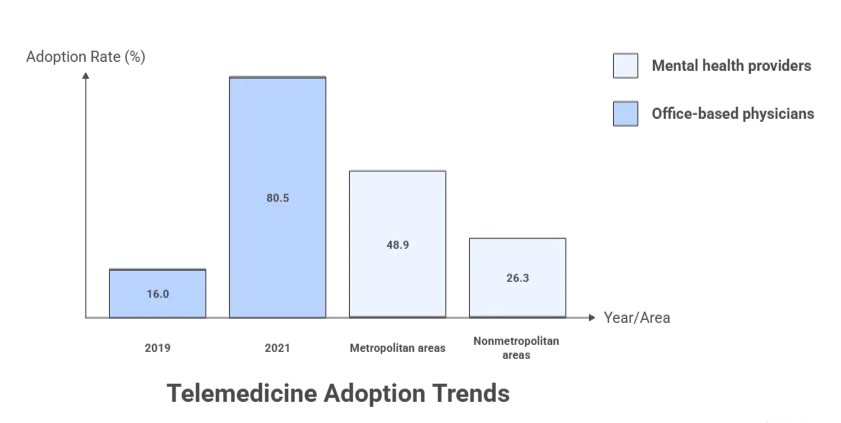
One of the most telling signs of telemedicine’s long-term potential is its widespread adoption among healthcare providers. In the U.S., the share of office-based physicians using telemedicine for patient care surged from 16.0% in 2019 to 80.5% in 2021. This isn’t just “pilot” adoption; it reflects a significant shift in institutional behavior.
Utilization Is Lower Than Peak, But Stable
Although telemedicine utilization has dipped from its pandemic peak, it remains consistently higher than pre-COVID levels. According to FAIR Health, U.S. telehealth utilization rose from 4.74% of medical claims in July 2024 to 5.04% in December 2024.
The Biggest Sticky Use Case: Behavioral Health
Behavioral health continues to be the dominant use case for telemedicine. Between July and December 2024, mental health conditions accounted for 66-67% of telehealth claim lines, solidifying it as the most persistent and in-demand telehealth service.
Rural Access: A Gap and Product Opportunity
Data from AHRQ/MEPS reveals a persistent gap in telehealth access between metropolitan and nonmetropolitan areas. For mental health providers, telehealth adoption was 48.9% in metropolitan areas, but only 26.3% in nonmetropolitan areas. This gap presents a significant product opportunity for telehealth solutions designed for low-bandwidth or hybrid modalities.
Financial Impact & Investment Opportunities: Where ROI Shows Up (and Where It Doesn’t)
The financial impact of telemedicine goes beyond basic cost savings. Let’s explore the most defensible ROI opportunities, the broader virtualization potential, and the latest healthcare software development trends that are shaping the market.
While telemedicine app development costs can be substantial, healthcare app development cost is an important consideration when evaluating the ROI of telemedicine. the ROI of telemedicine is most effectively realized through indirect savings, particularly from reductions in time, travel, and missed work, as well as improvements in operational efficiency. Rather than direct revenue generation, these factors contribute significantly to long-term cost reductions, making the financial benefits more defensible.
A notable economic evaluation in oncology found that:
-
Telehealth visits saved an average of $147–$186 per visit.
-
For new or established visits, savings ranged from $176.6 to $222.8, depending on mileage and travel distances.
The Macro Virtualization Opportunity
McKinsey estimates that up to $250B of U.S. healthcare spend could potentially shift to virtual or virtually enabled care. This figure serves as a useful benchmark for investors, signaling the size of the opportunity if workflows and reimbursement frameworks align.
While this is not a guarantee, it sets a clear boundary on the potential size of the market.
Venture Funding Signals: Capital Is Still Flowing (But Differently)
Although digital health funding has cooled since the 2021 peak, capital is still being invested, particularly in AI-driven operational tools. In 2024, U.S. digital health venture funding totaled $10.1B across 497 deals.
Technology and Platforms behind Telemedicine: Where Critical Software Features Are Built
Telemedicine platforms are evolving quickly, with cloud delivery and seamless integration becoming standard. Here’s how the key technologies are driving growth, expanding RPM market, and the critical software features that make platforms scalable and secure.
Telemedicine Platforms Are Scaling, Cloud and Integration Are Now Baseline
As these platforms expand, telemedicine app features like cloud-based delivery and seamless integration are becoming essential for scalability and efficiency. According to Grand View Research, the telehealth software market is experiencing strong growth, driven by the increasing demand for healthcare IT solutions and cloud-based infrastructure.
Remote Patient Monitoring (RPM): A High-Growth Adjacent Market
RPM is becoming an integral part of virtual care programs, especially for chronic diseases, hospital-at-home, and post-acute care. The RPM market is projected to grow from $27.72B in 2024 to $56.94B by 2030, reflecting a 12.7% CAGR.
Security & Compliance: A Core Product Feature
For U.S.-based platforms, HIPAA compliance is non-negotiable. HHS telehealth guidance sets the standard for both product design and vendor selection, ensuring platforms meet privacy and security requirements.
Software Opportunity Areas: Where Budgets Move
Key areas of investment in telemedicine software include:

- EHR Integration (Epic, Oracle Health, Cerner): Integration with major EHR systems allows seamless sharing of patient data across different care settings, improving coordination and reducing administrative tasks.
- Identity Management, Consent, and Audit Trails: Robust systems for verifying patient identities, securing consent, and maintaining audit trails ensure privacy, security, and compliance with regulations like HIPAA.
- Scheduling and Intake Automation: Automating scheduling and patient intake processes streamlines workflows, reduces errors, and improves the overall patient experience by minimizing wait times.
- Clinical Documentation Tools: Advanced tools for clinical documentation help healthcare providers capture accurate, real-time data, ensuring better record-keeping and reducing administrative burden.
- Claims and Reimbursement Optimization: Software that automates claims processing and reimbursement workflows helps reduce errors, speed up payment cycles, and ensure accurate billing.
- Multi-Modality Solutions (Video, Audio, Asynchronous Messaging): Multi-modality solutions support a variety of communication channels, enhancing flexibility and accessibility for both patients and providers, improving engagement and care delivery.
Patient & Provider Satisfaction: The Stickiness Metrics Investors Should Track
Patient Satisfaction: High, But Inconsistent (Room for UX Improvements)
Patient satisfaction with telehealth services is generally positive but varies by provider. J.D. Power reports:
| Telehealth Type | Satisfaction Score (out of 1000) | Year-over-Year Change | Barrier Percentage |
|---|---|---|---|
| Direct-to-consumer Telehealth | 730 | Down 1 point | – |
| Payer-provided Telehealth | 708 | Up 18 points | – |
| Patients Facing Barriers | – | – | 65% |
Provider Sentiment: Telemedicine Is Now Part of Routine Practice
A 2024 Doximity report shows broad clinician support for telemedicine:
- 77% of physician users engage in telemedicine at least weekly (35% daily).
- 83% want telemedicine to remain a permanent part of their practice.
- 96% of patients felt telemedicine care was equivalent to or better than in-person visits.
Challenges & Regulatory Landscape: The Risk Factors Investors Must Underwrite
Though this is the best time to invest in telemedicine, there sure are some areas you must consider when taking the final decision, they include:

Reimbursement and Policy Timing Still Matter (U.S.)
Medicare remains a critical policy driver for telehealth adoption. CMS has extended telehealth flexibility for Medicare beneficiaries through January 30, 2026, with changes starting for non-behavioral services on January 31, 2026.
Access & Infrastructure: Rural Disparity Remains
AHRQ data highlights the rural/metro gap in telehealth access, particularly for mental health services.
Governance & Evaluation: A Global Gap in Telehealth Assessment
Only 37% of European countries report evaluating their telehealth services, according to the WHO Europe survey. This indicates a significant gap in measurement and outcomes tracking.
The Future of Telemedicine: Where Growth Concentrates Next
Telemedicine is no longer just a stopgap measure. By 2026, it has solidified its place as a core, multifaceted component of healthcare delivery. This transition reflects not only widespread adoption but a rethinking of how technology can drive efficiency and continuity of care across patient and provider touchpoints.
Telemedicine Is Evolving into Virtual-First + Hybrid + Home Care
Telemedicine is transitioning from a niche solution to a central pillar of healthcare delivery. The most promising growth areas are in care models supported by advanced software rather than just video visits. For developers and healthcare providers, understanding these emerging trends is crucial, and a solid telemedicine app development guide can help ensure your platform remains adaptable and competitive.
Key Trends to Watch:
-
Hybrid Care Pathways: The integration of virtual and in-person care is becoming the norm. This model ensures continuity and flexibility for patients while optimizing resource utilization for providers.
-
Chronic Care Programs with RPM: Remote Patient Monitoring (RPM) is increasingly bundled with chronic care management programs, enabling better long-term management of conditions like diabetes, hypertension, and cardiovascular diseases. These programs are poised to scale as patients seek ongoing, remote care.
-
Behavioral Health at Scale: Behavioral health remains one of the highest growth sectors in telemedicine, with mental health services delivered remotely continuing to dominate the telehealth landscape. The demand for virtual mental health services is only expected to increase, especially as stigma decreases and access improves.
-
Digital Front Doors: Patient access points, whether through apps, portals, or virtual assistants, are becoming the first step in the healthcare journey. Digital front doors will streamline patient routing, ensuring they are directed to the appropriate level of care (virtual or in-person) based on their needs.
According to Mansor, AI technologies will also play a critical role in making these new models more efficient. He states, “By leveraging AI-driven tools, the future of telemedicine will empower healthcare systems to become more data-driven, improving everything from triage to chronic care management.”
Conclusion
Telemedicine has demonstrated its ability to scale, physician adoption in the U.S. surged from 16% to 80.5%, and utilization remains strong, with telehealth claim lines consistently around 5% in late 2024 (commercial claims data).
For investors, CFOs, and CTOs, the real opportunity lies not in funding another telemedicine app but in backing the infrastructure and workflow-native platforms that will shape the future of healthcare. The most promising areas for investment include platforms that:
- Reduce Friction: Streamlining intake, routing, documentation, and follow-up processes to make telemedicine more efficient for both patients and providers.
- Expand Access: Developing solutions for underserved regions, including rural areas, and offering low-bandwidth or hybrid modalities.
- Improve Outcomes Reporting: Enhancing tracking and reporting to ensure that telemedicine services meet reimbursement standards and support long-term contracts.
- Integrate Deeply with EHR and Cloud Ecosystems: Building platforms that seamlessly connect with existing electronic health record systems and cloud infrastructure for better data flow and operational efficiency.
The macroeconomic potential remains substantial, up to $250B of U.S. healthcare spend could shift to virtual or virtually-enabled care if care pathways continue to evolve.
Building these advanced, integrated solutions requires expertise in both healthcare and technology. AppVerticals, with its experience in creating tailored, scalable healthcare platforms, is well-positioned to support the development of the next generation of telemedicine solutions.
More Related Guides:
- AI in App Development Statistics 2026: Explores how AI integration in mobile and web apps is driving engagement, automation, and measurable ROI in 2026.
- AI Chatbot Technology in 2026: Explores how AI chatbots are being adopted across mobile and web apps, driving automation, cost reduction, and measurable business ROI in 2026.
- Global Mobile App Download Statistics 2026: Highlights worldwide mobile app download trends, user growth, and adoption patterns shaping the app ecosystem.
- Mobile App Development Market Growth and Size Statistics: Covers global market size, growth forecasts, and investment trends in mobile app development for 2026.
- App Monetization Statistics 2026: Breaks down global app revenue benchmarks, monetization models, retention metrics, and AI-driven growth strategies shaping profitable apps in 2026.
- Odoo ERP Market & Adoption Statistics 2026: Provides global user, revenue, and adoption insights, highlighting cloud, AI, and modular ERP trends driving mid-market growth in 2026.
- Mobile vs Web App Revenue Statistics 2025–2026: Analyzes global consumer spend, SaaS growth, hybrid monetization, and platform economics shaping app profitability and retention in 2026.
- How a 105 old Pharmacy get recognition: Provides a clear idea on how a successfull healthcare platform gets global recognition
- AI Automation Statistics for Enterprises (2026): Covers adoption, ROI, costs, and key trends shaping enterprise AI execution.