

























 ChatGPT
 Perplexity
 Google AI
The AI chatbot market has moved beyond experimentation, growing at a 23.3% CAGR from $7.76B in 2024 to $27.29B by 2030. Demand is rising for chatbots embedded in apps and digital platforms that deliver instant, intelligent interactions.
In 2026, chatbots go beyond FAQs, enabling task execution, workflow automation, and system-level actions. For executives, the focus is no longer adoption, but rapid deployment to boost revenue, cut costs, and ensure compliant scale.
Key Takeaways: AI Chatbot Adoption Statistics in 2026
- Banking, e-commerce, SaaS, telecom, and travel lead AI adoption due to 24/7 demand and clear, measurable ROI.
- AppVerticals identifies healthcare, insurance, education, government, and manufacturing as the fastest-accelerating adopters.
- Over 40% of enterprise applications will embed task-specific AI agents by 2026, prioritizing outcomes over engagement metrics.
- AppVerticals’ analysis confirms 148–200% ROI within 12 months, with up to $4.13 saved per automated interaction.
- AI chat qualifiers convert at 28–40%, compared to 2–3% for traditional forms, materially reducing CAC.
- Agentic chatbots deliver 3× higher conversion rates, 35% higher AOV, and up to 67% sales uplift.
- AppVerticals finds ChatGPT leads in traffic and engagement, while Meta AI leads in reported users, and Gemini/Copilot is rapidly gaining share.
- AppVerticals forecasts the coexistence of enterprise task-oriented agents and consumer engagement-focused chatbots, not a single dominant interface.
- Data residency mandates are pushing enterprises toward on-prem LLMs, TEEs, ZKPs, and confidential computing as trust differentiators.
Why Is AI Chatbot Technology Growing So Fast in 2026?
AI chatbot growth is being fueled by three converging forces: market demand for instant service, enterprise pressure to show measurable ROI, and rapid advances in LLM-powered automation.
How Big Is the Global AI Chatbot Market and Why Should Enterprises Care?
A projected 23.3% CAGR through 2030 places AI chatbots among the fastest-growing enterprise technologies. Unlike traditional SaaS tools, chatbot deployments touch multiple high-impact business areas simultaneously: customer support, sales, lead generation, compliance, and internal operations.
The scale of impact is what makes this market impossible to ignore: AI chatbots directly influence conversion rates, cost-per-call, customer wait times, and compliance risk, all of which sit squarely on executive dashboards.
What Industries Lead AI Chatbots Integration Today (2026)?
Top Industries With High AI Chatbot Adoption
| Industry | Primary Use Cases & Benefits | Adoption Level / Stats |
|---|---|---|
| Banking & Financial Services | Account inquiries, fraud alerts, and digital support | ~83–92% adoption in many banks; handling large inquiry volumes and lowering support load |
| E-Commerce & Retail | Product recommendations, order tracking, and customer service | ~79% adoption; major driver of purchase flows |
| Telecommunications | Billing, technical support, service queries | ~76% adoption, fast real-time issue handling |
| Travel & Hospitality | Booking support, itinerary management | ~71% adoption; peak-period efficiency |
| Healthcare | Appointment scheduling, patient support | ~64–66% adoption; admin task automation |
| Insurance | Claims queries, policy Q&A | ~68% adoption; improves customer experience |
| Software / SaaS / Tech Support | Onboarding help, tech support, and FAQ automation | ~81% adoption in tech/SaaS companies |
Why Are Companies Replacing Legacy Chatbots With AI Chatbots in Their Apps?
Legacy rule-based chatbots in apps often underperform. Less than 12% of conversations ever lead to successful outcomes, and most interactions require human hand-offs.
AI chatbots powered by LLMs overcome these limits by understanding user intent and executing multi-step workflows autonomously, from rebooking tickets to processing refunds and updating app databases, while reducing average handle time by 30%.
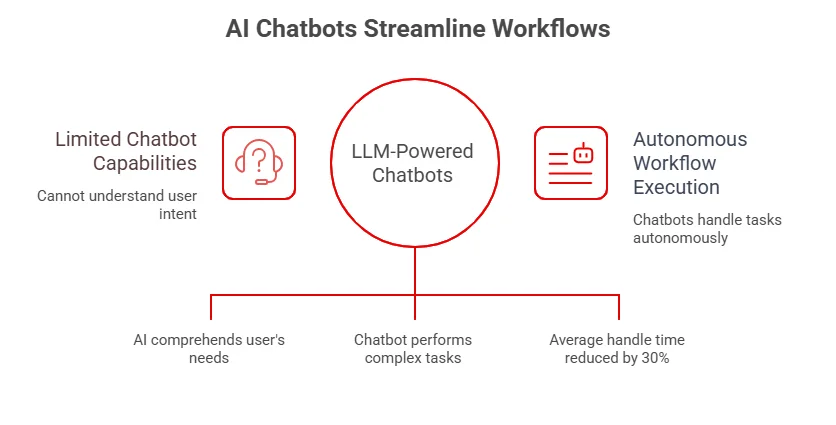
This evolution from scripted responses to intelligent AI chatbots is driving adoption in mobile and web apps, improving user engagement, satisfaction, and operational efficiency. At AppVerticals, we help businesses modernize legacy chatbot systems into intelligent, LLM-powered solutions, ensuring smoother workflows, higher engagement, and measurable ROI
“I see massive growth ahead in AI chatbot adoption within apps, very similar to how eCommerce exploded in the 2010s. Back then, platforms like Shopify made it easy for anyone to launch an online store. Today, AI is doing the same for intelligent, conversational experiences. AI chatbots are becoming plug-and-play components inside apps, lowering the barrier for non-technical and creative teams to prototype ideas quickly.”
– Simon Espinola Marin, Co-Founder
How Fast Is AI Chatbot Adoption Across Mobile Apps and SaaS Platforms?
AppVerticals’ data highlights that 51% of consumers prefer bots over humans, 73% of mobile users expect in-app chat, and 82% expect zero-wait response
In response, product-led growth (PLG) SaaS companies are embedding chatbots directly into onboarding and activation flows, reducing trial-to-paid churn by 18%.
How Are Companies Moving From Chatbot MVPs to AI-at-Scale Deployments?
AppVerticals’ research and industry insights show that worker access to AI tools increased by 50% in 2025, while the share of AI projects operating in production environments at 40% or higher is expected to double within six months.
As a result, boards and leadership teams are no longer funding experiments. Capital is being allocated to AI chatbot platforms that can scale from MVP to audited, compliant production environments without requiring re-architecture, accelerating enterprise-wide adoption in apps and digital platforms.
AI Chatbot ROI in 2026: How Do Chatbots Reduce Costs and Increase Revenue?
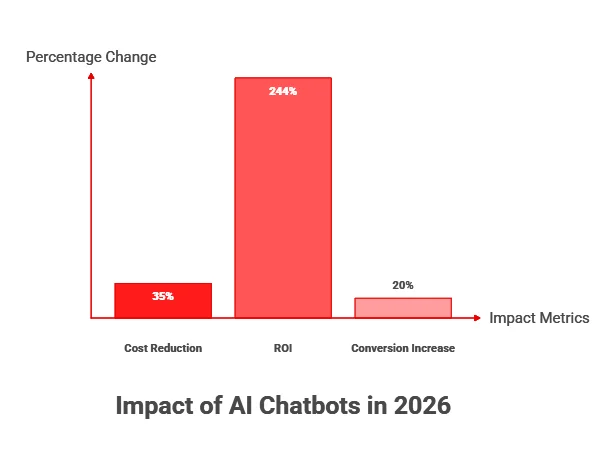
AppVerticals’ insights: In 2026, AI chatbots reduce customer support costs by up to 30–40% and deliver 148–340% ROI, while increasing conversions by 10–30% through real-time, intent-driven app interactions.
This is why forward-thinking business owners and founders are increasingly opting for AI development, turning chatbots and automation into tangible revenue and efficiency gains
How Do AI Chatbots Improve Ecommerce Conversion Rates and Sales Uplift?
Agentic AI Chatbot Performance Metrics
| Metric | Before Bot | With Agentic Bot |
|---|---|---|
| Average conversion rate | 2.1% | 6.3% |
| Average order value | $68 | $92 (+35%) |
| Sales uplift | — | +67% |
| Cart recovery | 8% | 31% |
How Are Banks and Financial Institutions Using AI Chatbots to Cut Costs and Stay Compliant?
In financial services:
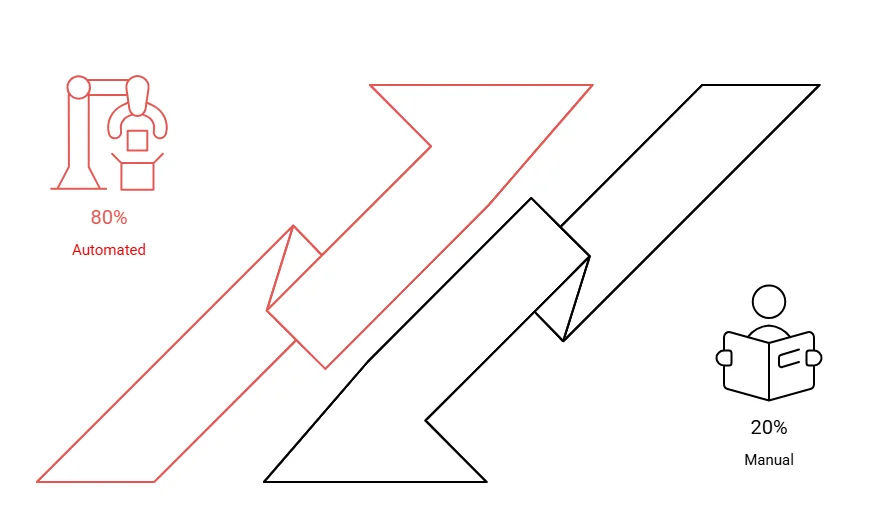
- 80% of routine KYC and fraud queries are resolved without human involvement
- $7.3B in annual cost savings is projected across retail banking by 2026
- Chatbot + RPA workflows reduce KYC cycles from 48 hours to 11 minutes
“I think it depends on how good they are at not puncturing the extremely thin veil of human-like behavior. AI chat is the way people increasingly expect to engage with content and interfaces. So, they are a step in the right direction. If they stay “on brand” and don’t hallucinate, then the veil remains in place. One small, stupid language or short-term memory flub and the veil is pierced. Perhaps forever in the user’s mind. Like the time my Spotify DJ referred to Sade as a band.”
– Tom Conlon, Founder + Coauthor
How Do AI Chatbots Improve Lead Generation and Funnel Economics?
This reduces the cost per sales-qualified lead from $84 to $31, a 63% efficiency gain that directly impacts CAC and revenue velocity.
Which AI Chatbot Platforms Are Leading App Adoption in 2025–2026?
AppVerticals’ research indicates that Meta AI leads in reported active users, but ChatGPT outperforms in traffic depth and engagement, suggesting stronger cross-platform usage across consumer, enterprise, and API environments. Rapid growth from challengers like Gemini is further fragmenting the AI chatbot ecosystem.
Top AI Chatbot Platforms (2025–2026)
| Platform | Usage / Share Indicator | Strength |
|---|---|---|
| ChatGPT (OpenAI) | Dominant web traffic leading with ~80%+ share of AI chat usage in some measures | Best general conversation, broad tasking, enterprise API use |
| ChatGPT (usage stats) | ~2.5 billion messages/day (Oct 2025) | Massive global engagement |
| Meta AI | Ranked #1 by some user counts with ~500 million active users (2025) | Deep integrative reach across WhatsApp/IG/Facebook |
| Google Gemini | Growing rapidly, with significant usage; estimates range from mid-hundreds of millions of monthly visits and a growing share | Integration with the Google ecosystem |
| Microsoft Copilot | ~3.58–4.05% global AI chatbot market share (2025) | Strong enterprise and Bing integration |
| Grok | Fast-growing emerging chatbot with notable YoY growth | Fast-growing rival, tied to the X platform ecosystem and niche user engagement |
| Perplexity | Significant second-tier platform with ~10–11% share in market share estimates and growing usage. | Research-centric chatbot with strong answer accuracy and niche audiences |
| Claude | Smaller share (usually ~1% or slightly above), but rising research/workflow adoption. | Focus on reasoning depth, enterprise contexts, and niche knowledge tasks |
Where Is AI Chatbot Technology Headed Next?
AppVerticals’ market insights indicate that AI chatbots are evolving from simple conversational tools into embedded intelligence layers inside apps and enterprise platforms. In 2026, the focus is no longer on how well chatbots respond, but on how effectively they retain context, personalize interactions, and integrate with core systems like CRMs and analytics tools.
The next phase centers on deeper automation, multimodal interaction, and governance at scale. AI chatbots are increasingly expected to connect across workflows, support voice and visual inputs, and operate within compliance-ready frameworks, turning conversations into measurable business actions and insights rather than isolated support events.
AI Chatbot Market Trends, Growth, and Industry Adoption in 2026
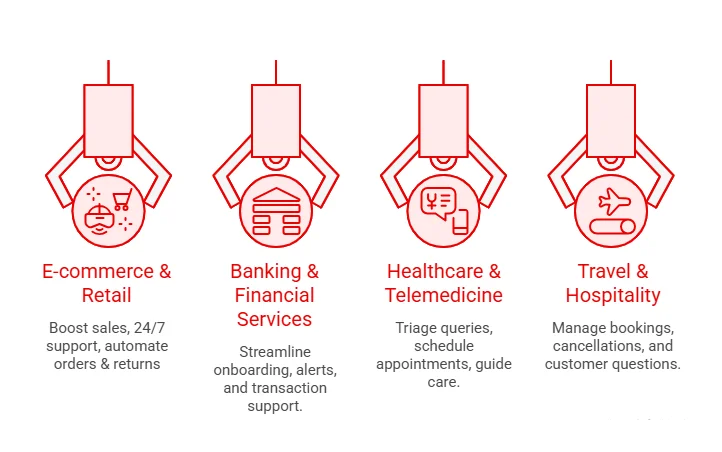
Adoption is particularly strong in sectors where real-time customer interaction and automation drive measurable ROI:
- E-commerce & Retail: AI chatbots enhance sales conversions, provide 24/7 support, and automate order tracking and returns.
- Banking & Financial Services: Chatbots streamline customer onboarding, fraud alerts, and transaction support while meeting strict compliance requirements.
- Healthcare & Telemedicine: Chatbots triage patient inquiries, schedule appointments, and provide personalized care guidance, reducing administrative workload.
- Travel & Hospitality: AI chatbots handle bookings, cancellations, itinerary updates, and customer queries, improving operational efficiency.
- Enterprise SaaS & Tech Platforms: Chatbots integrate into CRMs, ERPs, and analytics tools to automate workflows and deliver actionable insights across teams.
Despite widespread adoption, businesses in 2026 still struggle with “Hallucination Risk” (incorrect info) and Data Silos. Integration complexity remains the #1 hurdle for smaller apps trying to link their AI to legacy internal databases.
Key market trends shaping adoption in 2026 include:
- Embedded AI in apps and platforms for task execution and personalization.
- Multimodal interactions combining text, voice, and visual inputs.
- Compliance-ready deployments, including sovereign AI and secure frameworks like TEEs and zero-knowledge proofs.
- ROI-focused strategies, as companies measure tangible benefits in cost reduction, engagement, and revenue growth.
According to AppVerticals, businesses that adopt AI chatbots strategically, integrating them deeply into apps and workflows while ensuring compliance, are positioned to outperform competitors, turning conversational AI into a core driver of revenue, efficiency, and user satisfaction.
Unlock Generative AI for Your App
Leverage our generative AI expertise to build intelligent chatbots, automate workflows, and enhance user engagement—fully integrated and compliant.
How Will AI Chatbots Integrate With IoT and Physical-World Systems?
By 2027, 58% of companies will merge chatbots with physical AI systems such as robotics, drones, and industrial sensors.
– Luca Collina, Senior Advisor in Strategy, Transformation, and AI Governance
Expected Future Shifts in Platform Leadership
Based on current adoption and growth trends:
- Meta AI could rise further due to mass mobile/social reach, especially after consolidation in messaging platforms like WhatsApp.
- Google Gemini is growing quickly and may take a larger share with search integration.
- ChatGPT is still the traffic and engagement leader, with unmatched global use and integration breadth.
Predicted future scenario: Based on market analysis and ongoing enterprise research, AppVerticals identifies a clear shift toward AI market fragmentation by 2027. Multiple AI agents will coexist, some purpose-built for enterprise task execution and workflow automation, while others will focus on consumer engagement, conversational experiences, and content interaction. Rather than a single dominant AI interface, businesses will deploy specialized agents optimized for distinct use cases across operations, customer experience, and digital products.
Conclusion: What Should Enterprises Focus on When Deploying AI Chatbots in 2026?
The data is unambiguous:
23.3%
Market CAGR
148–200%
First-Year ROI
80%
FAQ Deflection
67%
Sales Uplift
Yet boards don’t fund technology; they fund outcomes. AI chatbots succeed only when deployed against measurable friction points: conversion loss, churn, cost-per-call, or compliance exposure. Solve those problems, and budgets unlock quickly.
Solve them at scale, and organizations position themselves ahead of the next enterprise AI S-curve.
More Related Guides:
- AI in App Development Statistics 2026: Explores how AI integration in mobile and web apps is driving engagement, automation, and measurable ROI in 2026.
- Global Mobile App Download Statistics 2026: Highlights worldwide mobile app download trends, user growth, and adoption patterns shaping the app ecosystem.
- Telemedicine Statistics 2026: Reveals key telehealth adoption metrics, patient engagement trends, and digital healthcare growth in 2026.
- Mobile App Development Market Growth and Size Statistics: Covers global market size, growth forecasts, and investment trends in mobile app development for 2026.
- App Monetization Statistics 2026: Breaks down global app revenue benchmarks, monetization models, retention metrics, and AI-driven growth strategies shaping profitable apps in 2026.
- Odoo ERP Market & Adoption Statistics 2026: Provides global user, revenue, and adoption insights, highlighting cloud, AI, and modular ERP trends driving mid-market growth in 2026.
- Mobile vs Web App Revenue Statistics 2025–2026: Analyzes global consumer spend, SaaS growth, hybrid monetization, and platform economics shaping app profitability and retention in 2026.
- AI Cloud Cost Statistics, Trends & Optimization (2026): Explores rising cloud spending, cost drivers, optimization strategies, and how AI is reshaping cloud efficiency and ROI in 2026.
- SaaS Development & Adoption Statistics 2026: Highlights global SaaS market growth, adoption trends, revenue benchmarks, churn metrics, and AI-driven innovations shaping scalable software businesses in 2026.
- E-commerce App Development Statistics 2026: Covers market size, mobile commerce growth, user behavior, AI adoption, development costs, and ROI insights shaping high-performing e-commerce apps in 2026.
- AI Automation Statistics for Enterprises (2026): Covers adoption, ROI, costs, and key trends shaping enterprise AI execution.