

























 ChatGPT
 Perplexity
 Google AI
This surge in app downloads highlights the evolving behavior of mobile users and the ever-growing importance of mobile apps in the daily digital experience. But the numbers don’t stop there, mobile users collectively spent a staggering 5.3 trillion hours in apps in 2025 and generated $167 billion in in-app purchase revenue, according to Sensor Tower’s latest data.
In this blog post, we’ll explore the most recent insights on global mobile app downloads, with a focus on the predictions for 2026 and beyond. From regional trends to growth forecasts, we’ll dive into actionable data that can help developers, marketers, and business leaders navigate the dynamic mobile app landscape.
See Which App Categories Are Dominating the Download Charts
Mobile App Download Statistics 2026: Quick Facts
| Metric | Latest Verified Figure |
|---|---|
| Global app + game downloads, 2025 | 142.2 billion |
| Google Play downloads, 2025 | 104.6 billion |
| iOS downloads, 2025 | 36.6 billion |
| App-only downloads, 2025 | 96.9 billion |
| Game downloads, 2025 | 45.3 billion |
| Current Google Play app count | 2,310,626 |
| Current Apple App Store app count | 2,242,101 |
| New apps published per day | 2,375 on Google Play; 3,161 on iOS |
| Broader mobile engagement, 2025 | 5.3 trillion hours spent |
| Global IAP revenue, 2025 | $167 billion |
What Are the Latest Global Mobile App Download Statistics in 2026?
The latest fully reported annual benchmark reveals that 142.2 billion apps and games were downloaded globally in 2025, marking a return to growth after a period of slower expansion.
According to Business of Apps, apps accounted for the lion’s share of this total, with 96.9 billion downloads, while games made up 45.3 billion, roughly 68% of all downloads. This shift emphasizes the continuing dominance of apps in the global mobile ecosystem, even as games maintain a strong presence.
On the other hand, Sensor Tower presents a slightly different but complementary picture of the market. In its 2026 market review, the analytics firm notes that downloads across both iOS and Google Play rose by 0.8% year-over-year, approaching 150 billion in 2025.
Growth Trends from 2021 to 2026
The app download figures for 2026 are expected to hit new milestones, continuing the growth seen in previous years.
| Year | Total Downloads (Billions) | YoY Growth | Key Drivers |
|---|---|---|---|
| 2021 | 144 | +2.34% | COVID-19, remote work adoption |
| 2022 | 148 | +2.78% | Continued digital transformation |
| 2023 | 156 | +5.41% | 5G expansion, emerging market growth |
| 2024 | 165 | +5.77% | AI integration, social commerce |
| 2025 | 173 | +4.85% | GenAI apps, video-first platforms |
| 2026 | 181 | +4.62% | Emerging market smartphone adoption |
Key Drivers behind Continued Growth
The growth in app downloads can be attributed to:
- Emerging Markets: Significant smartphone adoption in countries like India, Brazil, and Indonesia is driving global download numbers. These countries are seeing tremendous year-over-year growth in mobile usage.
- AI and Personalization: AI-powered recommendations are enabling more efficient app discovery, resulting in higher download rates.
- Subscription Models: An increase in subscription-based models, especially in sectors like health, fitness, and finance, has enhanced user engagement and retention.
Looking into 2026, experts predict continued growth in app downloads. With AI-driven recommendations becoming more precise and the widespread adoption of 5G networks, app ecosystems are set to expand, providing even more opportunities for app discovery and usage across both mature and emerging markets.
How Many Apps Are Available for Download in 2026 on Major App Stores?
Total Number of Apps in the Google Play Store and Apple App Store
That volume gap does not mean iOS is less important. Sensor Tower reports that the United States alone generated nearly $60 billion in mobile consumer spending in 2025, reinforcing the usual pattern: Google Play often leads on scale, while iOS can remain disproportionately important for revenue-heavy markets
Breakdown by Type of Apps
The variety of apps available reflects the diverse needs of users, and the app stores have continued to expand their offerings across multiple categories. Here’s a breakdown of the most prominent app types:
- Games: Dominating the app stores, gaming apps consistently account for the largest share of downloads.
- Social Media: Platforms like Facebook, Instagram, and TikTok remain staple apps for users worldwide.
- Productivity & Utility: Apps that help users stay organized, productive, or enhance device functionality (e.g., calendar, task managers, and cloud storage).
- Health & Fitness: With an increasing focus on personal well-being, health-related apps have experienced strong growth, especially in 2025.
- Entertainment & Streaming: Apps like Netflix, Spotify, and YouTube are among the most downloaded globally.
The wide array of available apps ensures that there is something for everyone, whether they’re looking to stay connected, play games, be productive, or simply be entertained.
What Are the Most Downloaded App Categories in 2026?
As of April 2026, 42matters reports 2,310,626 apps on Google Play and 2,242,101 apps on the Apple App Store. Combined, that is more than 4.55 million apps across the two largest mobile ecosystems. This is a better figure to publish than speculative multi-million estimates because it is tied to a current, dated inventory snapshot.
The stores continue to expand rapidly. A very recent traction reports 2,375 new Android apps and 3,161 new iOS apps published. That equates to more than 5,500 new apps per day across the two stores at the time of measurement, which is far more credible than unsourced claims about hundreds of thousands or millions of apps being created daily
Let’s look at the download share of mobile apps on the basis of multiple factors in detail:
Download Share by Category
The breakdown of the most downloaded app categories projection in 2026 shows that gaming apps continue to lead the way, with users engaging in both casual and more immersive experiences. Below is a closer look at the categories gaining the most traction:
| Category | Downloads (Billions) | Key Insights |
|---|---|---|
| Games | 34.54 | Games led global downloads, maintaining its position as the dominant category. Mobile gaming continues to be the largest share of overall download volume. |
| Entertainment | 10.04 | Ranked second, with strong engagement in media consumption. This includes streaming platforms and video apps that capture large user bases. |
| Finance | 6.84 | Significant growth in non-gaming categories. Financial apps like digital banking and personal finance are seeing increased adoption. |
| Productivity | 5.93 | Reflects ongoing expansion in the mobile market. Includes apps for work, task management, and collaboration. |
| Shopping | 5.86 | Marked as a key growth area outside of gaming, with e-commerce apps thriving due to the global shift to mobile-first shopping experiences. |
While games remain the leader in downloads, categories such as finance, productivity, and shopping are emerging as significant areas of growth, suggesting a broader shift in mobile app preferences and usage.
Which Individual Apps Led Downloads Most Recently?
These leading apps provide clear examples of how different categories are driving download growth, with established and emerging apps reshaping the mobile landscape through strong market presence and category-specific success.
| App Name | Category | Downloads (Millions) | Key Insights |
|---|---|---|---|
| ChatGPT | AI | 770 | Most downloaded app globally in 2025, demonstrating the significant impact of AI on mobile market trends. |
| TikTok | Social | 644 | Reinforces its dominance in the video content and social media space. |
| Temu | Shopping | 363 | Highlights the rapid growth of e-commerce apps. |
| Google Sheets | Productivity | 73 | Maintains its position as a leading mobile productivity and collaboration tool. |
| Flo | Health & Fitness | 52 | Signifies growing user interest in wellness and personal health apps. |
| WhatsApp Business | Business | 247 | Key tool for businesses using mobile apps for communication and customer engagement. |
Countries with the Highest Mobile App Downloads In 2026
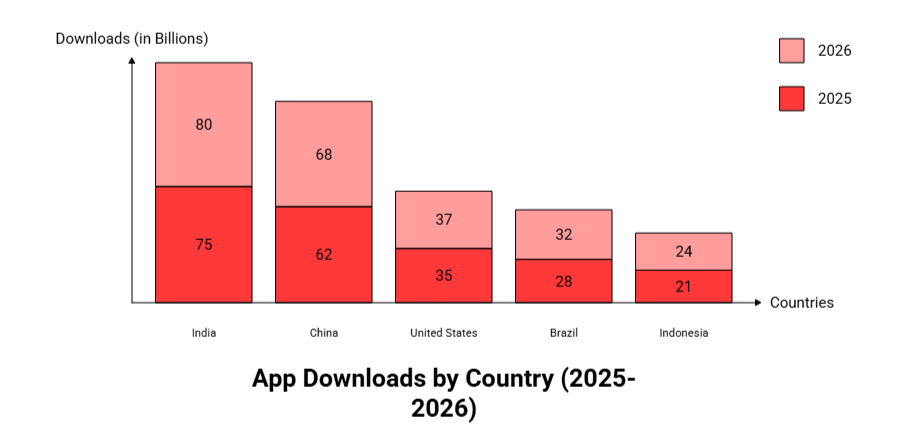
- India: In 2025, India led with 75 billion downloads, and by 2026, it’s expected to surpass 80 billion due to rapid smartphone adoption and high user engagement.
- China: China reached 62 billion downloads in 2025 and is predicted to hit around 68 billion in 2026, driven by WeChat and super apps.
- United States: The U.S. saw 35 billion downloads in 2025, with projections for 37 billion in 2026, maintaining dominance in app spending despite slower growth in downloads.
- Brazil: Brazil’s downloads grew to 28 billion in 2025, and in 2026, they’re expected to reach 32 billion, fueled by a fast-growing mobile app market.
- Indonesia: Indonesia recorded 21 billion downloads in 2025, and by 2026, it’s set to hit 24 billion, driven by high engagement in social and gaming apps.
How Many Mobile Apps Are Downloaded Each Day Worldwide in 2026?
Daily Download Figures in 2026
In 2026, app downloads are projected to average 860 million per day, up from 819 million in 2025. This reflects steady global app usage growth and spikes driven by e-commerce sales, holiday shopping, and major app launches.
Event-Driven Download Spikes

- Black Friday: Download volumes will likely spike to 1.6 billion, a 90% increase from daily averages, driven by shopping and retail apps.
- Christmas Day: Expect 1.4 billion downloads on Christmas, fueled by new device activations, especially in regions with strong iOS adoption.
- Prime Day and Singles’ Day: These e-commerce events will continue to drive a 60% increase in downloads, with retail and shopping apps leading the charge.
- Major Game Launches: Anticipated releases of popular mobile games could lead to 1.2 billion downloads on peak launch days.
- Major Sporting Events: Global events like the World Cup and Super Bowl will continue to generate substantial spikes, especially for sports streaming and betting apps.
Time-of-Day and Weekly Patterns in 2026
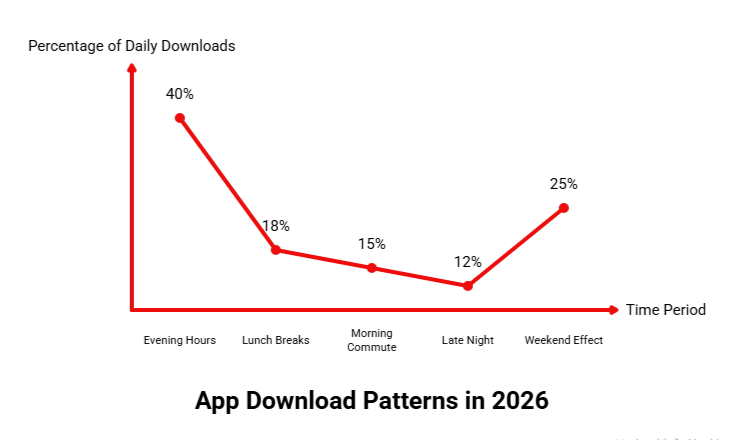
- Evening Hours (7-10 PM): The peak download period will account for 40% of daily downloads, with users most engaged after work or school.
- Lunch Breaks (12-2 PM): Expect 18% of daily downloads during lunch hours, primarily for new app discoveries.
- Morning Commute (7-9 AM): 15% of downloads will continue to occur in the morning, especially for news and productivity apps.
- Late Night (10 PM-1 AM): 12% of downloads will happen late at night, driven by social, dating, and gaming apps.
- Weekend Effect: Weekend downloads will see 25% higher activity than weekdays, skewing toward entertainment, gaming, and lifestyle apps.
How Many Apps Are Created Each Day Across the Major App Stores?
App Creation Rates in 2026
In 2026, Google Play Store will see over 2,200 new apps added daily, while the Apple App Store will add around 1,600 new apps daily. These rates reflect continued growth as developers tap into the expanding mobile ecosystem.
App Creation Trends (2026 Predictions)
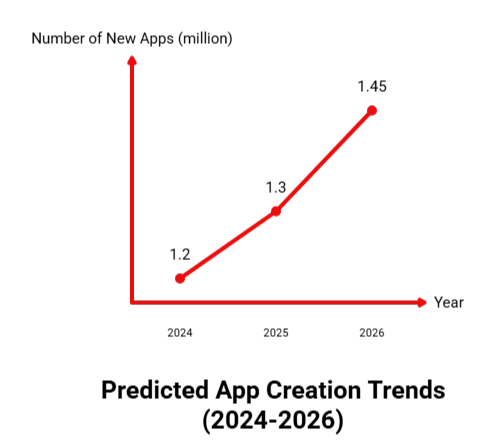
- 2024: Approximately 1.2 million new apps were created across both stores.
- 2025: The total rose to 1.3 million, marking an 8-10% increase year-over-year.
- 2026: With AI-driven development and cross-platform tools, 1.45 million new apps are expected to be created, representing a 10-12% increase compared to 2025.
The continued rise of AI-powered tools will simplify and speed up the app creation process, fueling the demand for new apps as smartphone usage and mobile commerce expand globally.
How Have Mobile App Download Statistics Evolved in the Last 5 Years?
While growth rates have slowed from the pandemic-driven surge, the continued adoption of 5G, AI integration, and emerging markets will drive this steady upward trend.
Mobile App Download Growth (2026 Predictions)
From 2020 to 2025, app downloads grew by over 65%, reflecting the impact of the pandemic, 5G expansion, and the rise of AI and social commerce. In 2026, we can expect the total number of global downloads to reach 320 billion, driven by increased mobile commerce, AI-powered apps, and widespread 5G adoption.
Growth Breakdown (2020-2026)
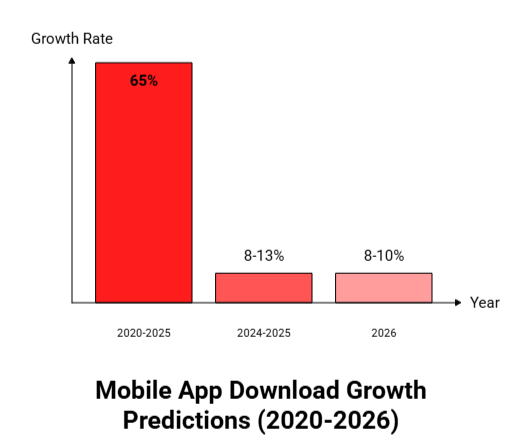
- 2020: A pandemic-driven surge led to a massive spike in app downloads as people relied more on mobile devices for work, entertainment, and communication.
- 2021-2023: Downloads continued to rise with the adoption of 5G and the expansion of emerging markets.
- 2024-2025: Growth stabilized at around 8-13% year-over-year, reflecting maturing markets and shifts in app usage patterns.
- 2026: A steady 8-10% growth is expected, with AI integration, social commerce, and mobile gaming apps driving the increase.
Key Growth Drivers
- AI and GenAI Apps (2023-2025): The introduction and rapid adoption of AI-powered applications like ChatGPT has had a profound impact on mobile app downloads. With 2025 projected to see an increase in AI app downloads by 17 billion, this trend is expected to continue driving app store growth.
- Social Commerce and Digital Transformation: The past few years have also seen a growing trend of social commerce, where apps like Instagram and TikTok drive shopping behavior directly within the app. Social media apps and messaging platforms dominate the most downloaded apps, as they integrate e-commerce capabilities.
- 5G and Mobile Gaming: The expansion of 5G networks has boosted gaming app downloads, as users seek higher-quality mobile gaming experiences. As mobile networks become faster, consumers are more willing to download large-scale gaming apps like Roblox, which experienced a growth in downloads by 7% YoY in 2024.
- E-commerce Growth: The rise of platforms like Temu and SHEIN, which focus on global e-commerce and shopping, has driven substantial growth in retail app downloads. Particularly in emerging markets, the e-commerce sector has seen explosive growth.
- Video-First Platforms: TikTok and Instagram’s growth continued into 2025, making entertainment apps one of the key drivers for download growth. With video consumption becoming increasingly popular, apps like CapCut (a ByteDance product) have also capitalized on this trend.
How Do Mobile App Downloads Impact App Revenue Generation?
In 2026, mobile app downloads will continue to drive revenue growth, with a direct correlation between download volumes and higher app revenues. The $585 billion projected market revenue in 2025 will see a further increase, fueled by the rise of subscription models, AI-powered monetization, and regional strategies.
Download-to-Revenue Correlation in 2026
In 2026, app revenue will continue to climb in tandem with download growth, reaching new heights due to AI-driven monetization and the growing adoption of subscription-based models. Apps with high download volumes, especially in sectors like gaming and e-commerce, will see significant revenue growth from in-app purchases (IAP), subscriptions, and advertising.
Revenue Forecast and Trends for 2026
- Freemium Models: Apps will continue to rely on freemium models, contributing to an increase in IAP revenue. The gaming and lifestyle sectors, along with apps like TikTok and Instagram, will generate substantial revenue from ads.
- Subscription-Based Apps: Subscription-based models will dominate in 2026, with health & fitness, video streaming, and news apps leading the shift towards monthly/annual subscriptions.
- AI & Personalized Monetization: AI-driven apps, such as ChatGPT and personalized fitness apps, will drive higher engagement and revenue, as they improve user experience and monetization strategies.
- Global Expansion: With markets like India, Brazil, and Indonesia contributing to higher download volumes, localized pricing strategies and regional monetization will further boost app revenues.
How Will App Store Optimization (ASO) Strategies Impact Download Growth in 2026?
App Store Optimization (ASO) has become a vital part of any app’s marketing strategy, directly influencing app visibility and download volumes. ASO focuses on optimizing an app’s listing on Google Play and the Apple App Store to improve its chances of being discovered by potential users.
By implementing effective ASO techniques, apps can significantly increase their visibility, leading to a higher number of downloads.
- App Title & Keywords: Optimizing the app title with the right keywords is one of the most basic and effective ASO strategies. Apps like TikTok and Instagram have fine-tuned their keyword strategy to rank higher for relevant searches, driving increased download volume.
- App Icon & Screenshots: A compelling app icon and attractive screenshots can drive higher click-through rates, influencing user decisions to download.
- User Ratings & Reviews: Positive user ratings and reviews contribute to higher visibility in the app stores, as apps with good ratings tend to rank higher. Review management tools and effective user feedback responses play a crucial role in maintaining high ratings.
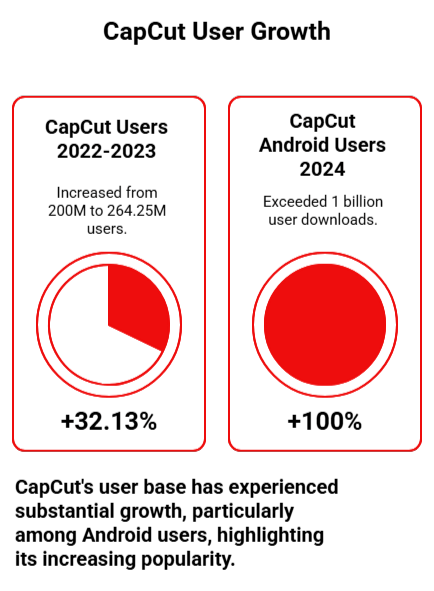
An example of the power of ASO in increasing downloads is CapCut. After optimizing its app listing with relevant keywords and a more compelling app icon, the app experienced a significant spike in downloads, rising to the top 10 most downloaded apps globally.
2026 ASO Strategies
Looking ahead to 2026, ASO strategies are expected to become even more data-driven and tailored to individual user preferences. Here’s what can be expected:
- AI-Powered ASO: The integration of AI into ASO strategies will help developers personalize app listings based on user behavior and preferences. Apps will become smarter in understanding which keywords and visuals work best for specific user segments.
- Localized ASO: As mobile apps continue to expand globally, app stores will adapt their algorithms to reflect local trends and cultural nuances, making localized ASO crucial for targeting regional markets.
- Video Content for ASO: Video previews and short-form videos will become more important in ASO, particularly for gaming and social media apps, helping potential users get a sense of the app’s experience before downloading.
What Is the Role of AI in Mobile App Downloads?
AI is no longer a niche story in mobile. Sensor Tower reports that generative AI app downloads doubled year over year to 3.8 billion in 2025, while in-app purchase revenue for the category climbed to more than $5 billion. It also says users spent 48 billion hours in generative AI apps and drove more than one trillion sessions during the year.
Ready to Build Your Own Mobile App?
Partner with our experts to create a custom app that thrives in the 2026 app landscape.
What Could Mobile App Download Statistics Look Like in 2030?
Looking ahead to 2030, mobile app downloads are expected to surpass 500 billion annually, driven by rapid advancements in technology, global smartphone adoption, and emerging markets.
Key Trends Influencing Growth
Sustained Growth
Annual app downloads will continue to rise, especially with smartphone adoption in emerging markets like India, Brazil, and Africa.
Technological Advances
- AI, 5G, and AR/VR will redefine app experiences, enabling new immersive and interactive categories like gaming, health, and e-commerce.
- 5G will boost high-data apps, while AR/VR will drive significant growth in gaming and entertainment.
Emerging Markets as Growth Drivers
Countries with expanding smartphone access will account for the majority of new downloads, likely making up 60-70% of global figures.
Dominant App Categories
- Health & Wellness
Mental health, fitness, and telemedicine app development will see substantial growth, driven by increasing health awareness and tech integration. - AI-Powered & E-Commerce Apps
AI will be embedded in apps across categories, while e-commerce will continue evolving with personalized shopping experiences.
Looking to 2030
2026 Outlook: What Should You Expect Next?
The most defensible 2026 outlook is not an unsupported single-number forecast. The market data suggests a more nuanced story: download growth is still happening, but slowly, while time spent and monetization are growing faster. Sensor Tower’s 2026 review shows downloads up 0.8%, hours spent up 3.8%, and IAP revenue up 10.6% in 2025. That points to a mobile economy that is becoming more efficient and more monetized, rather than simply bigger through raw install spikes.
For that reason, the safest 2026 framing is this: the mobile app market remains enormous, Google Play still leads global volume, iOS remains essential for monetization, AI is reshaping user behavior, and category winners are increasingly defined by retention and revenue quality rather than install growth alone.
References
More Related Guides:
- AI in App Development Statistics 2026: Explores how AI integration in mobile and web apps is driving engagement, automation, and measurable ROI in 2026.
- AI Chatbot Technology in 2026: Explores how AI chatbots are being adopted across mobile and web apps, driving automation, cost reduction, and measurable business ROI in 2026.
- Telemedicine Statistics 2026: Reveals key telehealth adoption metrics, patient engagement trends, and digital healthcare growth in 2026.
- Mobile App Development Market Growth and Size Statistics: Covers global market size, growth forecasts, and investment trends in mobile app development for 2026.
- Odoo ERP Market & Adoption Statistics 2026: Provides global user, revenue, and adoption insights, highlighting cloud, AI, and modular ERP trends driving mid-market growth in 2026.
- Mobile vs Web App Revenue Statistics 2025–2026: Analyzes global consumer spend, SaaS growth, hybrid monetization, and platform economics shaping app profitability and retention in 2026.
- AI Automation Statistics for Enterprises (2026): Covers adoption, ROI, costs, and key trends shaping enterprise AI execution.