






















 ChatGPT
 Perplexity
 Google AI
SAP ECC support ends on December 31, 2027, creating urgency for companies still on legacy systems. At the same time, Microsoft’s 2026 Wave 1 is accelerating adoption with embedded AI and ecosystem integration. SAP continues to dominate large enterprises, while Dynamics 365 is gaining ground in the mid-market due to faster deployment and lower cost barriers.
From what I’ve seen across implementations, the challenge is not selecting the platform but understanding the true cost, migration effort, and internal readiness required in real execution environments, which is often evaluated through a structured Microsoft Dynamics consulting approach.
TL;DR: Microsoft Dynamics 365 vs SAP S/4HANA
| Decision Factor | Microsoft Dynamics 365 | SAP S/4HANA |
|---|---|---|
| Licensing cost (real range) | $70–$210/user/month | $180–$400+/user/month (negotiated, module-based) |
| Implementation cost | $50K – $2M | $200K – $10M+ |
| Implementation speed | 4–12 months (mid-market avg) | 12–36 months (large enterprise avg) |
| AI capability (2026) | Native Copilot + agentic workflows | Joule + BTP extensions |
| Migration pressure | No forced timeline | ECC support ends 2027 (SAP confirmed) |
| Migration risk | Low–moderate | High (custom code + data model shift) |
| 5-year TCO (500–1,000 users) | ~$2M – $8M | ~$6M – $20M+ |
Need Help Choosing Between SAP & Dynamics 365?
Get expert Microsoft Dynamics 365 consulting to evaluate cost, migration, and ERP fit for your business in 2026.
Talk to ExpertsWhat Is Microsoft Dynamics 365?
What Is SAP S/4HANA?
SAP S/4HANA is SAP’s next-generation ERP system, built on the in-memory SAP HANA database. It replaced SAP ECC as the company’s flagship enterprise platform and is available in on-premise, private cloud, and public cloud editions. It standardizes business processes across finance, procurement, supply chain, manufacturing, and HR at enterprise scale.
What does this difference mean in enterprise reality
In real ERP programs, the difference is not about features. It shows up in how the transformation is executed.
- With Dynamics 365, organizations typically adopt ERP in phases aligned to business readiness.
- With SAP S/4HANA, transformation is usually structured as a system-wide redesign followed by organizational adaptation.
Neither approach is better by default. They simply assume different levels of change tolerance.
SAP S/4HANA is built for complexity and tightly integrated global processes. Microsoft Dynamics 365 is built for flexibility, modular adoption, and ecosystem alignment. The right choice depends on how much complexity an organization can realistically absorb. — Eric Kimberling, an independent ERP transformation advisor
Early decision insight:
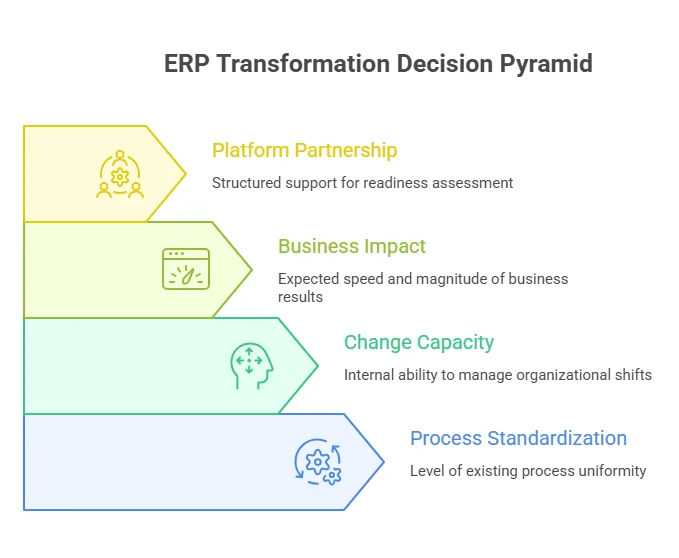
Before cost or migration planning begins, decisions are usually shaped by three factors:
- Level of process standardization already in place
- Internal capacity to manage change
- Expected speed of business impact
In practice, this is the stage where organizations align internally and engage structured advisory support through platform partnership frameworks to assess readiness across business, technical, and operational dimensions.
The SAP ECC Deadline: What Your SAP Vendor May Not Have Told You
SAP ECC 6.0 mainstream maintenance ends on December 31, 2027, after which systems stop receiving standard security patches, compliance updates, and bug fixes.
Organizations that remain on ECC typically move into one of three paths:
- Extended maintenance (until 2030) with higher annual cost increases
- Customer-specific support, which is reactive and limited in scope
- Third-party support providers, which reduce cost but disconnect systems from SAP’s innovation roadmap
Each option increases long-term dependency risk, either through cost, capability loss, or limited modernization.
What does Microsoft Dynamics 365 vs SAP S/4HANA cost in 2026?
Microsoft Dynamics 365 typically costs ~$100K–$4M for implementation with 5-year TCO around ~$2M–$15M, while SAP S/4HANA typically costs ~$500K–$15M+ for implementation with 5-year TCO around ~$10M–$35M+.
Real ERP cost structure (2026 benchmark view)
| Cost Component | Microsoft Dynamics 365 | SAP S/4HANA |
|---|---|---|
| Implementation | $100K – $4M | $500K – $15M+ |
| Licensing (annual per user) | ~$1K – $2.2K | ~$1.8K – $3.6K |
| 5-year TCO | $2M – $15M | $10M – $35M+ |
| Developer Ecosystem | Largest, mature SDKs | Strong .NET / Microsoft integration |
Hidden ERP costs most organizations underestimate
These are the cost drivers that typically push ERP programs over budget:
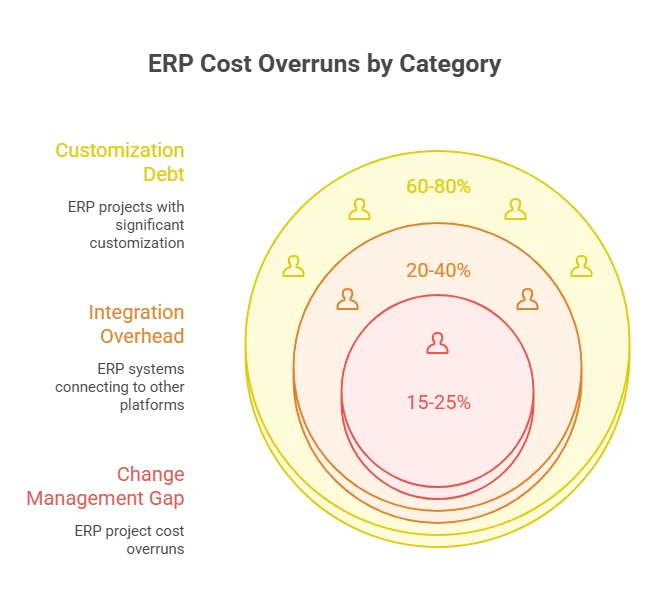
1. Integration overhead (20%–40% of total cost)
ERP systems rarely operate alone. They connect to CRM, BI, HR, supply chain, and data platforms.
- SAP: requires middleware-heavy integration via BTP / Integration Suite
- Dynamics: easier native integration but increases cost when ecosystems fragment
2. Customization debt (60–80% + 30–70% impact)
Customization drives long-term cost more than upfront implementation.
- 60–80% of ERP projects include significant customization
- Heavy customization increases upgrade and maintenance effort
- Impact can materially raise long-term ERP lifecycle costs in complex environments
3. Change management gap (most common failure driver)
Across enterprise ERP programs, this is consistently underfunded:
- Training cost underestimated
- Business process redesign delayed
- User adoption assumed instead of planned
This alone can account for 15%–25% of total project cost overruns.
Key Insight: Why ERP budgets actually overrun?
ERP cost escalation is not random. It follows a predictable pattern:
- SAP overruns → driven by migration + integration complexity
- Dynamics overruns → driven by scope expansion + uncontrolled customization
Understand the True Cost of ERP in 2026
Go beyond licensing—evaluate integration, customization, and long-term ownership cost.
View Cost InsightsThe 2026 AI Gap: Where Dynamics 365 Has a Structural Advantage Over SAP
In 2026, Microsoft Dynamics 365 leads in agentic AI delivery because AI is natively embedded into ERP workflows via Copilot and Power Platform, while SAP S/4HANA relies on SAP BTP and Joule, which introduces additional integration, licensing, and configuration layers.
What Dynamics 365 Wave 1 2026 delivers
Microsoft’s Wave 1 release shifts Dynamics 365 from AI-assisted ERP to AI-executed workflows, where agents act across finance, sales, and operations.
- Finance agents that reconcile accounts, process invoices, and detect anomalies automatically
- Sales agents combining CRM, email, and Teams data to trigger pipeline actions
- Supply chain agents that identify demand signals and initiate procurement workflows
- Business Central agentic ERP enabling natural-language-defined agents via Power Platform and GitHub
- MCP support enabling cross-system agent orchestration
SAP’s AI model in 2026
SAP’s AI strategy centers on Joule and Business Technology Platform (BTP), where AI is powerful but not fully native to ERP execution.
- Joule embedded in S/4HANA Cloud for conversational ERP tasks
- Strong analytics and supply chain intelligence via SAP BTP
- Requires configuration for agentic workflows beyond standard ERP use cases
- Dependent on SAP Business Data Cloud for AI effectiveness
SAP also positions measurable productivity gains:
Why is SAP considered more complex than Dynamics 365, and when does that matter?
SAP is more complex because it supports deeper enterprise processes, more configuration layers, and requires specialized expertise, which increases both implementation time and operational overhead.
Complexity Comparison
| Dimension | Dynamics 365 | SAP S/4HANA |
|---|---|---|
| Learning Curve | Moderate | Steep |
| Customization Approach | Low-code tools | ABAP + advanced config |
| Implementation Layers | Modular | Multi-layered |
| Governance Needs | Moderate | High |
When complexity is justified
SAP complexity makes sense when:
- You operate across multiple countries with compliance needs
- You require deep manufacturing or supply chain control
- You already run SAP (ECC → S/4 continuity)
What are the real migration paths: SAP ECC → S/4HANA vs Legacy ERP → Dynamics 365?
SAP migrations are typically structured but rigid, following predefined conversion models with high technical dependency, while Dynamics 365 migrations are more phased and incremental, especially in Microsoft-aligned environments where adoption can be modular and workload-based.
SAP migration paths (ECC → S/4HANA in real projects)
In most SAP environments, migration is not a single route. It usually follows one of three models, chosen based on cost, timeline, and tolerance for redesign.
1. Brownfield (system conversion)
Preserves existing ECC configuration, data, and custom code.
- Fastest path with lowest disruption
- Retains legacy complexity and technical debt
- Common when timelines are tight or reengineering is not feasible
2. Greenfield (reimplementation)
A full rebuild of the ERP environment with standardized processes.
- Clean architecture and long-term scalability
- High upfront effort and business redesign requirement
- Typically used during major transformation programs, not simple upgrades
3. Selective data transition (hybrid)
Migrates only selected data and processes into S/4HANA.
- Balances redesign and continuity
- High governance and planning complexity
- Often becomes the most difficult model in execution due to scope overlap
Dynamics 365 migration paths (legacy ERP → cloud ERP)
| Migration Path | Typical Approach | Timeline |
|---|---|---|
| NAV → Business Central | Extension-based rebuild of custom logic | 4–9 months |
| GP → Business Central | Phased migration with structured Microsoft tooling | 6–12 months |
| Non-Microsoft ERP | Staged rollout (finance → operations → supply chain) | 9–18 months |
| SAP ECC → Dynamics 365 | Full system and data transformation (in selective cases) | 12–24 months |
In one mid-market manufacturing migration I was involved in, the organization initially scoped SAP S/4HANA brownfield conversion but later shifted to a phased Dynamics 365 rollout. The key driver was the change in absorption capacity. The SAP approach required compressing too many decisions into a single transformation window, while Dynamics allowed finance and operations to go live in separate phases, reducing operational risk.
Why ERP Implementations Fail or Exceed Budgets (SAP vs Dynamics 365 Insights)
ERP implementations fail when organizations replicate legacy processes instead of simplifying them, and when governance cannot keep pace with transformation complexity.
Four recurring failure patterns in ERP programs
Across SAP and Dynamics programs I’ve seen or reviewed, cost overruns rarely come from licensing. They come from scope drift, customization debt, and weak decision ownership once execution begins.
1. Quiet scope creep
Small enhancements accumulate over time and gradually reshape the original system design, leading to rework and budget expansion.
2. Over-customization of standard processes
Teams often rebuild legacy workflows instead of adapting to standard ERP logic, increasing long-term maintenance and upgrade cost.
3. Weak governance during execution
When system integrators dominate decision-making, internal ownership weakens and delivery becomes reactive instead of outcome-driven.
4. Unrealistic delivery timelines
ERP programs are frequently approved with compressed schedules that ignore data readiness, training depth, and process redesign effort.
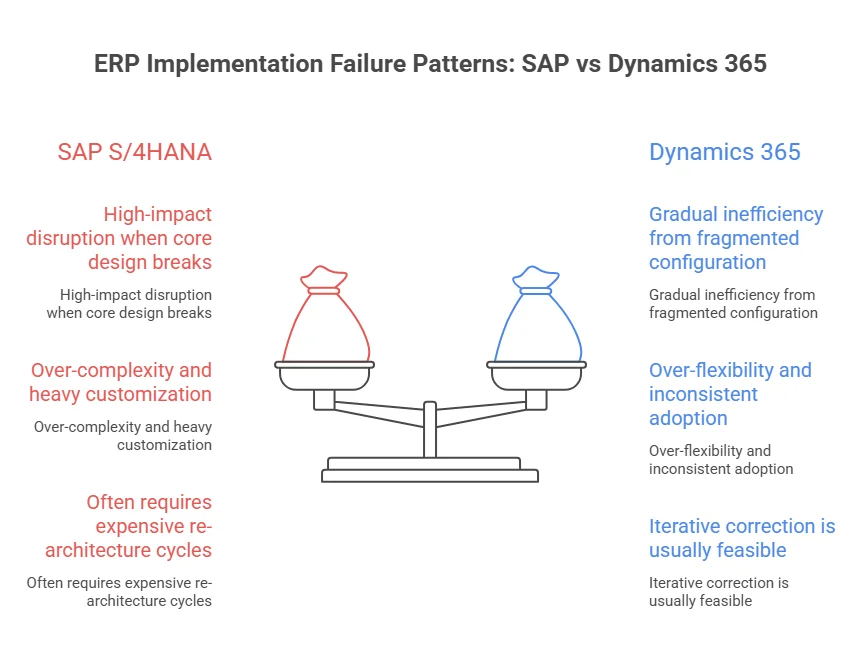
How SAP vs Dynamics failures typically differ
| Aspect | Dynamics 365 | SAP S/4HANA |
|---|---|---|
| Nature of failure | Gradual inefficiency from fragmented configuration | High-impact disruption when core design breaks |
| Primary driver | Over-flexibility and inconsistent adoption | Over-complexity and heavy customization |
| Recovery pattern | Iterative correction is usually feasible | Often requires expensive re-architecture cycles |
Real-world ERP failure signals
These patterns are consistently reflected in independent case studies, litigation records, and consulting analyses.
Is SAP S/4HANA overkill for mid-sized companies compared to Dynamics 365?
In most mid-market cases, SAP S/4HANA is heavier in cost, complexity, and implementation effort than required, while Dynamics 365 better fits faster, modular ERP adoption.
When SAP feels excessive
- Single-region or low regulatory complexity
- Lean or non-SAP IT teams
- Need for fast ROI and shorter deployment
Result: longer timelines, higher consulting cost, stricter processes.
When SAP is justified
- Multi-country, high-compliance operations
- Complex manufacturing or supply chains
- Existing SAP ecosystem already in place
Decision takeaway
- If priority is speed, flexibility, and phased rollout → Dynamics 365
- If priority is global standardization at scale → SAP S/4HANA
Industry Verdicts: Which ERP Fits Best by Sector in 2026?
SAP S/4HANA aligns better with highly regulated, global, and manufacturing-heavy environments, while Microsoft Dynamics 365 fits mid-market, service-led, and fast-scaling businesses needing flexibility and quicker deployment.
However, ERP fit depends on operational complexity, global scale, and process standardization, not a single winner per industry.
| Industry | Better Fit | Why It Wins |
|---|---|---|
| Manufacturing (global, complex) | SAP S/4HANA | Strong MRP II, production planning depth, global process standardization |
| Manufacturing (mid-market, agile) | Dynamics 365 | Faster rollout, modular supply chain, lower TCO and complexity |
| Financial services / fintech | Depends (often SAP / hybrid) | SAP for core banking complexity; Dynamics for mid-tier finance + faster compliance workflows |
| Logistics & distribution | Dynamics 365 | Strong warehouse + transport integrations within Microsoft ecosystem |
| Professional services | Dynamics 365 | Project-centric ERP (Project Operations + CRM + Teams integration) |
| Retail & commerce | Dynamics 365 | Unified commerce + customer data + faster digital rollout |
| Multi-country enterprise (highly regulated) | SAP S/4HANA | Strongest fit for global standardization, compliance, and governance |
Which ERP integrates better with modern cloud ecosystems, DevOps, and data platforms?
Microsoft Dynamics 365 integrates more easily with modern cloud and DevOps environments, while SAP S/4HANA is better suited for complex, multi-system enterprise integrations.
Integration strength depends less on raw capability and more on ecosystem alignment.
Microsoft Dynamics 365 ecosystem (Azure-native approach)
- Works tightly with Microsoft cloud stack (Azure, Entra ID, Power Platform)
- Data flows through Dataverse and Power BI with minimal friction
- Strong alignment with low-code automation via Power Automate
- Easier integration for teams already using Microsoft 365
In practice, this reduces the “integration tax”, meaning fewer custom middleware layers and faster deployment cycles.
SAP S/4HANA ecosystem (platform-centric integration)
- Built around SAP Business Technology Platform (BTP)
- Strong enterprise-grade integration via SAP Integration Suite
- Designed for hybrid landscapes (SAP + non-SAP + legacy systems)
- Highly capable in multi-vendor enterprise environments
Where SAP stands out is in large-scale orchestration, not simplicity.
What do developers and ERP consultants actually say about SAP vs Dynamics?
Community sentiment consistently shows SAP as more powerful but heavier to operate, while Dynamics is seen as more flexible but easier to misconfigure if governance is weak.
SAP is not difficult because it lacks tools; it’s difficult because it governs everything. Every decision connects to four others. That depth is its power and its problem. — r/SAP practitioner thread
Dynamics 365 issues are usually implementation and governance-driven, not platform-driven, with strong value emerging when properly configured. — r/Dynamics365 community thread
These community signals map to implementation reality: SAP complexity is front-loaded and visible; Dynamics complexity is back-loaded and often invisible until governance fails.
Neither is inherently safer; both require deliberate organizational investment to succeed.
Enterprise ERP Decision Framework: How Companies Actually Choose in 2026
ERP selection in 2026 is driven by four core filters: cost tolerance, operational complexity, internal capability, and time-to-value.
Step 1: Cost & risk appetite
- Lean, budget-sensitive programs → Dynamics 365
- High-investment transformation programs → SAP S/4HANA
(This reflects risk tolerance for long transformation cycles, not just licensing cost.)
Step 2: Operational complexity
- Standardized finance and supply chain → Dynamics 365 is usually sufficient
- Multi-country, compliance-heavy operations → SAP fits naturally
Step 3: Internal capability
- Microsoft-skilled teams (Azure, M365, Power Platform) → Dynamics reduces friction
- Established SAP teams and governance → SAP continuity is more efficient
Step 4: Time-to-value expectation
- 6–12 months ROI expectation → Dynamics 365
- 18–36+ month transformation horizon → SAP S/4HANA
Final Decision Logic
- SAP fits when scale, compliance, and long transformation cycles are acceptable trade-offs for structural control
- Dynamics 365 fits when speed, modular adoption, and lower operational friction are the priority.
Final Verdict: Which ERP is better for your business in 2026?
If you compress the entire SAP vs Dynamics decision into one lens, it comes down to how your organization manages complexity vs speed of change.
SAP S/4HANA fits organizations where complexity is the operating model: multi-country operations, strict compliance environments, and long transformation cycles where deep process standardization is required.
Microsoft Dynamics 365 fits organizations where agility is the operating model; faster rollout expectations, modular adoption, and a need to scale without heavy transformation overhead.
The most common mistake is not choosing the “wrong ERP,” but underestimating internal change capacity; how much disruption teams, processes, and leadership can realistically absorb without slowing execution.
Plan Your ERP Strategy with Confidence
Get expert guidance on SAP vs Dynamics 365 to choose the right path for cost, migration, and long-term scalability.
Talk to Microsoft ERP Experts