

















 ChatGPT
 Perplexity
 Google AI
The real question is not whether to build an MVP. It is how to approach MVP development in a manner that it creates evidence quickly without locking the team into the wrong scope, architecture, or budget.
This guide breaks down the process, cost logic, timeline expectations, AI considerations, and launch metrics that make an MVP investment defensible.
TL;DR
How to Build an MVP?
- Define the Problem & Target Audience: Identify the problem you’re solving and your target audience’s pain points.
- Analyze Competitors: Research existing solutions to find your unique value proposition.
- Define Core Features (Scope Down): Focus on the essential features that solve the problem, cutting anything unnecessary.
- Create Wireframes/Prototypes: Design simple user flows to visualize the solution before development.
- Build the MVP (No-Code/Code): Use no-code tools (e.g., Bubble, Webflow) or rapid development to focus on speed over perfection.
- Launch and Gather Feedback: Release to early adopters, track user behavior, and gather feedback.
- Iterate: Continuously improve based on data and user insights.
MVP Strategies
- Wizard of Oz (Human Automation): Simulate automation manually behind the scenes to test demand without building complex systems.
- Landing Page/Concierge MVP: Use a landing page to gather interest through signups or manually serve the first customers.
Key Tips for Success:
- Focus on Learning, Not Perfection: Prioritize learning over building a flawless product.
- Set Strict Deadlines: Limit development to 1-2 weeks to avoid overbuilding.
- Avoid Overbuilding: Skip complex features like authentication or dashboards initially.
- Measure Value: Use analytics tools (e.g., Google Analytics) to track user engagement and guide iterations.
What Should An MVP Actually Prove Before You Build It?
An MVP is not just a smaller version of the final product.
For decision-makers, a viable MVP should answer a short list of questions:
- Will a clearly defined user adopt the solution?
- Does the product solve an urgent enough problem to change behavior?
- Can the team deliver and support the first version with the resources available?
- Is there evidence of a path towards the app making money, retention, revenue, or operational value?
How Do You Decide What Goes Into An MVP And What Stays Out?
The hardest part of MVP planning is not feature selection. It is choosing what not to build yet.
A practical scoping framework looks like this:
1. Start with the Business Problem, Not the Feature List
Define the commercial or operational outcome first.
For Example:
- Reduce manual claims handling time by 40%
- Help warehouse managers spot delayed shipments faster
- Let independent therapists fill cancellations inside 24 hours
2. Choose One User Segment
Do not design for all users. Design for the earliest user group with the clearest pain and the shortest path to adoption.
3. Define One Core Workflow
A good MVP usually centers on one workflow, such as:
- submit request → receive result
- upload file → get analysis
- create listing → get booking inquiry
4. Separate Must-Have from Nice-To-Have
Use a ruthless filter:
- Does this feature directly support the main job?
- Is it necessary for first-user adoption?
- Will removing it prevent us from learning something essential?
If the answer is no, cut it.
5. Prioritize For Time-To-Value
The fastest MVPs are not always the ones with the fewest screens. They are the ones that get users to their first wow moment quickly. That is why rare but useful planning concepts like thin slice, time-to-value, and growth engine are more helpful than generic feature prioritization.
A useful rule for both startups and enterprises, weather you’ve partnered with a mobile app development company or still exploring, is this: if the first version needs multiple personas, multiple approval layers, or multiple platforms to work, it is probably not an MVP yet.
How Do You Build An MVP Step By Step?
The most reliable MVP builds follow a short learning loop rather than a long development cycle.
Step 1: Define the Riskiest Assumption
Every MVP should test a clear hypothesis.
For Example:
- Users will upload bank statements to get an instant lending recommendation.
- Clinic managers will pay to automate appointment reminders.
- Field technicians will use AI summaries instead of writing full visit notes.
- The testable assumption should connect to user behavior, not internal optimism.
Step 2: Validate Demand before Full Development
Before code-heavy work begins, test demand with low-cost signals:
- landing pages
- waitlists
- demo videos
- clickable prototypes
- fake-door tests
- concierge delivery
This matters because some MVPs should begin with a manual or semi-manual workflow. Product School’s examples of fake-door, concierge, single-feature, and piecemeal MVPs are a good reminder that the right MVP format depends on what you need to learn first.
Step 3: Scope the Thin Slice
Once demand is plausible, define the smallest end-to-end experience that lets a user complete the core job. For a software MVP, that usually means:
- one role
- one platform
- one workflow
- one success metric
- only the minimum integrations needed to make the workflow usable
This is where many teams overbuild. They design future-state architecture too early, add dashboard layers nobody needs yet, or spend time on advanced permissions before confirming baseline usage.
Step 4: Build For Learning, Not Polish
Y Combinator’s Michael Seibel is especially direct here: for most startups, an MVP should be built in weeks, not months, and sometimes the first version can be as simple as a landing page and spreadsheet if that is enough to start learning.
That does not mean quality is optional. It means the team should optimize for:
- stable core workflow
- enough UX clarity to complete the job
- instrumentation from day one
- fast iteration after launch
Step 5: Beta with a Narrow User Group
A small beta beats a broad launch. Pick users who:
- feel the pain acutely
- are willing to give feedback
- represent the initial commercial opportunity
At this stage, qualitative interviews matter as much as analytics. You need to hear where users hesitate, what they misunderstand, and what they try to do that the product does not yet support.
Step 6: Measure and Decide
The Lean Startup method frames this as build-measure-learn. The MVP is only valuable if it gives the team enough evidence to tune, expand, pivot, or stop.
The post-launch decision should be explicit:
- Persevere if adoption and value signals are strengthening
- Refine if the user problem is right but the workflow is weak
- Pivot if the problem, segment, or delivery model is off
Need help narrowing the right MVP scope?
Turn stakeholder ideas into a buildable first release, a feature cut list, and a decision-ready roadmap.
How Much Does It Cost To Build An MVP And How Long Does It Take?
There is no credible fixed mobile app development cost for an MVP, because the budget depends on what you are actually trying to prove. Still, decision-makers need a planning frame.
For a true MVP, the goal is to stay near the lower end of that spectrum by controlling the following drivers:
What Increases MVP Cost
- Multiple user roles
- Native iOS and Android from day one
- Complex integrations
- Compliance-heavy data handling
- Custom admin systems
- AI features without clear evaluation criteria
- Premature scalability work
What Keeps MVP Cost under Control
- One platform first
- One user segment
- One core workflow
- Limited integrations
- Reuse of proven components
- Feature flags for staged rollout
- Manual back-office support where acceptable
A Practical Timeline Rule
If the first release cannot be described as a narrow build that launches in a matter of weeks, scope is likely still too large. Y Combinator’s advice to build in weeks, not months, is a good test of whether the product is truly minimal.
For CFOs, the better question is often not What will this cost? But, what evidence will this spend buy us? A well-scoped MVP should reduce uncertainty around demand, usability, conversion, retention, or delivery risk.
Want a clearer budget before approving the build?
Map scope, platform choice, integrations, and delivery model into a realistic MVP investment range.
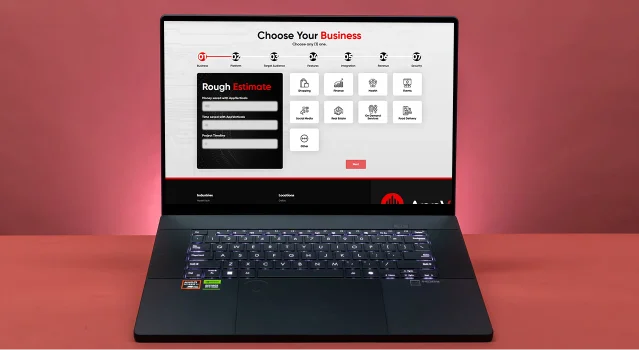
Calculate Your MVP Cost
How Do Startups And Enterprises Build An MVP With AI Without Adding Unnecessary Risk?
AI development can accelerate research, prototyping, coding assistance, and product capability. But adding AI does not automatically make the MVP better.
Google Cloud’s guidance is useful here: teams should validate whether an AI-powered product is even the right solution before productionizing it, and should prototype both the user experience and the model behavior before committing to a full build.
Their framework emphasizes user-centered strategy, clickable prototypes, model prototypes, and integration into an MVP only after business and user value are clear.
A strong AI MVP follows five rules:
1. Prove the Workflow, Not Just the Model
Users do not buy a model. They buy a better outcome:
- faster triage
- clearer summaries
- better recommendations
- fewer manual steps
2. Keep the AI Surface Area Narrow
Start with one AI-enabled task:
- summarize a document
- classify a ticket
- draft a follow-up
- recommend the next action
3. Add Guardrails Early
For AI MVPs, minimum viability includes:
- output validation
- privacy and access controls
- fallback behavior when confidence is low
- logging and monitoring
4. Test with Real Users, Not Internal Enthusiasm
Product School’s AI MVP playbook recommends defining the problem and success metric first, validating with AI-assisted research, prototyping the experience, building a thin slice, adding AI safely, then testing and iterating with real users.
5. Separate AI Novelty from Business Value
If the same user outcome can be delivered faster and more reliably without AI, that is often the better MVP.
For mobile app startups, AI can compress early work. For enterprises, AI raises additional requirements around governance, security, traceability, and operational ownership. In both cases, the principle is the same: start with the smallest useful AI behavior, not the biggest model ambition.
Exploring an AI-enabled MVP?
Validate use case fit, guardrails, and technical feasibility before your team commits to model integration.
How Do You Know Whether Your MVP Is Working After Launch?
The right MVP metrics depend on the business model, but the first dashboard should usually answer four questions:
- Are users reaching activation? Do they complete the first meaningful action?
- Are they coming back? Retention is a stronger signal than raw signups.
- Is time-to-value short enough? Can users get to the outcome quickly, or are they stalling?
- Are they willing to change behavior or pay?
That may look like repeat usage, pilot expansion, conversion, or internal adoption.
Progress is not measured by the amount of software produced. It is measured by validated learning and whether the evidence supports continuing on the current path.
A Decision Checklist after Launch:
- Keep building if users adopt and the value signal is strengthening
- Rework onboarding if users sign up but do not activate
- Re-scope the offer if usage is shallow
- Pivot if the problem is not compelling enough
What Are The Most Common Mistakes Teams Make When Building An MVP?
The most common failure pattern is feature bloat. Teams start with a simple test, then add edge cases, dashboards, roles, integrations, and automation until the MVP becomes a delayed version of the full product.
Other repeat mistakes include:
- targeting too many user segments at once
- solving a mild problem instead of an urgent one
- measuring output instead of user behavior
- treating an internal prototype as market validation
- adding AI because it sounds strategic, not because it improves the workflow
- skipping feedback loops and instrumentation
Poor product-market fit remains one of the biggest reasons companies fail, which is why overbuilding before evidence is so expensive.
Conclusion: Next Steps for Building an MVP
Building a successful MVP is a strategic move for any startup or business aiming to reduce risks and validate product-market fit early on. The key lies in focusing on the most essential features that serve the target audience, gathering data, and learning quickly from real market responses.
As you plan your MVP, ensure that it doesn’t overcommit resources to untested ideas but provides enough substance to gauge customer interest and pain points. Focus on agility, continuous iteration, and use feedback to refine your vision into a fully realized product.
For CTOs, CFOs, and founders aiming to develop an MVP, the next steps should include:
- Defining clear, testable hypotheses around your product’s core value proposition.
- Selecting a development team that can work with speed without compromising quality.
- Setting measurable metrics for validation (e.g., user acquisition, retention, engagement).
- Preparing for rapid iteration based on feedback and maintaining flexibility in your roadmap.
By following these strategies, your MVP will not only help you build a market-fit product but will also allow you to pivot quickly if necessary, ensuring long-term success.