Choosing between in-house and outsourcing software development in 2026 comes down to one thing: building the right product without slowing down growth or overspending.
From what I’ve seen working with teams scaling digital products, hiring locally is getting harder and more expensive. In the US alone, the average software developer salary has crossed $120,000 per year , while global talent gaps are expected to reach 85 million unfilled tech roles by 2030.
That’s why many businesses are turning to outsourcing or flexible custom software development services to stay competitive without long hiring cycles.
The real question is not which model is better, but which one aligns with your product goals, speed requirements, and long-term control.
This guide helps you evaluate both approaches based on cost, control, scalability, and risk so you can make a decision that actually supports your product growth.
In-House vs Outsourcing Software Development at a Glance
- In-house software development is ideal for core product/IP, long-term roadmap, security-sensitive systems.
- Average US developer cost: $120k/year + ~31% benefits → ~$157k total/year.
- Pros: full control, institutional knowledge, stronger internal tech culture.
- Cons: slow hiring (40–60 days), high fixed costs, difficult to scale quickly.
- Outsourcing software development is ideal for MVPs, startups with limited budget, specialized tech (AI, blockchain, cloud), short-term projects.
- Typical cost: $25–$60/hour → ~$50k–$120k/year per developer (variable).
- Pros: fast start (days, not months), access to global talent, scalable, converts fixed costs into variable.
- Cons: coordination risks, vendor dependency, IP/security management required.
- In-house = depth, long-term ownership, control.
- Outsourcing = speed, flexibility, access to specialized skills.
- The right choice depends on product stage, speed requirements, and cost constraints.
- Hybrid models exist, but they complement these approaches rather than replace the decision between in-house and outsourcing.
What Is In-House vs Outsourcing Software Development?
In-house software development means building and managing your product with an internal team of developers, designers, and engineers who work directly within your company. This approach gives you full control over processes, communication, and long-term product direction.
Outsourcing software development involves partnering with an external company or hiring remote teams to build your product. These teams can deliver custom software development services based on your requirements, timelines, and budget without the need to hire internally.
When companies choose each:
- In-house is preferred when long-term product ownership, data control, and deep internal alignment are critical
- Outsourcing is chosen when speed, cost-efficiency, and access to specialized expertise are the priority
Should You Outsource Software Development or Build In-House in 2026?
The real decision comes down to where your product is today and what it needs next: speed or control.
If you are trying to validate an idea, launch faster, or scale delivery without slowing down, outsourcing software development gives you immediate execution.
If your product is tightly tied to your business logic, evolving architecture, or long-term differentiation, building in-house becomes essential. The mistake most teams make is choosing based on comfort instead of timing.
What works in practice is not choosing one model, but aligning the model with the stage of the product.
What Your Decision Should Depend On
- Budget
In-house hiring includes salaries, benefits, and infrastructure, while outsourcing offers variable and often lower operational costs
- Time-to-Market
Outsourcing allows immediate access to ready teams, reducing delays caused by hiring and onboarding
- Project Complexity
Highly complex or IP-sensitive systems often benefit from in-house control, while well-defined projects can be outsourced efficiently
- Long-Term vs Short-Term Goals
Long-term product ownership favors in-house, while short-term builds or rapid scaling align better with outsourcing
Quick Decision Snapshot
| Scenario |
Best Approach |
| Startup / MVP |
Outsourcing |
| Enterprise with ongoing roadmap |
In-house or hybrid |
| Urgent scaling |
Outsourcing |
| Core IP-sensitive product |
In-house |
Remember!
The most effective approach in 2026 is rarely one or the other. Companies that balance in-house control with outsourced execution tend to move faster while maintaining product stability.
What are the Key Differences Between In-House and Outsourcing Software Development
I’ve worked with teams that tried both models, and the difference rarely shows up in theory. It shows up in how fast you ship, how much you spend over time, and how much control you actually need day to day.
Most comparisons oversimplify this. In reality, each factor below directly affects delivery outcomes, not just structure.
Key Differences That Actually Impact Delivery
| Factor |
In-House |
Outsourcing |
| Cost |
High fixed investment |
Flexible, variable spend |
| Control |
Full ownership |
Structured, shared control |
| Speed |
Slowed by hiring cycles |
Immediate execution |
| Scalability |
Hiring-dependent |
On-demand scaling |
| Expertise |
Limited internally |
Access to global specialists |
What I’ve Learned From Real Projects
Cost is where most teams underestimate in-house
When you build in-house, you’re not just paying salaries. Benefits, retention, and overhead push total compensation significantly higher. In the US, benefits alone account for about 31% of total compensation costs. That changes how you think about long-term team size versus flexible external support.
Speed is where outsourcing consistently wins early-stage
Every time a team delays hiring, the product roadmap shifts. Open roles stay unfilled for weeks, sometimes months, and that delay compounds. Outsourcing removes that waiting time. You’re not starting from zero, you’re plugging into an already functioning team.
Control sounds great until it slows you down
In-house gives you full control, but it also means you own every bottleneck. Decision-making, reviews, and dependencies all sit internally. With outsourcing, control doesn’t disappear, it just shifts into process, contracts, and communication clarity.
Scalability is the breaking point for most in-house teams
Hiring doesn’t scale linearly. One good developer can take weeks to find, and ramp-up takes even longer. Outsourcing lets you increase or reduce team size based on actual workload, which is critical when priorities change mid-cycle.
Expertise is no longer about who you can hire locally
The biggest shift I’ve seen is this: teams don’t build everything in-house anymore. If you need AI, cloud migration, or cross-platform expertise, outsourcing through custom software development services gives you access to specialists without building that capability from scratch.
If I had to simplify it:
In-house gives you depth and long-term ownership. Outsourcing gives you speed and execution leverage. The real advantage comes from knowing when to use each, not choosing one blindly.
Pros and Cons of In-House Development
In-house development works well when the product is deeply tied to your business and requires ongoing ownership. But it also comes with operational pressure that most teams only realize after committing to it. The advantages are real, but they demand time, hiring consistency, and long-term investment to fully pay off.
Pros of In-House Development
In-house teams perform best when speed of decision-making, product understanding, and long-term continuity matter more than short-term flexibility.
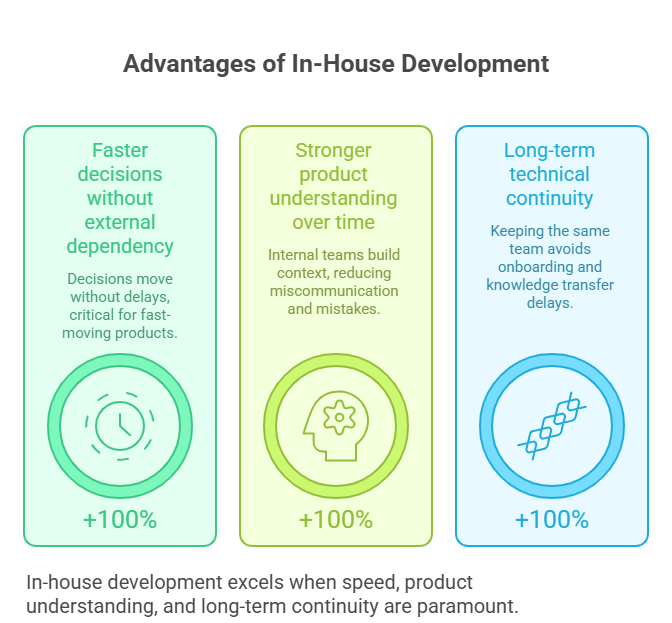
Faster decisions without external dependency
When teams sit internally, decisions move without delays. There’s no dependency on external communication loops or approval cycles. This becomes critical in fast-moving products where priorities shift frequently.
Stronger product understanding over time
Internal teams build context around the product, users, and technical decisions. That reduces miscommunication and prevents repeated mistakes.
According to Science Direct, developers with higher familiarity with their codebase report significantly better efficiency, which is a direct outcome of long-term in-house continuity.
Long-term technical continuity
As systems evolve, complexity increases. Keeping the same team close to the product avoids repeated onboarding and knowledge transfer delays.
Developers spend a significant portion of time understanding systems and fixing technical debt, which becomes easier when continuity is maintained internally.
Cons of In-House Development
While in-house gives control, it also introduces constraints around hiring, scaling, and cost structure that can slow teams down if not planned properly.
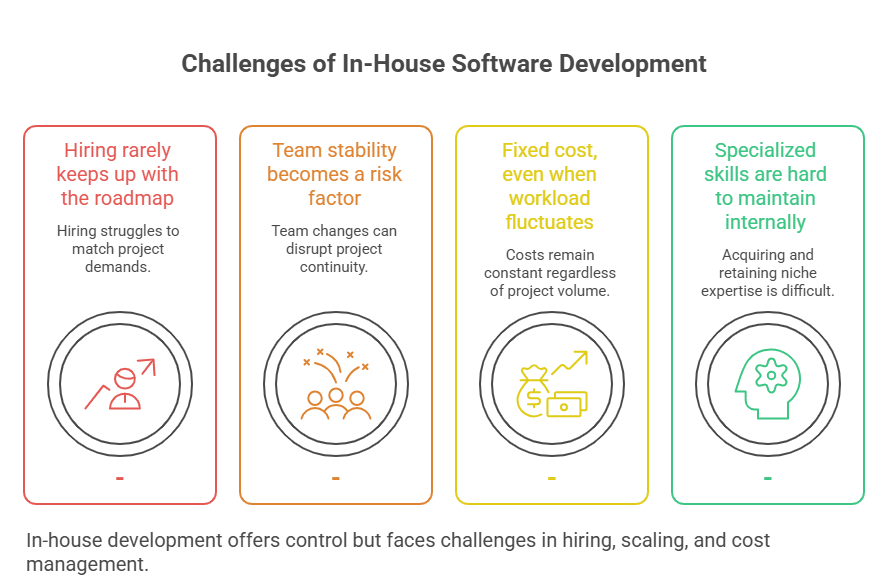
Hiring rarely keeps up with the roadmap
Even well-funded teams struggle to hire at the pace their roadmap demands. Open roles stay unfilled longer than expected, slowing delivery.
According to Deloitte, software engineering roles are among the hardest to fill globally, which is why hiring delays are common.
Team stability becomes a risk factor
When a key developer leaves, system knowledge leaves with them. Rebuilding that context takes time and affects delivery momentum.
Data from shows consistent turnover across professional roles, reinforcing that retention is an ongoing challenge.
Fixed cost, even when workload fluctuates
In-house teams require consistent investment, even when development needs slow down.
According to , benefits and overhead form a significant portion of total employee compensation, increasing long-term cost commitments.
Specialized skills are hard to maintain internally
Modern applications require niche expertise such as AI, cloud, or security, which may not be needed full-time.
A report by highlights growing demand for specialized roles, making it difficult for a single in-house team to cover all needs efficiently.
Pros and Cons of Outsourcing Software Development
Outsourcing software development has moved far beyond cost savings. In 2026, companies outsource to move faster, access specialized talent, and scale product development without building large internal teams. But outsourcing also introduces communication, security, and dependency risks that teams need to manage properly.
The companies that benefit from outsourcing are not the ones that outsource everything. They are the ones that outsource strategically.
Pros of Outsourcing Software Development
Outsourcing teams perform best when companies need faster execution, flexible scaling, and access to global technical expertise without long hiring cycles.
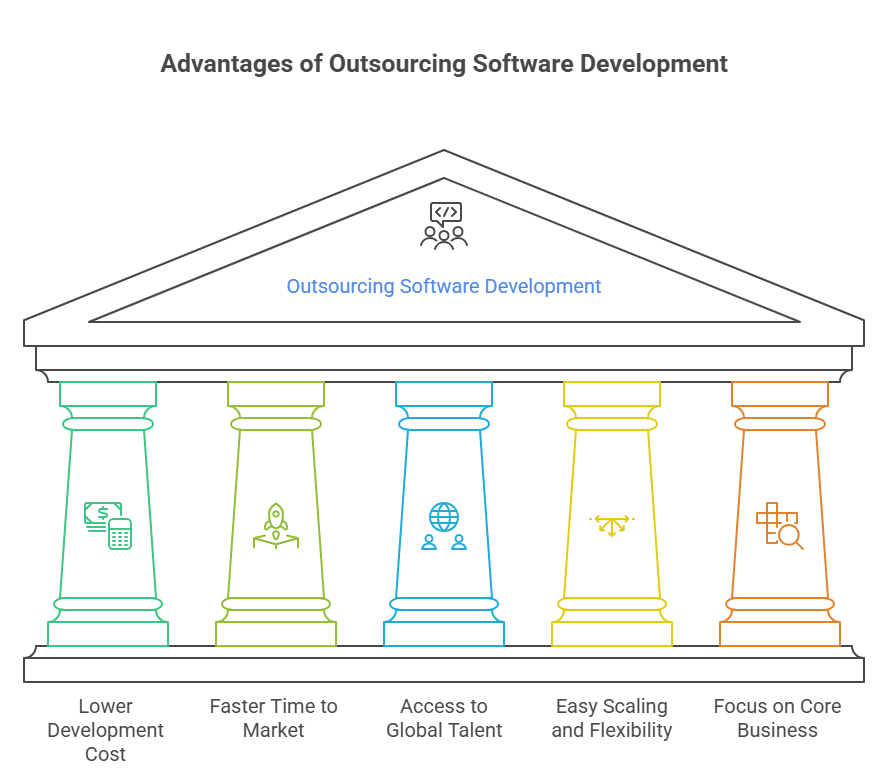
Lower Development Cost
The biggest advantage I’ve seen with outsourcing is speed. Hiring developers internally can take weeks or months, and onboarding adds additional delays before development actually starts.
According to Glencoyne, the total cost of an in-house developer can be 1.25x to 1.4x their base salary when benefits and overhead are included.
Outsourcing converts these fixed costs into variable costs, meaning companies only pay for development when work is being done.
Faster Time to Market
Speed is where outsourcing usually creates the biggest competitive advantage.
Hiring internally can take 4 to 12 weeks for technical roles, and onboarding can take another 4 to 8 weeks before a developer becomes fully productive. That means a company may lose 2–4 months before development even starts.
Outsourcing removes most of this delay because development teams are already assembled and experienced in working together. Projects can often start within days instead of months.
For companies launching startups, SaaS products, or mobile apps, this speed difference can determine whether they enter the market early or late.
Access to Global Talent
One major reason software development outsourcing continues to grow is the global developer shortage.
Industry reports estimate that the global talent shortage could reach tens of millions of unfilled tech roles by 2030, which means many companies simply cannot hire all the talent they need locally.
Modern software products rarely require just one type of developer. Projects often need cloud engineers, mobile developers, UI/UX designers, DevOps engineers, security specialists, and sometimes AI or data engineers.
Instead of hiring all these specialists in-house, companies can bring them into projects only when needed.
Easy Scaling and Flexibility
Scaling an in-house team is slow because hiring takes time and training takes even longer. Outsourcing teams can usually scale much faster because vendors already have developers available or can allocate additional resources quickly.
This flexibility allows companies to align development cost with actual product workload instead of maintaining a large permanent team.
Focus on Core Business
When companies rely only on in-house hiring, project timelines often depend on how quickly positions are filled. If hiring is delayed, product development is delayed.
Outsourcing reduces this dependency on hiring timelines and allows companies to plan development schedules more predictably. This improves overall business productivity and leadership focus.
Accelerate Your Product Growth with the Right Development Model
Not sure whether to go in-house, outsource, or adopt a hybrid approach? Our experts can help you design a strategy that balances speed, cost, and control.
Get a Free Consultation
Cons of Outsourcing Software Development
While outsourcing provides speed and flexibility, it also introduces coordination and management challenges that companies do not face with fully in-house teams.
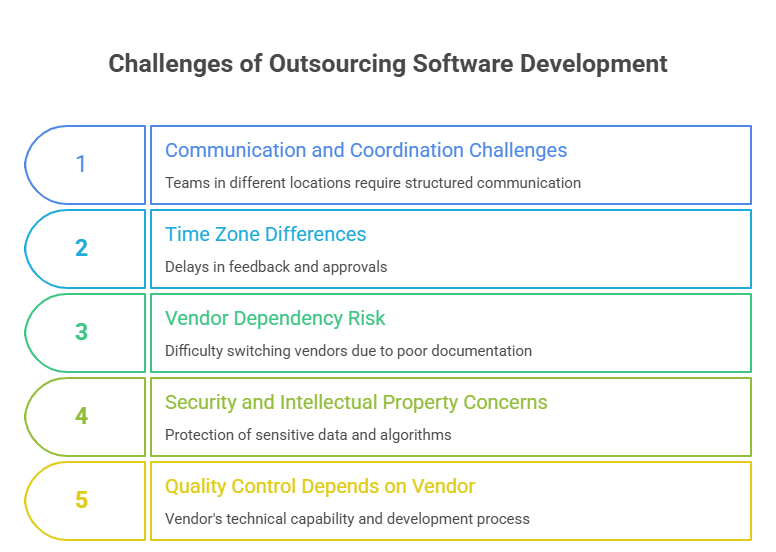
Communication and coordination challenges
The most common outsourcing challenge is communication. When teams are not working in the same office, communication must be structured through documentation, project management tools, and regular meetings. If requirements are unclear or communication is inconsistent, outsourcing projects can slow down quickly.
Research on hiring and project workflows shows that long hiring and coordination processes often lead to delays and candidate or project drop-offs.
Time zone differences can slow feedback cycles
Working across time zones can sometimes delay feedback, approvals, and requirement clarification. Even small delays in feedback can slow development cycles when they happen repeatedly across sprints.
Vendor dependency risk
Another risk in outsourcing is becoming too dependent on an external development partner. If documentation is poor, knowledge is not transferred, or the vendor controls all infrastructure and code repositories, switching vendors later becomes very difficult.
Security and intellectual property concerns
Security and intellectual property protection are important considerations when outsourcing software development, especially for products involving sensitive data, proprietary algorithms, or enterprise systems.
Companies need clear contracts, non-disclosure agreements, access control policies, and defined ownership of code and infrastructure before starting outsourced development.
Quality control depends heavily on the vendor
Quality problems in outsourcing usually come from choosing vendors based only on cost instead of technical capability and development process.
Poor documentation, lack of testing, and weak architecture decisions can create long-term technical debt that becomes expensive later.
What are the Software Development Outsourcing Models
Choosing the right outsourcing model determines how fast your product ships, how much it costs, and how much control you retain. Each model is a strategic lever for your business.
1. Staff Augmentation: When You Need Skills Fast
Staff augmentation works when your internal team is strong but cannot meet immediate deadlines. You plug in experts temporarily to fill gaps without hiring long-term.
Deloitte reports 50% of companies struggle to hire specialized developers, making this model the fastest way to prevent roadmap delays.
From experience, executives underestimate the management effort required: augmented staff perform best when fully integrated into your internal processes, not siloed.
2. Dedicated Development Team: For Long-Term Continuity
A dedicated team is for multi-year projects where continuity and product knowledge matter.
In my experience, the real benefit is retaining institutional knowledge externally, so decisions don’t bottleneck when internal teams shift priorities.
3. Project-Based Outsourcing: When Scope Is Clear
Project-based outsourcing is ideal when deliverables are well-defined and unlikely to change mid-way. 67% of IT projects fail due to unclear requirements.
I’ve advised multiple C-level clients to use this model only for discrete, time-boxed initiatives, like MVPs or isolated features, anything evolving will introduce hidden costs and risk delays.
4. Offshore Development: For Cost-Efficient Scale
Offshore development accelerates scale while reducing costs.
Statista reports approx 50% of companies offshore to reduce software costs. From a strategic standpoint, offshore works best when process discipline and clear KPIs are in place; without them, distance and time zones amplify risk.
5. Nearshore Development: Agile Without Delay
Nearshore teams deliver faster iteration because they overlap work hours and reduce communication friction. I advise using this model when speed and adaptability outweigh cost savings. It’s particularly effective for rapidly changing product roadmaps.
6. Onshore Development: For High-Risk or Regulated Projects
Onshore outsourcing prioritizes compliance, IP security, and regulatory alignment.
In practice, this model is not about cost-efficiency; it’s about strategic control and legal certainty. Use it selectively for products where errors or breaches carry major financial or reputational risk.
Comparison Table of Software Development Outsourcing Models
| Model |
Best For |
Control |
Cost |
Flexibility |
| Staff Augmentation |
Immediate skill gaps |
High |
Moderate |
High |
| Dedicated Development Team |
Multi-year complex projects |
Moderate-High |
Moderate |
Moderate |
| Project-Based Outsourcing |
Clear, fixed-scope projects |
Low-Moderate |
Fixed |
Low |
| Offshore Development |
Large-scale projects, cost optimization |
Moderate |
Low |
High |
| Nearshore Development |
Agile, fast iteration |
Moderate |
Moderate |
High |
| Onshore Development |
Regulated/high-risk projects |
High |
High |
Moderate |
In-House vs Outsourcing Cost Comparison in 2026
When evaluating outsourcing software development, the key question is: Which model delivers the best ROI while meeting your product timelines and quality standards?
1. Salary vs Hourly Outsourcing
An in-house developer in the US costs $120,000 per year on average. Outsourcing developers, depending on region and expertise, typically range $25–$60 per hour.
For a 2,000-hour yearly workload, outsourcing can cost $50,000–$120,000, effectively matching or undercutting in-house costs while providing flexibility.
The strategic insight: outsourcing allows you to scale hours up or down, avoiding idle payroll, whereas in-house teams require fixed salary commitments regardless of workload.
2. Hidden Costs
In-house teams carry hidden costs beyond salary: benefits, payroll taxes, health insurance, and retention programs. In the US, benefits alone add ~31% to total compensation. Recruiting, onboarding, and replacing staff further increase the total investment.
Outsourcing reduces these hidden costs since contracts often include all operational overhead, but you must account for vendor management time and potential quality risk.
3. Infrastructure
An internal team requires office space, collaboration tools, hardware, and software licenses. Annual infrastructure costs per developer can easily reach $10,000–$15,000.
Outsourced teams usually provide their own infrastructure, letting you avoid upfront capital expenditures.
4. Recruitment and Training
Hiring in-house involves posting jobs, screening, interviewing, and onboarding, average US developer recruitment takes 40–60 days.
Training also costs both time and money. Outsourced developers arrive with ready-to-go expertise, often reducing ramp-up time to less than two weeks.
5. Long-Term Cost Comparison
Over three years, a single in-house developer may cost:
- Base salary: $120k × 3 = $360k
- Benefits (31%): ~$112k
- Infrastructure, tools, training: ~$30k
- Total: ~$502k
Compare with an outsourced developer billed $40/hour for 2,000 hours/year × 3 years = $240k, including infrastructure. Even with occasional management overhead, outsourcing can save 40–50% in total cost, while providing flexibility to scale team size based on project needs.
When Should You Successfully Outsource Software Development?
You should consider outsourcing software development whenever it delivers speed, specialized skills, or cost efficiency without compromising product quality. The key is aligning outsourcing with your product’s stage and strategic goals.
1. Building an MVP
Outsourcing is ideal when launching a Minimum Viable Product. Experienced external teams can turn concepts into functional prototypes 2–3x faster than in-house teams still recruiting and ramping up.
This allows executives to validate the market quickly without committing long-term resources.
2. Startups With Limited Budget
For startups, hiring full-time engineers is often cost-prohibitive. Outsourcing developers at $25–$60/hour lets you build and iterate without carrying fixed payroll or benefits overhead, while still accessing top-tier talent globally.
This approach keeps burn rates lower and runway longer, critical for early-stage companies.
3. Need Specialized Tech (AI, Blockchain, Cloud)
Modern software increasingly requires niche expertise. Outsourcing gives you immediate access to specialists in AI, blockchain, cloud, or cybersecurity without the multi-month hiring cycles.
Attempting to build such expertise in-house often results in skills gaps and delayed timelines.
4. Short-Term Projects
Projects with a defined, limited scope, such as building a new module, integrating third-party services, or testing a new feature, are perfect for outsourcing.
It avoids long-term employment commitments while achieving results with specialized skillsets.
When In-House Development Is the Better Choice
In-house development is the right choice when control, continuity, and long-term strategic ownership outweigh cost or immediate speed. Choosing the wrong model here can lead to IP risk, technical debt, or slowed innovation.
1. Core Product or Intellectual Property
When your product is the central differentiator of your business, keeping development in-house ensures full control over proprietary algorithms, architecture, and sensitive features. According to PwC, more than 50% of executives list IP protection as the top factor in sourcing decisions.
Outsourcing core IP can introduce leakage risk or legal exposure if contracts and processes are not airtight.
2. Long-Term Product Roadmap
If your product evolves continuously over years, an in-house team builds and retains institutional knowledge, reducing repeated onboarding and misalignment.
Research shows developers familiar with the codebase complete tasks up to 20% faster than new hires or external teams.
For C-suite leaders, this translates into predictable delivery and reduced operational friction.
3. Security-Sensitive Systems
For products handling sensitive data, like healthcare, finance, or regulated industries, keeping development internal ensures compliance and minimizes exposure to third-party breaches.
This level of control is hard to replicate with outsourced teams, even with strict contracts.
4. Continuous Product Iteration
Products that require constant updates, experimentation, and iterative improvements benefit from an internal team fully immersed in the business context.
External teams can execute sprints quickly, but in-house developers understand nuanced business logic, customer feedback, and interdependencies, reducing miscommunication and rework.
5. Strong Internal Tech Culture
Companies with a mature engineering culture, like code reviews, knowledge sharing, and DevOps practices, gain more from in-house teams. Culture impacts productivity more than tools or location. Outsourcing can supplement skills but rarely replaces this depth of alignment.
Hybrid Model: The Most Practical Approach in 2026
The hybrid approach combines the strategic control of in-house teams with the flexibility and expertise of outsourcing, making it the preferred model for companies scaling digital products in 2026.
1. In-House Core Team
A small, dedicated internal team focuses on core architecture, product strategy, and proprietary IP. This ensures long-term continuity, deep understanding of business logic, and immediate decision-making without dependency on external vendors.
2. Outsource UI/UX, Testing, Integrations, and Mobile Apps
Non-core functions like UI/UX design, QA testing, third-party integrations, and mobile app development are ideal for outsourcing. This allows organizations to access specialized skills on demand without inflating headcount or infrastructure costs.
3. Scale Team During Peak Development
Hybrid models provide flexibility to ramp up resources during sprints, feature launches, or seasonal spikes. Outsourcing allows temporary expansion without long-term commitments.
4. Reduce Team After Release
Once the intensive development phase concludes, outsourced teams can be scaled down or rotated out, leaving the in-house team to manage maintenance, updates, and future iterations. This optimizes cost efficiency while preserving institutional knowledge internally.
| Scenario |
Recommended Approach |
Why |
| Product is core to business |
In-House |
Ensures full control over IP, architecture, and strategic decisions |
| Long-term roadmap |
In-House |
Retains institutional knowledge for continuous development and evolution |
| Security critical |
In-House |
Minimizes risk of breaches or compliance issues |
| You can afford hiring |
In-House |
Supports investment in a dedicated internal team for long-term ROI |
| Continuous development required |
In-House |
Maintains momentum and reduces repeated onboarding delays |
| Need fast launch |
Outsourcing |
Provides ready-to-go teams for rapid MVP or feature delivery |
| Limited budget |
Outsourcing |
Reduces fixed payroll, benefits, and infrastructure costs |
| Need specialized skills |
Outsourcing |
Access to AI, blockchain, cloud, or other niche expertise without long hiring cycles |
| Short-term project |
Outsourcing |
Avoids long-term commitments while delivering results efficiently |
| Need to scale quickly |
Outsourcing |
Allows flexible team ramp-up/down during peak workload |
| Growing product |
Hybrid |
Combines internal control with external flexibility for scaling features |
| Need control + speed |
Hybrid |
Core IP handled internally, non-core tasks outsourced for faster delivery |
| Enterprise scaling |
Hybrid |
Balances cost efficiency with consistent governance over large product teams |
| Ongoing roadmap with changing workload |
Hybrid |
Hybrid teams adjust dynamically to development cycles without disrupting internal operations |
Why AppVerticals Is the Best Choice for Your Software Development Needs
AppVerticals combines global technical expertise with a proven track record of delivering scalable, high-quality solutions.
Whether you’re building a core enterprise system, a startup MVP, or a complex mobile application, our teams are equipped to handle every stage of development efficiently.
Our dedicated developers, designers, and engineers integrate seamlessly with your internal teams, providing transparency, clear communication, and timely delivery.
With experience across industries and cutting-edge technologies like AI, cloud, and blockchain, AppVerticals ensures your product not only meets functional requirements but also supports long-term growth.
Final Words!
Choosing between in-house and outsourcing in 2026 is about alignment with your product goals, speed, and control. In-house ensures ownership and continuity, outsourcing delivers speed and specialized expertise, and hybrid balances both.
Smart leaders evaluate cost, risk, and scalability to decide which approach fits their current stage and roadmap. Leverage the right model strategically to accelerate development, optimize resources, and maintain long-term product stability.
Related Guides:
Software Development Trends
Outsource web development
Optimize Your Software Development in 2026
Discover how leading companies leverage hybrid and outsourcing models to scale fast without overspending. Learn what works for your roadmap and team.
Schedule Your Strategy Call






























 ChatGPT
 Perplexity
 Google AI