

























 ChatGPT
 Perplexity
 Google AI
Legacy software modernization in 2026 usually costs between $150,000 and $2 million+, with most mid-sized systems landing in the $150K–$500K range depending on how much needs to change.
If you’re looking at that number and thinking it’s high, it usually means your current system is already costing more than it should. Most teams don’t notice it because the spend sits in maintenance, patching, and workarounds.
The U.S. Government Accountability Office notes that agencies allocate around 80% of IT budgets to operations and maintenance, much of it tied to legacy systems.
That’s why companies start exploring legacy software modernization services not as a tech upgrade, but to regain control over cost and flexibility.
How much does legacy software modernization cost in 2026?
That range is wide for a reason. You’re not paying for modernization itself. You’re paying for how complex your system has become over time.
Cost by project size:
| Project Size | Cost Range |
|---|---|
| Small | $50K – $150K |
| Mid-size | $150K – $500K |
| Enterprise | $500K – $2M+ |
What this actually looks like in real scenarios:
In real-world projects, legacy software modernization cost varies based on how much of the system needs to change. Costs increase as systems become more complex, integrated, and difficult to modify.
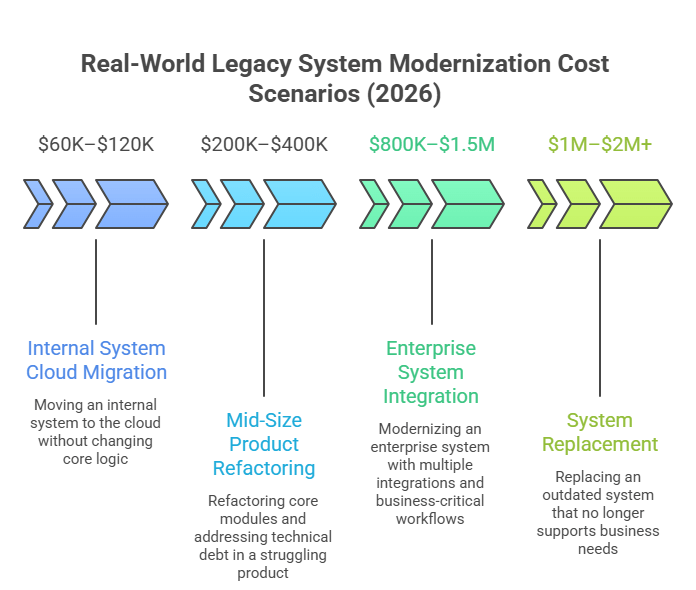
1. Internal system on outdated infrastructure
You’re not changing how the system works. You’re moving it to cloud, improving performance, and removing obvious bottlenecks.
👉 Typical cost: $60K–$120K
This stays lower because you’re not touching core logic.
2. Mid-size product starting to struggle with scale
The system works, but releases are slowing down, bugs take longer to fix, and performance drops under load.
👉 Typical cost: $200K–$400K
Costs increase because teams start refactoring core modules and addressing technical debt.
3. Enterprise system with multiple integrations
You’re dealing with APIs, third-party systems, large datasets, and business-critical workflows. Downtime is not an option.
👉 Typical cost: $800K–$1.5M
The cost comes from coordination, phased rollouts, and ensuring system stability.
4. System that no longer supports the business
Every change takes too long, integrations fail, and the architecture no longer fits your needs.
👉 Typical cost: $1M–$2M+
At this point, you’re replacing the system entirely.
What actually pushes costs higher:
- Monolithic systems take more effort to modernize than modular ones.
- The more patches and workarounds in the code, the more time it takes to fix.
- Moving large datasets and reconnecting systems adds both cost and risk.
- Regulated industries require additional validation, security, and documentation.
Still unsure where your modernization cost will land?
Get a realistic estimate based on your system, not generic ranges. We assess your architecture, technical debt, and integration complexity before recommending the right approach.
Get Your Modernization Cost BreakdownWhat factors affect the cost of legacy system modernization?
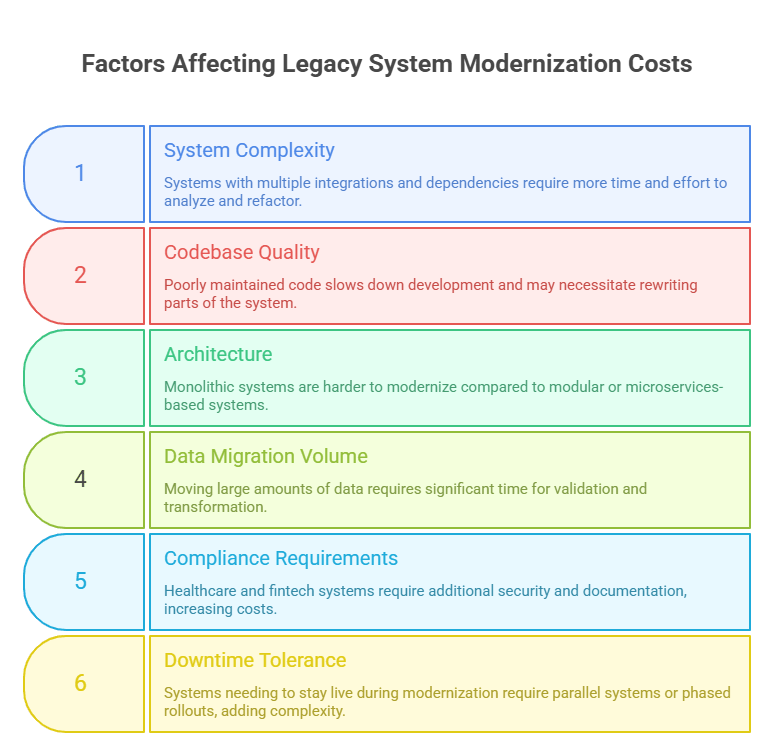
The more complex and constrained your system is across these areas, the higher the cost moves. Here’s how these factors actually play out:
1. System complexity
Systems with multiple integrations, dependencies, and workflows take more time to analyze, refactor, and test.
2. Codebase quality (technical debt)
Poorly maintained code slows down development and often forces teams to rewrite parts instead of improving them.
3. Architecture (monolith vs microservices)
Monolithic systems are harder to break and modernize. Modular or microservices-based systems reduce effort.
4. Data migration volume
The more data you move, the more time you spend on validation, transformation, and ensuring nothing breaks.
5. Compliance requirements
Healthcare and fintech systems require additional security, audits, and documentation, which increases both cost and timelines.
6. Downtime tolerance
If your system needs to stay live during modernization, teams must build parallel systems or phased rollouts, which adds complexity.
How each factor impacts cost:
| Factor | Impact on Cost |
|---|---|
| System complexity | Increases overall development, testing, and integration effort |
| Codebase quality | Poor quality leads to rework and longer timelines |
| Architecture | Monoliths require more effort compared to modular systems |
| Data migration | Larger datasets increase risk, validation, and effort |
| Compliance | Adds security layers, audits, and regulatory checks |
| Downtime tolerance | Zero-downtime setups require additional infrastructure and planning |
Most projects don’t become expensive because of one factor alone. Costs increase when two or three of these factors combine, especially in systems that have evolved over years without structured updates.
Legacy software modernization cost breakdown: rehost vs replatform vs refactor vs rebuild
It directly impacts budget, timelines, and how much value you get from the investment.
Cost breakdown by approach:
| Approach | Cost | Time | Risk | Use Case |
|---|---|---|---|---|
| Rehosting | Low | Fast | Low | Lift & shift |
| Replatforming | Medium | Medium | Medium | Minor upgrades |
| Refactoring | Medium–High | Medium | Medium | Code optimization |
| Rebuilding | High | Long | High | Full transformation |
What each approach really means in practice:
- Rehosting (Lift and Shift)
You move your system to modern infrastructure without changing much of the code. It’s the fastest and cheapest option, but it doesn’t solve deeper issues like scalability or technical debt. - Replatforming
You make small improvements while moving to a better platform. This gives you some performance gains without the cost of a full rewrite. - Refactoring
You restructure parts of the codebase to improve performance and maintainability. Costs go up here because teams start touching core logic, but you also start seeing real long-term benefits. - Rebuilding
You replace the system entirely. This is the most expensive route, but it gives you full control over architecture, scalability, and future growth.
Most teams don’t choose the most expensive option. They choose the one that fits their current constraints. If your system still works but struggles with performance, refactoring often makes sense. If it’s holding back growth or impossible to maintain, rebuilding becomes a more practical investment.
What is the cost difference between rehosting, refactoring, and rebuilding?
It reflects how much of the system you’re changing and how far you want to take it.
Cost difference by approach:
- Rehosting ($50K – $150K)
Minimal changes. You move the system to modern infrastructure and keep most of the code intact. Lower cost, faster timelines. - Refactoring ($150K – $500K)
You improve the codebase, fix performance issues, and remove technical debt. Costs increase because teams work inside the core system. - Rebuilding ($500K – $2M+)
You replace the system completely. Highest cost, longest timeline, but full flexibility and scalability.
When each approach makes sense:
- Choose rehosting
When your system works fine but runs on outdated infrastructure and you need a quick improvement. - Choose refactoring
When performance issues, bugs, or technical debt slow you down, but the core system is still usable. - Choose rebuilding
When the system limits growth, becomes hard to maintain, or can’t support new features or integrations.
How this plays out in real scenarios:
- Startup
A small product running on legacy code usually leans toward rehosting or light refactoring. Budget matters, and speed is critical. A full rebuild rarely makes sense unless the product is breaking. - Mid-size SaaS
Growth starts exposing limitations. Teams often choose refactoring, sometimes combined with partial rebuilds, to improve scalability without disrupting the business. - Enterprise
Systems are deeply integrated and business-critical. Many enterprises move toward rebuilding or phased modernization, especially when legacy systems block innovation or create operational risk.
The right choice usually comes down to one question. Are you trying to extend the life of the system or replace it for the future.
What are the hidden costs of legacy software and modernization strategies in 2026?
Hidden costs usually add 20–40% on top of your modernization budget. In complex systems, that overrun can go even higher.
Enterprises report up to $370 million annually in losses due to legacy systems and technical debt, including maintenance inefficiencies and failed modernization efforts.
Most teams don’t plan for this. They budget for development, but the real cost sits in what surrounds it. Here’s what that actually looks like in practice.
Hidden costs of not modernizing:
1. Maintenance overhead
You keep spending every year just to keep the system stable. That money doesn’t move the business forward. It just keeps things from breaking.
2. Downtime and performance issues
Systems slow down, fail more often, and take longer to recover. That cost shows up in lost revenue and operational delays.
3. Security risks
Older systems are harder to patch and monitor. One serious incident can cost more than the modernization you delayed.
4. Lost scalability
This is where most companies feel it. You stop shipping faster. You avoid new features. Growth slows down because the system can’t keep up.
Hidden costs during modernization:
- Data migration issues
Data is rarely clean. Fixing and validating it can quietly add $50K–$200K+ depending on size and quality. - Retraining teams
People need time to adjust. Productivity dips before it improves. - Integration issues
Legacy systems don’t disconnect cleanly. Reconnecting everything takes more effort than expected. - Temporary productivity loss
During the transition, teams slow down. This isn’t always visible in the budget, but it impacts delivery.
👉 What this looks like in reality
A platform rebuild and modernization helped a marketplace scale revenue from $100K to $13M, showing how modernization costs often tie directly to growth unlock rather than just system upgrades.
Is it cheaper to modernize or rebuild legacy software?
The reason this shifts is cost efficiency over time. According to McKinsey & Company, organizations that modernize effectively can reduce IT costs by up to 30% while improving delivery speed and scalability. That’s where rebuilding starts to make sense. You stop carrying the weight of old architecture.
Quick decision framework:
| Scenario | Best Option |
|---|---|
| Stable system | Modernize |
| Outdated architecture | Rebuild |
| High technical debt | Rebuild |
How to think about it in practice:
- Choose modernization when the system still delivers value
If your workflows are stable and you mainly need performance or scalability improvements, modernization keeps costs controlled. - Choose rebuilding when the system limits growth
If every new feature takes too long or integrations keep breaking, rebuilding gives you a clean foundation. - Technical debt changes the cost equation
Once a large portion of the system needs fixing, modernization becomes expensive without solving the root problem.
In most cases, teams don’t choose the cheaper option. They choose the one that avoids paying the same cost again in the next two to three years.
Is AI-assisted legacy modernization cheaper in 2026?
In some teams, productivity gains go as high as 50%, but the actual cost savings depend on how the tools are used.
The shift is already visible. Tools like GitHub Copilot, Cursor, and Claude Code are now part of real modernization workflows, not just experiments.
Where AI actually reduces cost:
- Faster development cycles
Teams complete tasks 20–30% faster on average, which directly reduces engineering hours. - Automated refactoring and code suggestions
AI tools help rewrite legacy code, generate boilerplate, and identify issues across large codebases, reducing manual effort. - Debugging and issue resolution
Developers spend less time diagnosing problems. AI can surface fixes quickly based on context.
Where expectations need to stay realistic:
- Not all productivity gains translate to cost savings
Some studies show experienced developers can be slower when reviewing AI-generated code, especially in complex systems. - AI doesn’t remove complexity
Legacy systems still require architectural decisions, data migration planning, and integration work. - Quality control still matters
Faster code generation can introduce errors if not properly validated, which can increase rework.
What this means in practice
AI reduces the execution cost, not the decision complexity.
If your modernization effort is heavy on repetitive work, refactoring, and debugging, AI can bring real savings. But if the challenge sits in architecture, integrations, or compliance, AI won’t cut those costs significantly.
In most real projects, AI helps teams move faster and slightly cheaper. It doesn’t turn a $500K modernization into a $100K project. It helps you get more done within the same budget or reduce timelines without compromising delivery.
Case Study: Lulo Freight Modernization with AppVerticals
Lulo Freight’s legacy system struggled with slow performance, limited transparency, and scalability issues, preventing business growth and operational efficiency.
AppVerticals modernized the platform by:
- Overhauling the backend for scalable architecture.
- Enabling real-time shipment tracking.
- Simplifying the UI for a better user experience.
- Automating workflows to improve efficiency.
Results:
- Improved scalability to handle more users and data.
- Real-time tracking led to faster, more transparent operations.
- Increased customer satisfaction and 25% higher user engagement.
- 300 man-hours saved/month through automated processes.
Conclusion
Legacy software modernization cost in 2026 isn’t a fixed number. It moves based on how much of your system needs to change and how complex that system has become over time. Most projects fall between $150K and $500K, but costs rise quickly when architecture, data, and integrations require deeper changes.
What matters is not just the upfront investment, but the direction of your spending. You either continue putting budget into maintaining a system that slows you down, or you invest in changing it so it supports growth.
In most cases, the decision becomes clear when you look at your system honestly. If it still works and only needs improvement, modernization keeps costs controlled. If it’s limiting your business, rebuilding becomes the more practical choice.
Modernize, refactor, or rebuild. What actually makes sense for your system?
Avoid overpaying or choosing the wrong approach. Get a clear, technical evaluation of your system and a roadmap aligned with your budget and growth plans.