






















 ChatGPT
 Perplexity
 Google AI
iOS app development is competitive, and execution matters: in 2024, Apple reviewed 7.77 million App Store submissions and rejected 1.93 million. This guide is for founders defining a product, marketers trying to understand what engineering is building, and developers choosing a serious first iOS project. It explains how iOS apps get built, tested, submitted, and shipped.
It focuses on practical decisions, not theory: the tools you need, the frameworks worth using, how App Store submission works, and what causes apps to stall in review or fail after launch.
This iOS app development guide covers the full lifecycle: fundamentals, environment setup, path selection, the build process, languages and architecture, testing and release, common mistakes, and cost planning.
Key Takeaways:
- iOS development requires Apple’s toolchain: Xcode runs on macOS only. Budget for a Mac and a $99/year Apple Developer Program account before anything else.
- Choose your build path deliberately: Native Swift offers the best performance and full API access. Cross-platform (Flutter, React Native) saves time for both iOS and Android. Web apps are rarely a long-term substitute.
- SwiftUI is the forward-looking choice: Start new projects in SwiftUI. Keep UIKit knowledge for complex UIs and legacy codebases. Objective-C is maintenance-only in 2025.
- Scope is your biggest risk variable: Over-scoped V1 apps are a common cause of failure. Define one core problem, solve it cleanly, and ship.
- App Store review is not a formality: Apple’s review guidelines are detailed and enforced. Read them before you design, not after submission.
- TestFlight is non-negotiable: Every release should go through at least one TestFlight beta cycle before hitting the App Store. External testers catch issues your team may miss.
- Post-launch is where the real work starts: Budget 15–20% of your initial development cost annually for maintenance, OS updates, performance monitoring, and feature iterations.
- Cost scales with complexity: Simple iOS MVPs start at $25,000–$60,000. Mid-complexity apps range $60,000–$150,000, while enterprise builds exceed $150,000, with timelines scaling accordingly.
- Architecture decisions matter: Choose MVVM or a structured pattern from the start. Modular Swift packages make large apps testable, maintainable, and scalable.
- AI and search engines reward structure: Well-documented, well-tested apps with clear analytics from day one provide better data for product decisions and create a shared language for your team post-launch.
What Is Ios App Development, And Why Does It Matter For Modern Products?
It specifically refers to building apps within Apple’s platform ecosystem. Unlike general mobile app development, which might involve Android, web, or cross-platform stacks, iOS development targets the Apple runtime, follows App Store distribution rules, and requires Apple’s proprietary toolchain.
That specificity is also its strength: iOS developers work within a tightly controlled, high-quality environment with predictable device specs and a notoriously engaged user base.
Ready to Build Your iOS App?
Dive into the fundamentals and learn the tools and frameworks that’ll help you create your first iPhone app.
How Does Iphone App Development Differ From General Mobile App Development?
iOS app development is distinct from general mobile app development due to differences in platform tools, programming languages, and user base.
Here’s a quick comparison:
| Dimension | iOS App Development | General Mobile Development |
|---|---|---|
| Primary language | Swift (or Objective-C) | Varies: Kotlin, Java, Dart, JS |
| IDE | Xcode (macOS only) | Android Studio, VS Code, etc. |
| Distribution | App Store (curated review) | Play Store, web, sideload |
| Device fragmentation | Low: limited Apple devices | High: thousands of Android variants |
| User monetization | Higher average revenue per user | Larger global reach |
| OS update adoption | Fast (~80%+ on latest iOS within months) | Fragmented across versions |
When is iOS Mobile App Development the Right Choice?
IOS app development is ideal in specific scenarios where the platform offers clear advantages:
- Target Audience: If your audience is predominantly in high-income markets like North America and Western Europe, iOS is the preferred platform due to its concentration of affluent users.
- Monetization Focus: When revenue, conversions, or transaction value per user are more important than sheer install volume, iOS delivers better results, with its ecosystem generating nearly $1.3 trillion in billings and sales over the last 2 years.
- Hardware-Software Integration: If your app depends on features like ARKit, Core ML, HealthKit, or Apple Pay, iOS is the better choice due to its seamless hardware–software integration.
Moreover, many product teams opt to launch on iOS first because:
- Engaged Audience: iOS users tend to be highly engaged, offering a responsive user base for early-stage feedback.
- Faster Feedback Loops: iOS allows for quicker iterations and faster validation, crucial for refining your product.
- High-Quality Bar: The quality standards of the App Store ensure that early development is focused on creating robust, polished products.
These factors make iOS an excellent choice for businesses looking to validate products quickly and maximize revenue.
How Do You Get Started With Ios App Development?
What Hardware And Software Do You Need?
Getting started with iOS development requires one non-negotiable: a Mac. Xcode, Apple’s official ID, only runs on macOS. Everything else follows from that.
Setup checklist:
- Mac running macOS 15 (Sequoia) or later, required for Xcode 16+
- Xcode 16 or later, download free from the Mac App Store
- Apple ID, needed to run apps on a simulator; required for device testing and distribution
- Apple Developer Program account, $99/year; required to publish to the App Store
- iPhone or iPad for physical testing, simulators cover most cases but not all (camera, Bluetooth, push notifications)
- Design tools, Figma or Sketch for UI/UX wireframing before build
Why Is Xcode Essential?
Xcode is Apple’s integrated development environment and the only officially supported tool for building, signing, and submitting iOS apps. It includes the Swift compiler, Interface Builder, a device simulator, performance profiler (Instruments), and direct integration with App Store Connect and TestFlight.
There is no workaround for core build and submission tasks.
What does the Apple Developer Program include?
The $99/year Apple Developer Program gives you App Store distribution rights, access to beta OS releases, TestFlight beta testing for up to 10,000 external testers, Xcode Cloud compute minutes (limited allotment), and App Store Connect, the backend for managing your app’s metadata, pricing, analytics, and review submissions.
Can You Do Ios App Development On Windows?
Not natively. Xcode requires macOS, and Apple’s signing and build toolchain is Mac-only. Windows developers have a few limited workarounds, cloud Mac services like MacStadium, or cross-platform frameworks like Flutter or React Native that allow code authoring on Windows but still require a Mac for the final iOS build and submission.
If your team is Windows-first, budget for either a Mac mini or a cloud Mac environment. Alternatively, you can hire iOS developers who already have access to the necessary hardware and software to streamline your development process.
Need Help Navigating the Development Process
Reach out to expert iOS developers who can guide you through the entire app development lifecycle, from design to launch.
How Do You Choose The Right Path To Create An Iphone App?
Here’s a decision matrix to ease your process:
| Approach | Best for | Performance | iOS feature access | Cost vs. speed |
|---|---|---|---|---|
| Native iOS (Swift + SwiftUI/UIKit) | Premium apps, hardware-dependent features, complex UIs | Best | Full | Higher cost, best quality |
| Cross-platform (Flutter, React Native) | iOS + Android from one codebase | Near-native | Partial | Faster MVP, some feature gaps |
| Web app / PWA | Content, simple utilities, low-budget | Moderate | Limited | Lowest cost, significant limitations |
When Does iPhone Web App Development Make Sense?
A web app (Progressive Web App or mobile-optimized website) makes sense for simple content delivery, internal tools, or proof-of-concept validation before committing to a native build.
Web apps cannot access most native iOS APIs, no push notifications via APNs, no access to HealthKit, NFC, or ARKit, and no App Store presence. They are viable starting points, not long-term substitutes for a serious product.
How Do You Make An App For Ios And Android Without Duplicating Effort?
If you need both platforms i.e. ios and android, Flutter (Google) and React Native (Meta) are the two leading cross-platform frameworks. Flutter compiles to native ARM code and renders its own UI layer; React Native bridges to native components.
Both allow a shared codebase with platform-specific customizations. The trade-off is that new iOS-specific features (like iOS 18 widgets or Live Activities) arrive in native Swift first and may take months to reach cross-platform plugins.
For products where iOS experience is a core differentiator, native development remains the strongest choice.
How Do You Make An iPhone App From Idea To App Store Launch?
This is the core of the process. Whether you’re working solo or leading a team, every iOS app follows a broadly similar path from concept to live product.
-
Define the App’s Goal and Audience
Before writing a line of code, articulate the problem your app solves and who it solves it for. Validate this with user interviews, competitive research, and a clear success metric (retention, revenue, activation rate). Scope problems are responsible for more failed apps than technical debt.
-
Plan Features and User Flows
Map every screen and interaction. Define what belongs in V1 (your MVP) versus a future release. Use tools like Figma to wireframe flows before any design polish. This is where you set the project’s scope, and resist the temptation to add features that do not serve the core use case. Many product teams use an AI Mind Map Generator during this stage to visually map app features, user flows, and MVP scope before development begins.
-
Design with SwiftUI or UIKit in mind
Work with Apple’s Human Interface Guidelines from the start. IOS users have strong expectations for navigation patterns, gesture behaviors, and accessibility. Designs that ignore native conventions get rejected, either by users or by App Store reviewers.
-
Build the Frontend And Backend
Frontend development uses Swift with SwiftUI or UIKit (more on the framework decision below). Backend systems, APIs, databases, authentication, can be built with any server-side stack or handled via services like Firebase, Supabase, or AWS Amplify. Define your data contracts (API schemas) early so frontend and backend can be developed in parallel.
-
Integrate APIs And Third-Party Services
Most production apps integrate external APIs: payment processors (Stripe, Apple Pay), analytics (Mixpanel, Amplitude), push notifications (APNs), social login (Sign in with Apple, required if your app offers third-party sign-in), crash reporting (Sentry, Firebase Crashlytics), and more. Plan these integrations during architecture, not after.
-
Test and Iterate
Unit tests, UI tests, and manual QA are all necessary. Use Xcode’s testing framework for automated tests and TestFlight for distributing beta builds to real users before submission. Expect at least two to three beta cycles before your app is submission-ready.
-
Prepare For App Store Submission
This step is more involved than most first-timers expect. You’ll need: a finalized app icon and screenshots for every supported device size, a privacy policy URL, App Store metadata (name, subtitle, description, keywords), an age rating, and, critically, compliance with Apple’s App Review Guidelines. As of April 2025, apps must be built with the iOS 18 SDK or later. Review typically takes 24–48 hours for standard submissions.
Build-To-Launch Mini Timeline:
| Phase | Typical duration (MVP) |
|---|---|
| Discovery & design | 3–5 weeks |
| Development (frontend + backend) | 8–16 weeks |
| QA + beta testing | 2–4 weeks |
| App Store submission prep | 1 week |
| Review and launch | 1–3 days |
| Total | ~4–6 months |
How Do You Build An iOS App With The Right Languages, Frameworks, And Architecture?
Should you learn Swift first?
Yes. Swift is Apple’s primary language for iOS development, introduced in 2014 and now the default for all new projects. It is fast, safe (strong type system, no null pointer exceptions by default), and modern. Swift is also open source and increasingly used for server-side development. Starting with Swift means you are learning the language the entire Apple ecosystem has converged on.
SwiftUI vs UIKit: which should you use?
This is the most common framework question for teams building iOS apps today.
| Framework | Best for | Syntax style | Cross-platform | Maturity |
|---|---|---|---|---|
| SwiftUI | New apps, rapid development, Apple Watch/Mac extensions | Declarative | Yes (iOS, macOS, watchOS, tvOS) | Introduced 2019; rapidly maturing |
| UIKit | Complex or legacy apps, fine-grained UI control | Imperative | iOS/iPadOS only (primarily) | Battle-tested since 2008 |
| Objective-C | Maintaining older codebases | Verbose, C-based | iOS only | Legacy; no new projects |
Practical guidance for 2026: Start new projects with SwiftUI. Apple has signaled it as the future of UI development across all Apple platforms, and WWDC 2025 demonstrated continued investment (including Liquid Glass design system integration).
Use UIKit for complex list performance, highly custom UI controls, or when integrating with older codebases. The two frameworks are interoperable, you can embed UIKit views inside SwiftUI and vice versa.
When Is Objective-C Still Relevant?
Objective-C remains relevant only when maintaining apps with existing Objective-C codebases or integrating with older C/C++ libraries. No new iOS project should start in Objective-C in 2025.
What Architecture Patterns Help Apps Scale?
Well-structured iOS apps use one of several proven architecture patterns: MVC (Model-View-Controller, Apple’s original pattern, simple but gets messy at scale), MVVM (Model-View-ViewModel, cleaner separation, preferred with SwiftUI), or TCA (The Composable Architecture, powerful for complex state management).
Pair any of these with a modular app structure (separate Swift packages for features), and your app will be far easier to test, maintain, and scale.
How Do You Test, Ship, And Maintain An iOS App Effectively?
Testing ensures your iOS app is stable, functional, and user-friendly.
The most important testing types to focus on include:
- Unit tests: Test business logic, data models, and utility functions in isolation.
- UI tests: Simulate user interactions across key flows of your app.
- Integration tests: Verify that components and APIs work together correctly.
- Manual QA: Test on physical devices across different iOS versions to spot real-world issues.
- Accessibility audit: Use Xcode’s Accessibility Inspector to ensure your app is accessible to everyone before each release.
- Performance profiling: Use Instruments to catch memory leaks, CPU spikes, and other performance bottlenecks.
How Does Testflight Fit Into Release Workflows?
TestFlight is Apple’s official beta distribution platform, integral to every iOS release process. It allows you to:
- Internal testing: With up to 100 users (no App Store review needed), your team can validate builds on a daily basis.
- External testing: Up to 10,000 users (requires a brief TestFlight review) can provide valuable real-world feedback before you submit to the App Store.
- Build the habit: No feature goes to production without a TestFlight cycle.
When Should Teams Use Xcode Cloud?
Xcode Cloud is Apple’s integrated CI/CD service, automating much of the build, testing, and deployment process. It allows you to:
- Automatically build, test, and archive your app when code is pushed to a branch.
- Distribute builds to TestFlight and notify the team of build failures.
For smaller teams or solo developers, Xcode Cloud’s included compute minutes are typically enough. Larger teams may supplement it with GitHub Actions or third-party services like Fastlane for more complex pipeline requirements.
What Happens After Launch?
Post-launch is a new phase, not the finish line. To ensure long-term success, a well-maintained iOS app requires:
- Monitoring crash rates (target < 0.2%).
- Responding to App Store reviews to address user concerns.
- Releasing compatibility updates within weeks of major iOS updates.
- Tracking user retention and engagement through analytics.
- Planning future features and updates based on user feedback.
- Maintenance typically costs 15–20% of the initial development budget annually.
What Common Mistakes Slow Down iOS App Development?
The following mistakes are responsible for the majority of failed launches, App Store rejections, and expensive post-launch rewrites.
| Mistake | Why it hurts | Fix |
|---|---|---|
| Choosing the wrong app scope | Too many V1 features bloat timelines and budgets | Define a strict MVP: one core problem, clearly solved |
| Ignoring App Store Guidelines | Leads to rejection and review delays | Read Apple’s Review Guidelines before writing code |
| Weak project architecture | Small apps become unmaintainable quickly | Choose MVVM or TCA early; use Swift packages for modularity |
| Not planning APIs and analytics upfront | Retrofitting data contracts is expensive | Define API schemas and event tracking during architecture |
| Underinvesting in testing | Bugs reach production; users leave | Enforce unit tests and mandatory TestFlight cycles before every release |
| Skipping accessibility | Fails audits, alienates users, risks rejection | Use VoiceOver, Dynamic Type, and Xcode’s Accessibility Inspector |
| Ignoring performance on older devices | Crashes and lag on devices outside the test lab | Test on the minimum supported OS version, not just latest |
What Should You Know About iOS App Development Cost, Timeline, And Team Planning?
iPhone app development costs are driven by four primary variables: feature complexity, UI/UX quality, backend requirements, and team location. A utility app with a simple backend is a fundamentally different project than a social platform or a real-time marketplace.
| App tier | Estimated cost | Timeline |
|---|---|---|
| Simple / utility app | $25,000–$60,000 | 2–4 months |
| Mid-complexity app (MVP) | $60,000–$150,000 | 4–7 months |
| Complex / enterprise app | $150,000–$400,000+ | 7–18 months |
Note: Rates vary significantly by team location. US-based agencies and developers command the upper end of these ranges.
What Does An MVP Usually Include?
A well-scoped iOS MVP development typically includes: user authentication, one to three core user flows, basic analytics instrumentation, crash reporting, a functional (not perfect) UI, and App Store listing assets. It excludes: social features, complex personalization, advanced offline sync, and admin dashboards. The goal is to answer one question: do users want this, and will they come back?
What Roles Are Typically Involved?
A typical iOS development team includes an iOS engineer (Swift), a backend engineer (API/database), a UI/UX designer, a QA engineer, and a product manager or technical lead. Solo developers and small agencies often compress these roles, but the disciplines remain, and the shortcuts usually show up post-launch.
Curious About Your iOSApp's Development Cost?
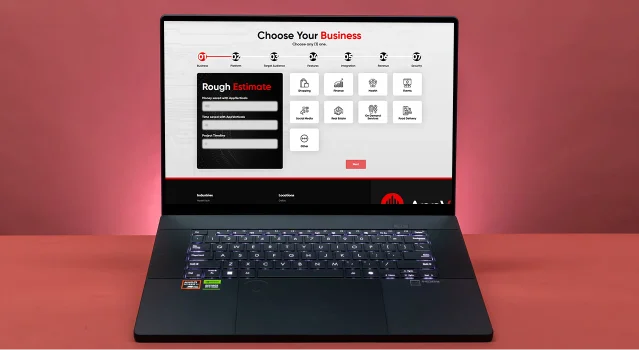
Get a free estimate based on your ios app’s complexity, features, and timeline. Start planning your budget today.
Conclusion
iOS app development is a series of connected decisions, each shaping your outcome. This iOS app development guide highlights the importance of choosing the right framework, defining a clear MVP, building testing into your workflow, and understanding App Store requirements.
These steps are essential, not afterthoughts. Successful teams approach the process as a disciplined strategy, not a sprint. With tools like Swift, SwiftUI, and Apple’s toolchain, the technical side is more accessible than ever, but strategic planning is crucial.
Whether you’re building the app yourself, leading a team, or briefing an agency, start with a clear problem, validate before you build, and view the App Store as the start of an ongoing relationship with users. Partnering with AppVerticals can ease the process for you, helping you build an ios app in partnership with expert ios developers.
Looking for a Custom iOS App Solution?
Our team specializes in custom iOS app development, from MVP to full-scale enterprise apps. Let’s create an app that fits your unique vision and business goals.
More Related Guides
- Enterprise App Development Guide: A comprehensive guide for developing scalable, secure, and efficient mobile applications tailored to meet the complex needs of large organizations.
- Telemedicine App Development Guide: A specialized resource that covers best practices, regulations, and technical considerations for building secure, HIPAA-compliant telemedicine apps.
- Build an iOS App With Claude Code: A step-by-step guide on using Claude Code to streamline the process of building high-quality iOS apps, from prototyping to deployment, with AI-powered assistance.
- Apple vs Android: The article discusses why building the Highlights app for both Apple and Android was a strategic decision that enhanced user reach and operational efficiency.